



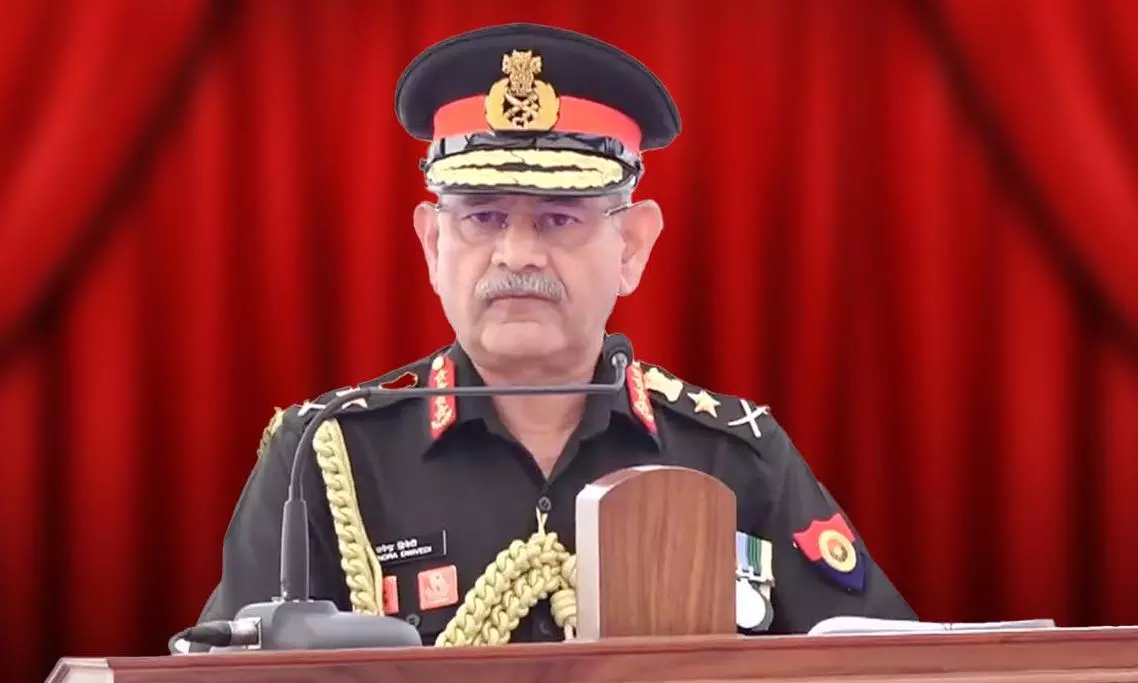
Operation Sindoor remains ongoing, warns Army chief
Army chief says Operation Sindoor reset deterrence, curbed terror in J&K, and showcased tri-service synergy amid volatile borders and rising global conflicts

Operation Sindoor remains an ongoing military mission and any future misadventure will invite a resolute response, Indian Army Chief General Upendra Dwivedi said on Tuesday (January 13), underlining that India’s response to cross-border terrorism has fundamentally altered strategic assumptions.
"As you may be aware, Operation Sindoor remains ongoing, and a future misadventure will be resolutely responded to. I must acknowledge the proactive role of all stakeholders at the national level, including CAPFs, Intelligences, civic bodies, state administration and other ministries, whether it's MHA, Railways and many more,” General Dwivedi said, describing the operation as a calibrated but decisive answer to the Pahalgam terror attack.
Also Read: India carried out LoC deployments ahead of Operation Sindoor, says DGMO
Addressing a press conference, he said the decision to respond was taken at the highest political level, and the operation was executed with precision and clear objectives. “Operation Sindoor was conceptualised and executed with precision,” he said, adding that the mission involved 22 minutes of initiation on May 7 and an orchestration lasting 88 hours till May 10.
He also said that the Indian Army had mobilised its troops and was ready for ground offensives.
According to the Army Chief, the operation struck deep, dismantled terror infrastructure, and punctured Pakistan’s long-standing nuclear rhetoric. Of the nine identified targets, seven were destroyed, with the Army playing a central role in ensuring a calibrated response to subsequent Pakistani actions.
“Operation Sindoor was the best example of tri-service synergy under clear-cut political directive and full freedom to act or respond,” he said.
Terror grid weakened, local recruitment near zero
Placing Operation Sindoor in the wider internal security context, General Dwivedi said the situation along the Western Front and in Jammu and Kashmir remains sensitive but firmly under control.
Since January 2025, security forces have eliminated 31 terrorists, around 65% of them of Pakistani origin. These include the three perpetrators of the Pahalgam attack, neutralised during Operation Mahadev. Active local terrorists are now in single digits, while terrorist recruitment has almost ceased, with only two new recruits reported this year.
“Terrorist recruitment is almost non-existent, with only 2 in 2025. Clear indicators of positive change in J&K include robust development activity, revival of tourism and peaceful Sri Amarnath Yatra, which saw more than 4 lakh pilgrims exceeding the five-year average. The theme of terrorism to tourism is gradually taking shape,” the Army Chief said.
Preparedness key amid rising global conflicts
Situating India’s security posture in a global context, General Dwivedi noted that the past year has seen a sharp rise in the number and intensity of armed conflicts worldwide.
“These global shifts underline a simple reality: nations that stay prepared prevail,” he said, adding that Operation Sindoor demonstrated India’s readiness, precision and strategic clarity in responding to cross-border terrorism.
Also Read: Army Chief flags fractured world order, pushes defence transformation
He said the Army’s progress in 2025 must be seen through the lens of reforms and transformation, guided by the framework of Jointness, Atmanirbharta and Innovatio (JAI), articulated by the Prime Minister and reinforced by the Defence Minister’s reform agenda.
Northern borders stable, vigilance continues
On the Northern Front, General Dwivedi said the situation remains stable but requires constant vigilance. Apex-level interactions, renewed contact, and confidence-building measures have contributed to gradual normalisation, which has made civilian activities such as grazing and local camps along border areas possible.
"With our continued strategic orientation on this front, our deployment along the Line of Actual Control remains balanced and robust. Concurrently, capability development and infrastructure enhancement are progressing through a whole-of-government approach," he said.
Northeast sees improved stability
Turning to the Northeast, the Army Chief said, "As regards the Northeast, neutral, transparent and decisive action by security forces, along with many proactive government initiatives, has led to a marked improvement in the situation in Manipur during 2025."
He cited the peaceful conduct of the Durand Cup, the resumption of cultural festivals, and the renewal of Suspension of Operations agreements with Kuki insurgent groups in September 2025 as key markers of stability.
Also Read: Indian Army posts 1971 news clip amid US tariff row
In response to turbulence in Myanmar, he said a comprehensive multi-agency security grid involving the Army, Assam Rifles and Home Ministry agencies has helped insulate India’s Northeast from spillover effects. With phase two elections completed in Myanmar, he said engagement is expected to improve.
Army as first responder in disasters
Highlighting the Army’s humanitarian role, General Dwivedi said the force conducted humanitarian assistance and disaster relief operations across two neighbouring countries and 10 Indian states, rescuing over 30,000 people.
He recalled the Punjab floods in Pathankot, where an Army aviation helicopter carried out a daring rescue of CRPF personnel from a collapsing building, and noted that in several border states the Army acted even before formal requests were received.
“These reaffirm our role as the natural first responder during HADR crises,” he said.