



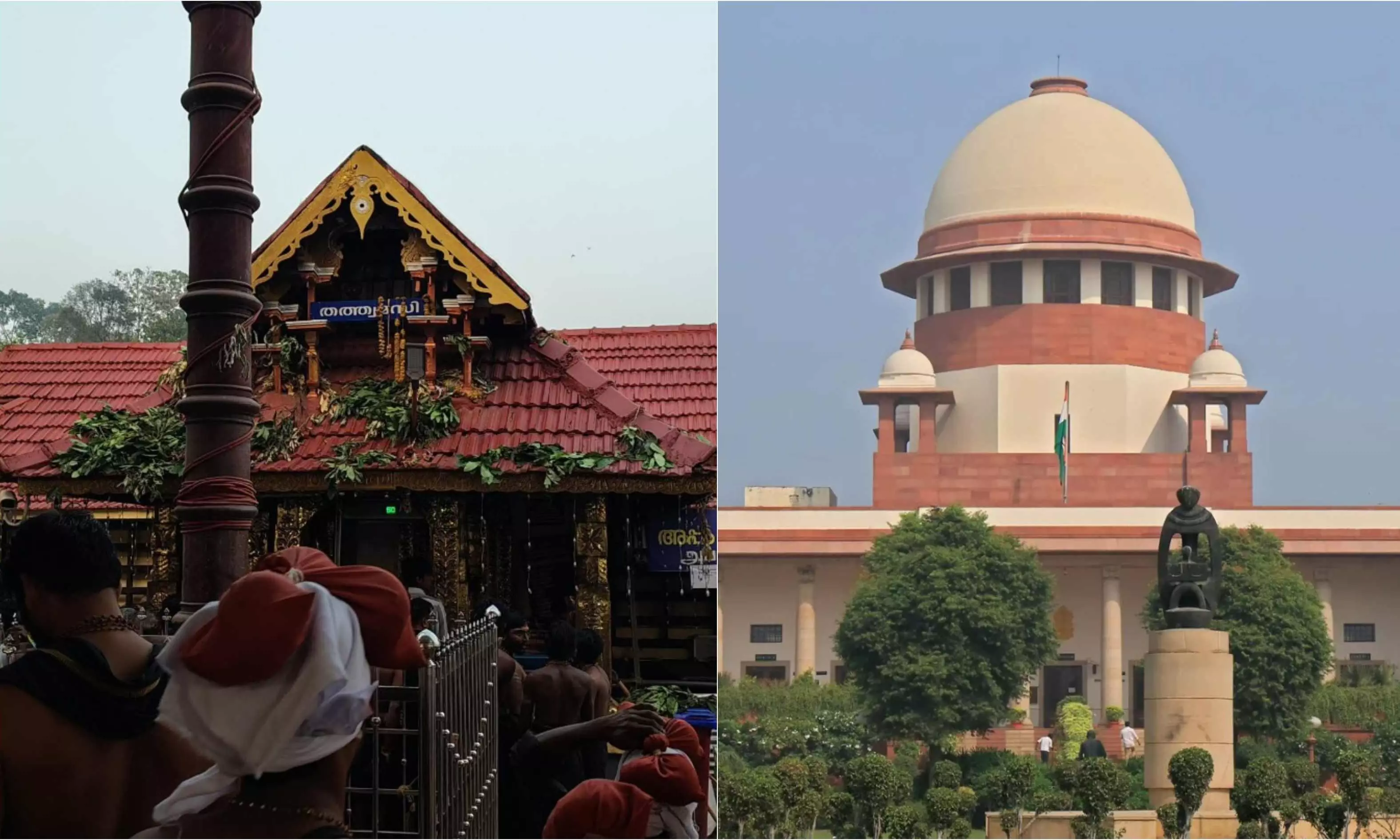
A nine-judge Supreme Court bench has reserved its order on women's entry into Sabarimala and other places of worship. Photo: Instagram/sabarimala_ayyappan_official
Nine judges to rule on where religious freedom ends and women's rights begin
A nine-judge bench headed by CJI Surya Kant sat for 16 days on pleas covering Sabarimala, Muslim women's entry into mosques, and Parsi women at Agiaries

A nine-judge Supreme Court constitution bench on May 14 reserved its order on petitions related to discrimination against women at religious places, including Kerala's Sabarimala temple, and on the scope of religious freedom practised by multiple faiths.
The bench, headed by Chief Justice Surya Kant, heard the matter for 16 days. Arguments were made by Solicitor General Tushar Mehta and senior advocates C S Vaidyanathan, Abhishek Singhvi, Mukul Rohatgi, Indira Jaising, Neeraj Kishan Kaul, and Gopal Sankaranarayanan, among others. The bench also comprised Justices B V Nagarathna, M M Sundresh, Ahsanuddin Amanullah, Aravind Kumar, Augustine George Masih, Prasanna B Varale, R Mahadevan and Joymalya Bagchi.
Centre supports review of verdict
Ahead of the hearing, the Centre filed written submissions urging the court to uphold the restriction on the entry of women of menstruating age into the Sabarimala temple. The Union of India contended that the issue falls squarely within the domain of religious faith and denominational autonomy, and lies beyond the scope of judicial review. Solicitor General Mehta, appearing for the Centre, said he supported the review of the 2018 Sabarimala verdict that had allowed women of all age groups entry into the hilltop shrine.
Also Read: Sabarimala case | SC rejects ‘WhatsApp Varsity’ inputs, stresses limits of personal opinions
In September 2018, a five-judge constitution bench, by a 4:1 majority, lifted the centuries-old ban that prevented women between the ages of 10 and 50 from entering the Ayyappa shrine at Sabarimala, holding the practice to be illegal and unconstitutional.
Issues referred to larger bench
On November 14, 2019, another five-judge bench headed by then Chief Justice Ranjan Gogoi referred, by a 3:2 majority, the question of discrimination against women at various places of worship to a larger bench. The bench held that the broader issues of religious freedom could not be decided without examining the specific facts of each case. Besides Sabarimala, the referral also covered the entry of Muslim women into mosques and dargahs, and the entry of Parsi women, married to non-Parsi men, into the holy fire place of an Agiary.
On May 11, 2020, another bench affirmed that a five-judge bench has the power to refer questions of law to a larger bench under its review jurisdiction in the Sabarimala matter.
Seven questions the bench framed
The top court had earlier read out seven questions framing the scope of the reference, stating it remained open to additions and deletions:
One, what is the scope and ambit of the right to freedom of religion under Article 25? Two, what is the interplay between rights of persons under Article 25 and the rights of religious denominations under Article 26? Three, whether the rights of a religious denomination under Article 26 are subject to fundamental rights beyond public order, morality, and health.
Four, what is the scope and extent of the word "morality" under Articles 25 and 26, and whether it encompasses constitutional morality? Five, what is the scope and extent of judicial review concerning a religious practice under Article 25? Six, what is the meaning of the expression "sections of Hindus" in Article 25(2)(b)? Seven, whether a person not belonging to a religious denomination can question the practices of that denomination by filing a public interest litigation.
Beyond Sabarimala to other faiths
The bench noted that it would need to evolve a judicial policy to do "substantial and complete justice" in matters of freedom of religion — covering not just Sabarimala, but the entry of Muslim and Parsi women into their respective places of worship. The final hearing, which the court had initially expected to commence on April 7 and conclude by April 22, ran considerably beyond schedule before the bench reserved its order on May 14.