Neo Sapien CEO on AI wearable innovation, summit chaos, and device theft
Neo Sapien CEO Dhananjay Yadav explains how the Neo 1 personal AI wearable works, the focus on privacy, India’s emerging voice AI market, and the AI Impact Summit incident

“Privacy was a myth earlier. Now we want to create a privacy-first wearable where everything is encrypted and the user decides what to share.”
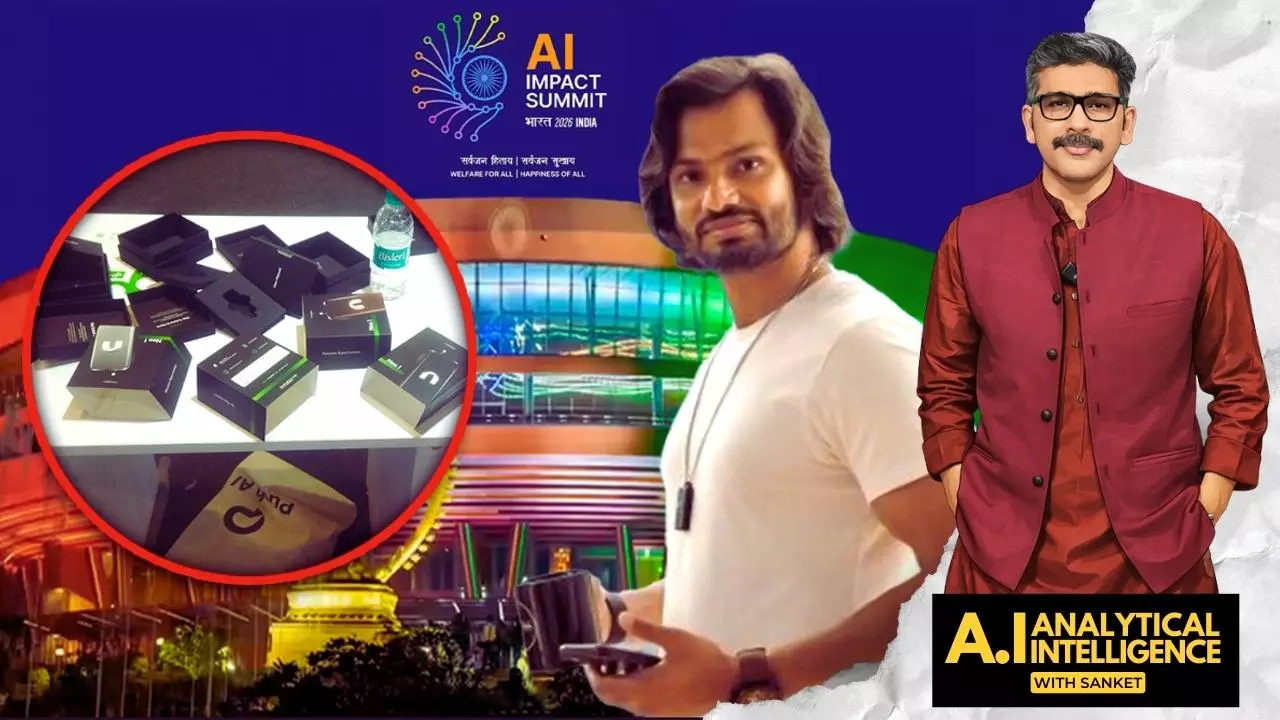
Amid controversy at the AI Impact Summit after his product was briefly stolen, Neo Sapien CEO Dhananjay Yadav says the incident only strengthened his resolve to build India’s biggest AI wearable company. On AI With Sanket, The Federal spoke to Yadav about his product Neo 1, the summit mismanagement row, privacy concerns, and why he believes India will lead the voice AI revolution.
What is Neo Sapien and what exactly does Neo 1 do?
Neo 1 is India’s first AI wearable, and it acts like your personal assistant. As I speak to you, it creates my voice fingerprint and understands who you are. It builds what we call a relationship graph between us based on facts, figures and entities.
For example, if I am speaking with you about the AI Summit and mentioning who introduced us, it keeps getting smarter with every interaction. After this conversation, I can go back to Neo and check curated minutes of the meeting.
Because it understands my relationship with you, it can create highly personalised meeting notes. I can ask it what my first, second or third conversation with you was, or who all I met at the AI Impact Summit.
Right now, AI understands only about 5% of context — what you proactively type into ChatGPT, Claude or Gemini. Imagine if it understood 100% of your context — what you discuss with doctors, partners and colleagues. It becomes powerful enough to take decisions on your behalf.
For example, if my mother tells me to order food from Swiggy, it will understand where to order from, what cuisine and which specific dish. We are building an AI wearable that creates the most personal context. We were so early that even OpenAI is now entering this space. We have also received a patent for our product.
Is Neo Sapien built on existing AI models or does it use its own technology?
Our advantage is that we use a group of expert models, both open and closed source, fine-tuned specifically for Indic languages. Currently, we are among the best in terms of Indic language understanding.
If you are a doctor, it uses a different model. If you are asking a companion-related query, another model responds. If you are a tech professional, it understands differently.
We can perform canonical searches in a personalised way. If you, as a senior correspondent, ask about your business goals, you will get a different response than your finance manager asking the same question. That is the true power of personalisation.
One of the main reasons I moved from Berlin to India is because I believe we can build one of the biggest companies here. India will be the largest voice AI market.
Isn’t this wearable essentially a snooping device that constantly listens?
When we started, our goal was to make humans more human. Around 70% of our tasks are laborious — booking calendars, sending emails, booking cabs. I want to free people from these tasks so they can focus on creative work.
On privacy, we get many questions. Big tech companies have built businesses on user data. If I mention Nike near my iPhone, within five minutes I see Nike ads on Instagram. Most apps already have microphone access and share data internally.
We want to build a privacy-first wearable. Everything is encrypted. You decide what data to share and with whom — whether with calendars, food delivery apps or others. It is entirely user-controlled.
What about affordability and product redundancy? Will early buyers be left behind?
We have priced Neo 1 at ₹12,000 with an unlimited subscription. We built everything in India. When I returned to India, I wanted to ensure our products were not white-labelled or copied. We created our own playbook. We also wanted it to be affordable for everyone.
I truly believe human-machine interaction will change. Just as we moved from desktops to laptops to smartphones with 3G and 4G, we are now moving towards AI wearables. Most work will be handled by AI wearables, while phones will handle limited tasks — much like laptops today.
Take us through what happened at the AI Impact Summit when your product was stolen.
We reached the venue as advised and set up our booth by 9.30 am. I was very excited because events like this are a step in the right direction — India needs something like CES or Web Summit.
After placing our devices, sanitisation and coordination began. One set of security personnel said one person could stay back. I told them we were building India’s first patented AI wearable and wanted to showcase it. They agreed.
Later, another security group asked us to leave immediately. I told them I had been permitted to stay, but they insisted. I asked whether I should leave the devices there. They told me it was a secure zone and others had left their belongings too.
Later, we were informed that gates would open only after 5 pm. A volunteer from IIT Roorkee, Sai, who has followed our journey, offered to pick up our devices. When the gates opened around 6.30 pm, he made a video call and showed that everything had been ripped off. The device cases were gone.
What happened after your tweet went viral?
Around 7.30 pm, I was extremely disappointed. We had spent on flights, accommodation and logistics. I just wanted to express what happened, so I tweeted. Overnight, it went viral. I appreciated how the ecosystem supported us.
The next morning at 8.30 am, the police called me. Many officers reached out. I went to meet them directly. They treated me with empathy and care. I have become a fan of the Delhi Police because they handled it very well.
How was the device eventually recovered?
The police examined CCTV footage and identified two contractual workers who had taken the device. Neo 1 stands out and looks like a premium device, so they may have mistaken it for something valuable like a pen drive.
They identified the individuals, and the product was recovered.
Despite the incident, you continue to support the AI Summit. Why?
If I, as a cutting-edge tech founder, don’t promote such events, who will? I want this event to become even bigger next year — just better planned.
We learned a lot on the first day, and we will learn more after reflecting on the event. I want to continue supporting it because I want it to become one of the biggest global events.
I love my country. That’s why I shifted here. I am excited, and I will promote the event as much as I can.
The content above has been transcribed from video using a fine-tuned AI model. To ensure accuracy, quality, and editorial integrity, we employ a Human-In-The-Loop (HITL) process. While AI assists in creating the initial draft, our experienced editorial team carefully reviews, edits, and refines the content before publication. At The Federal, we combine the efficiency of AI with the expertise of human editors to deliver reliable and insightful journalism.