Is BJP’s Nehru-Gandhi focus about historical accountability or political deflection?
After Modi’s Rajya Sabha speech and a BJP ‘library’ plan on Nehru-Gandhi, critics ask: is his relentless focus on the Nehru-Gandhi clan making him irrelevant today?

Prime Minister Narendra Modi’s 97-minute reply to the Motion of Thanks in the Rajya Sabha, dominated by repeated references to Jawaharlal Nehru and Indira Gandhi rather than present-day governance, has triggered a fresh political flashpoint. BJP MP Nishikant Dubey’s announcement that he plans to set up a “library” documenting what he calls the misdeeds, corruption, and policy failures of the Nehru-Gandhi family has further escalated the debate.
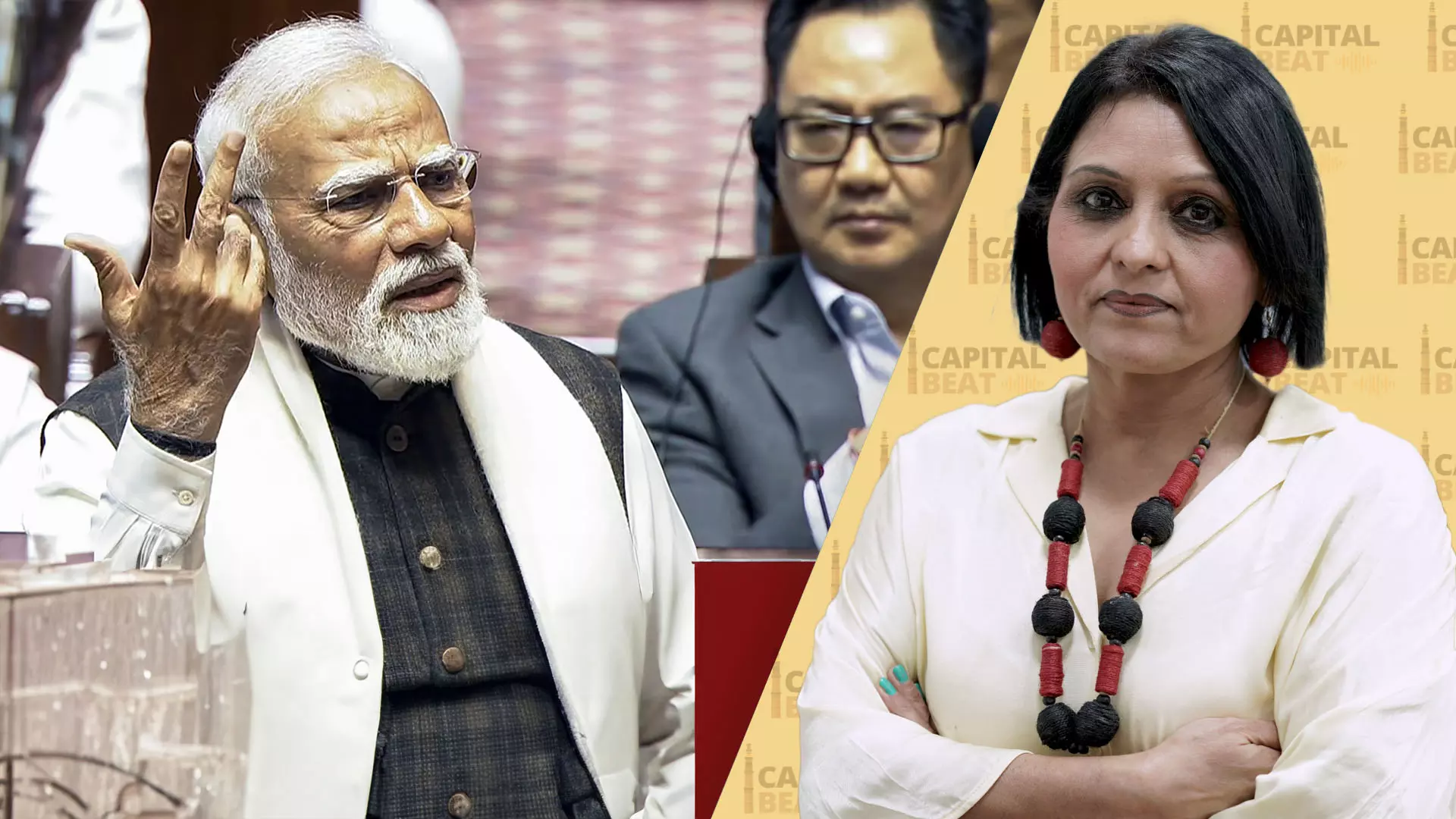
Against this backdrop, The Federal spoke to BJP spokesperson Dr B Ramachari, Congress spokesperson Wing Commander Anuma Acharya (Retd), and senior journalist and political commentator Anand K Sahai to examine whether the ruling party’s persistent focus on Nehru-Gandhi family reflects historical accountability—or political deflection.
A familiar pattern
Prime Minister Modi’s speech in the Upper House once again followed a now-familiar pattern. Instead of outlining his government’s roadmap on trade negotiations, economic challenges, or employment, the prime minister devoted a significant portion of his address to criticising India’s first prime minister and the Congress legacy.
Quoting Indira Gandhi’s recollection of Nehru allegedly describing India’s then population of 35 crore as “problems,” Modi argued that earlier leaders saw citizens as burdens, while he sees India’s 1.4 billion people as solutions. This framing, critics argue, reinforces a narrative contrast rather than offering policy substance.
Priyanka Gandhi’s challenge
The debate gained sharper political resonance with Congress leader Priyanka Gandhi Vadra’s remarks during the last Monsoon Session. She had sarcastically proposed allocating 10, 20, or even 40 hours of parliamentary time exclusively for the BJP to list all its complaints and abuses against Nehru and the Gandhi family—once and for all.
After that, she argued, Parliament should return to its core purpose: debating inflation, unemployment, women’s safety, and governance failures.
Her appeal, panelists noted, was less about defending Nehru-Gandhi and more about reclaiming parliamentary time for contemporary issues.
The ‘library’ proposal
It is in this political context that Nishikant Dubey’s proposal to create a library documenting alleged Congress-era failures has emerged. Appealing to supporters to contribute books, documents, and research material, Dubey framed the initiative as an educational project aimed at informing India’s youth about what he described as decades of administrative blunders.
Dr B Ramachari defended the idea, arguing that history must be revisited to understand how the country “collapsed” under Congress rule. He cited books such as Himalayan Blunder and writings attributed to BR Ambedkar to argue that Nehru’s leadership damaged India’s strategic and economic interests.
“For 50–60 years, Congress ruled by dividing society. Young people must know these blunders,” Ramachari said, adding that comparing India before and after 2014 was both necessary and legitimate.
Congress: Deflection, not history
Congress spokesperson Anuma Acharya dismissed the library proposal as political marketing rather than scholarship. She argued that even if an entire parliamentary session were devoted to Nehru, the BJP would not stop invoking him because it has “nothing to offer” in terms of governance outcomes.
Acharya took particular objection to Modi’s interpretation of Nehru’s “35 crore problems” remark, saying it reflected a lack of constitutional understanding. “The Constitution begins with ‘We, the people of India’. Nehru treated every citizen’s hardship as his own problem,” she said.
She accused the government of avoiding accountability on issues ranging from unemployment and inflation to security lapses such as Pulwama, arguing that past attacks are used to distract from present failures.
Parliamentary norms questioned
Senior journalist Anand K Sahai broadened the discussion by focusing on parliamentary procedure and democratic norms. He noted that the prime minister’s speech came in response to the President’s Address, yet contained little engagement with it.
Sahai pointed out the irony that while the Leader of the Opposition was not allowed to speak or quote from an unpublished book or magazine article, the prime minister freely digressed into decades-old history. “If the opposition is denied space and the prime minister speaks on irrelevant matters, Parliament risks becoming a grand joke,” he said.
He also criticised what he described as the ruling party’s intolerance of dissent, arguing that patriotism was being narrowly defined as agreement with the government of the day.
Is Modi making himself irrelevant?
A central question raised during the discussion was whether Modi’s repeated invocation of Nehru and Indira Gandhi risks making him appear insecure or overly dependent on the past.
Sahai rejected the idea that Modi is irrelevant within his party, noting that he continues to dominate the BJP despite the party’s reduced majority in the last Lok Sabha election. However, he argued that relentless historical attacks weaken serious scrutiny of current policies—particularly on China, trade negotiations with the United States, and economic sovereignty.
He warned that deflecting debates toward Nehru-Gandhi family prevents meaningful discussion on India’s present global positioning and domestic challenges.
BJP’s defence
Dr Ramachari rejected the charge that the BJP lacks vision, asserting that India’s rise to the world’s fourth-largest economy under Modi speaks for itself. He maintained that 95 per cent of Indians support the prime minister and accused opposition leaders of disrupting parliamentary proceedings for publicity.
According to him, Rahul Gandhi failed to follow procedural rules and behaved irresponsibly as Leader of the Opposition. “He can criticise the government on economy or development, but he must follow rules,” Ramachari said. He insisted that revisiting Congress-era decisions was essential for national self-awareness and development.
An unresolved divide
The discussion ultimately highlighted a deep and unresolved divide. For the BJP, revisiting the Nehru-Gandhi family is about correcting historical narratives and educating the youth. For the Congress and independent commentators, it reflects an avoidance of present accountability and a dilution of parliamentary purpose.
As Nishikant Dubey’s proposed library takes shape, the larger question remains whether India’s political discourse will continue to revolve around its first prime minister—or finally shift to addressing the anxieties of its present and future.
The content above has been transcribed from video using a fine-tuned AI model. To ensure accuracy, quality, and editorial integrity, we employ a Human-In-The-Loop (HITL) process. While AI assists in creating the initial draft, our experienced editorial team carefully reviews, edits, and refines the content before publication. At The Federal, we combine the efficiency of AI with the expertise of human editors to deliver reliable and insightful journalism.