NEET PG cut-off row reaches Supreme Court as doctors challenge lowered scores
Petitioners question NBEMS move allowing candidates with very low or negative scores into counselling, warning of risks to merit and patient safety

A fresh controversy has erupted around NEET PG 2025–26 admissions, with doctors moving the Supreme Court against a sharp reduction in qualifying cut-offs that allows candidates with extremely low and even negative scores to enter counselling for postgraduate medical seats.
The Public Interest Litigation (PIL) challenges a decision by the National Board of Examinations in Medical Sciences (NBEMS) to drastically lower eligibility criteria for the third round of NEET PG counselling, triggering widespread concern within the medical community. The move has reignited debate over merit, patient safety, and the credibility of India’s premier postgraduate medical entrance examination.
Cut-off reduced
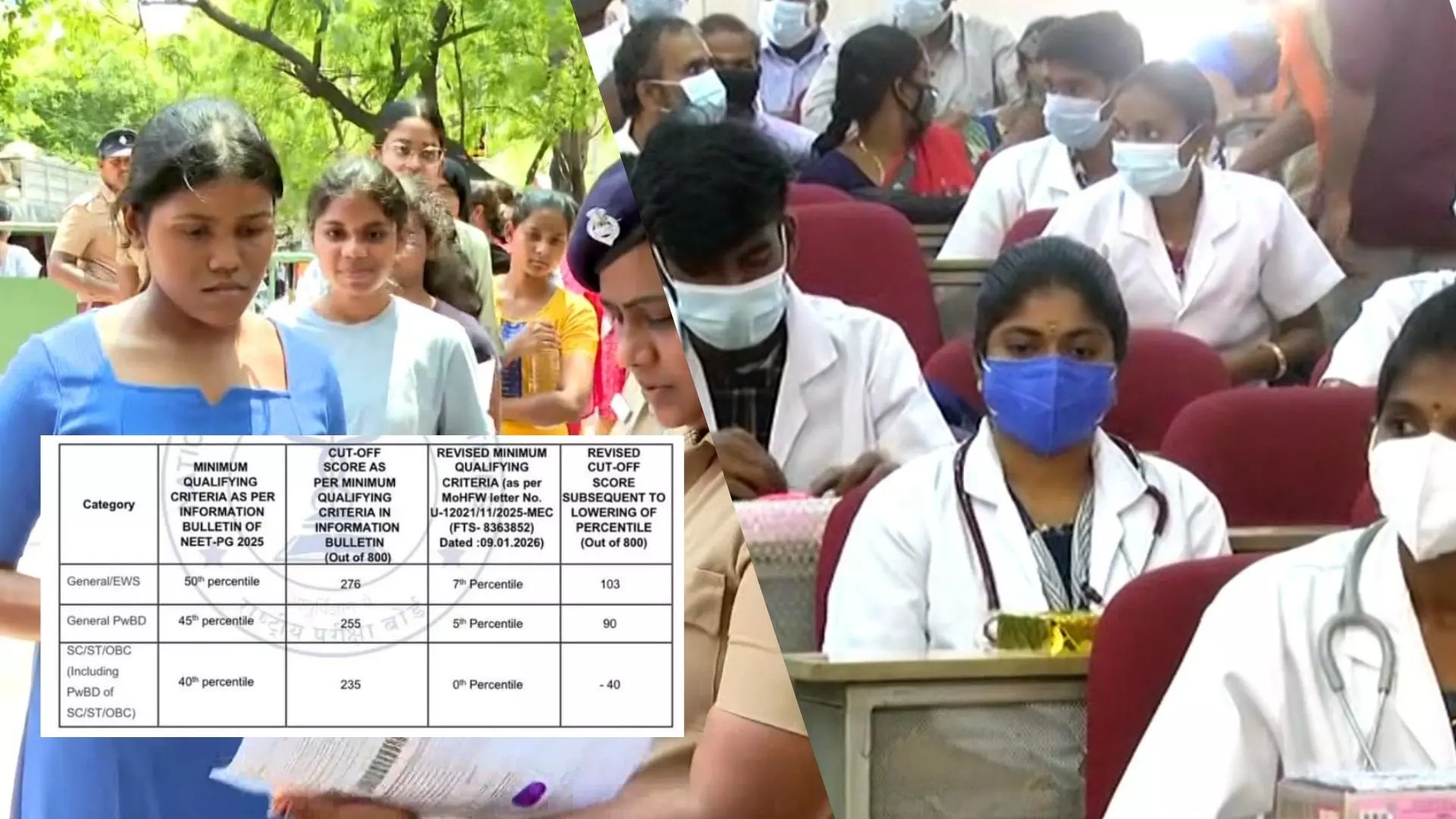
NBEMS issued a notification on January 13, 2026, slashing the minimum qualifying percentile for the third round of counselling. For general and EWS category candidates, the cut-off was reduced from the 50th percentile to the 7th percentile, translating to about 103 marks out of 800.
For reserved categories, including SC, ST, and OBC, the qualifying percentile was brought down to zero. This means candidates with scores as low as minus 40 marks are now eligible to participate in counselling.
The decision, backed by the Union Health Ministry, was justified as a one-time measure to fill more than 18,000 vacant postgraduate medical seats and address the shortage of specialist doctors across the country. Authorities have also clarified that the original merit list and ranks published in August 2025 remain unchanged.
Doctors file PIL
The United Doctors Front (UDF), along with several petitioners, has challenged the decision as arbitrary and unconstitutional. The PIL has been filed by Dr Lakshya Mittal, president of the United Doctors Front, along with social worker Harisharan Devgan, neurosurgeon Dr Saurav Kumar, and World Medical Association member Dr Akash Soni.
According to the petitioners, the cut-off reduction dilutes merit and violates standards laid down under the National Medical Commission Act. They argue that allowing ill-prepared candidates into specialist training programmes poses serious risks to patient safety and public health.
Dr Mittal said the decision appears to be part of a larger design to benefit private medical colleges. “We have filed a PIL in the Supreme Court of India challenging the shocking reduction of NEET PG cut-off to minus 40 marks. This decision doesn’t look accidental. It appears to be a game plan and part of a well-oiled system that benefits private medical college mafias,” he said.
He further warned that the move undermines the foundation of medical education. “Allowing doctors with negative marks to enter PG training not only destroys merit but also threatens patient safety. This dilution of medical education standards is unacceptable, and that is why we have approached the Supreme Court to protect merit, ethics, and patient lives,” Dr Mittal added.
Patient safety fears
Petitioners have stressed that the issue goes beyond examinations and directly impacts public trust in the healthcare system. They argue that patients cannot be exposed to doctors who qualify for specialist training despite failing to demonstrate basic competence.
Social worker and petitioner Harisharan Devgan voiced deep personal anguish while opposing the policy. “When health is concerned, you just cannot trust someone lacking competence,” he said. He also cautioned that the policy could have unintended social implications. He said abrupt changes to eligibility norms might reinforce existing prejudices and affect public confidence in doctors from reserved categories, potentially undermining the goal of inclusion.
Recounting his personal motivation for filing the PIL, Devgan said, “When my mother was ill, we came across some incompetent doctors who worsened her condition. Later, I learned that they were unqualified. She passed away, and that trauma pushed me to file this PIL. We should not allow candidates who fail to meet minimum competence thresholds.”
Legal challenges ahead
Medical bodies such as the Federation of Resident Doctors’ Association (FORDA) and the Federation of All India Medical Associations (FAIMA) have also criticised the cut-off reduction, calling it unprecedented and damaging to NEET PG’s credibility as a merit-based examination.
Advocate Satyam Singh Rajput, representing the petitioners, argued that the decision could have long-term consequences for the healthcare system. “You are making future doctors, and the entire health system will depend on them. If incompetent doctors are produced, they will be hazardous to people,” he said. He also warned that lowering the cut-off could worsen discrimination. “First they brought zero percentile, now minus 40. This move only benefits private medical colleges that need to fill their seats,” he said.
The Supreme Court is expected to hear the matter soon, even as third-round counselling registrations are underway. With NEET PG already facing criticism over multiple exam shifts and repeated cut-off changes, the outcome of this case could have far-reaching implications.
As the debate continues, doctors and aspirants alike are calling for fairness, transparency, and accountability, underscoring the delicate balance between addressing specialist shortages and maintaining rigorous standards in medical education.
The content above has been transcribed from video using a fine-tuned AI model. To ensure accuracy, quality, and editorial integrity, we employ a Human-In-The-Loop (HITL) process. While AI assists in creating the initial draft, our experienced editorial team carefully reviews, edits, and refines the content before publication. At The Federal, we combine the efficiency of AI with the expertise of human editors to deliver reliable and insightful journalism.