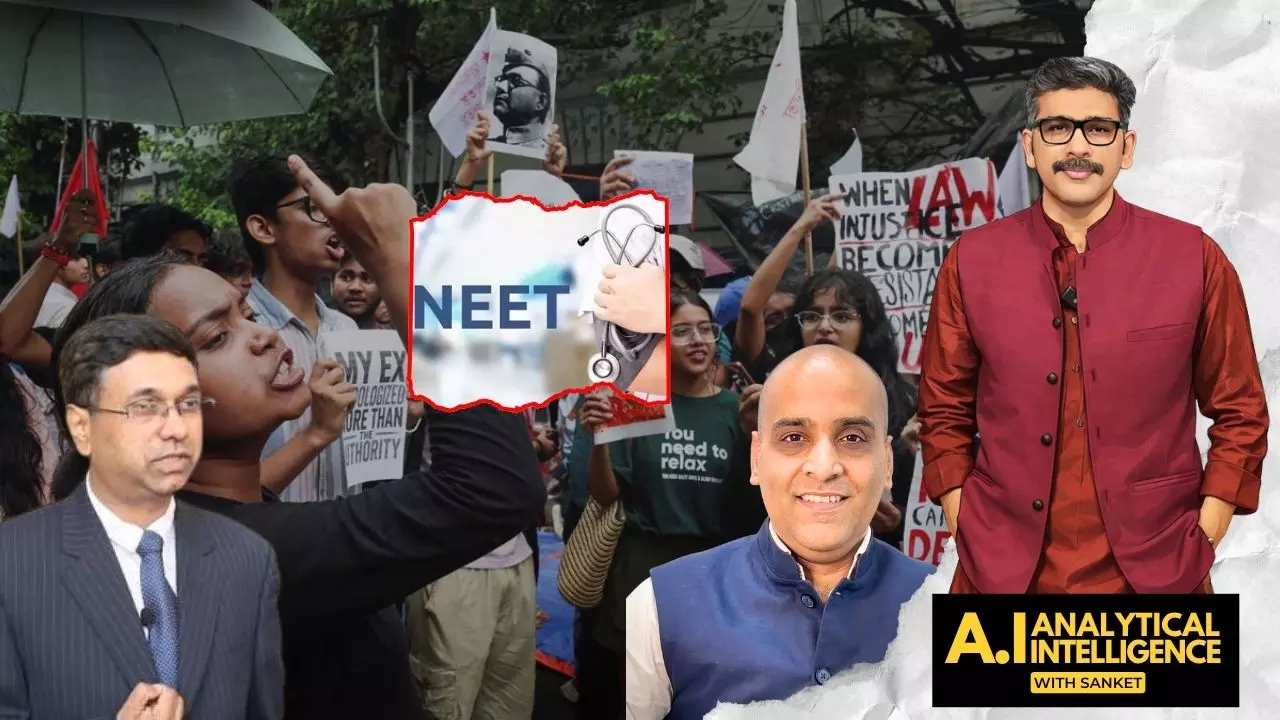
The distinction between contractual workers and NTA officials responsible for the agency’s functioning has now become the focal point.
NEET-UG leak: Can the NTA escape scrutiny for security lapses?
The NEET paper leak probe risks letting the NTA evade scrutiny while placing the blame on contractual staff, raising questions about exam security and justice for affected students

The CBI’s first supplementary charge sheet in the NEET-UG 2026 paper leak case has renewed questions about the accountability of National Testing Agency (NTA) officials, given the agency’s role in conducting the examination and overseeing its security.
Keshav Agarwal, vice president of the Coaching Federation of India, argued that the latest charge sheet appeared to place responsibility on lower-level and contractual employees, despite the NTA's role in conducting the examination and managing the processes surrounding it. “How a paper leak could occur in an examination conducted by the National Testing Agency (NTA) without the agency itself facing scrutiny,” he argued during The Federal’s AI With Sanket.
Also read: NEET 2026 paper leak: CBI chargesheet names three NTA subject experts as primary sources
Meanwhile, advocate Naveen Jindal said decisions about access, security and the deployment of personnel fell within the examination system's administrative framework. He said the charge sheet did not clearly establish how many NTA officials had been investigated, making the scope of the probe a central concern.
Questions over security
Agarwal recalled how the NEET controversy in 2024 had prompted an investigation, but said questions remained unanswered. Referring to the subsequent acknowledgement of a leak and the latest investigation, he argued that the authorities needed to establish how confidential examination material could be accessed and circulated.
He also raised concerns on the agency's security arrangements, pointing to the involvement of people appointed through the NTA's processes. If contractual employees could access sensitive material and compromise an examination, he argued, the responsibility could not simply be separated from the institution that engaged them.
However, Jindal argued that the NTA's responsibility to secure examination papers extended to everyone with access to them, whether permanent employees, contractual staff or subject experts.
He pointed to reported shortcomings in the handling of subject experts, including the alleged absence of proper frisking and checks on entry to and exit from confidential sections. He also referred to the repeated use of the same experts across different stages of the examination process. Jindal argued that these were not merely individual lapses by subject experts.
Who is accountable?
The distinction between contractual workers and NTA officials responsible for the agency’s functioning has now become the focal point. Agarwal questioned why the government had terminated 47 NTA officials if there had been no serious problems within the agency. He also referred to the departure of former NTA chief Vineet Joshi, asking what these developments indicated about institutional accountability.
Also read: NEET-UG 2026 paper leak: Whistleblower claims pre-exam PDFs matched questions
Agarwal argued that the NTA could not distance itself from the actions of contractual employees when it was responsible for engaging them. He criticised what he described as a lack of transparency and said students who raised concerns about their results had faced threats of legal action.
He also questioned whether irregularities in examination results and the handling of complaints had received adequate scrutiny. In his view, investigations needed to examine the entire chain of responsibility instead of focusing narrowly on people at the lowest levels.
Students still await relief
For Jindal, the consequences of the controversy extended beyond the investigation itself. He described the distress experienced by students who believed their marks had been altered or whose examination results had been challenged. He said he had handled around 10 to 12 related cases in the Delhi High Court but had not received satisfactory documentation from the NTA to resolve the concerns he described.
Jindal said some students had spent three or four years preparing for the examination before finding themselves caught in disputes over their results. He called the situation heartbreaking and argued that students continued to face uncertainty despite the investigations and public debate surrounding the leak.
Agarwal said the damage went beyond the loss of confidence in a particular examination. Students who spent years preparing could lose faith in a system when others appeared to benefit from leaked material. He warned that failing to identify those responsible would leave the conditions for future leaks unchanged.
The challenge of proving a leak
Agarwal also raised concerns about the evidence required to prove the leak in court. He argued that allegations based on claims that questions had been dictated or circulated could be difficult to establish without primary evidence demonstrating that confidential examination material had actually been compromised.
Also read: Anti-paper leak bill proposes tougher punishment, omits deeper flaws in supply chain
He warned that those accused could escape conviction if investigators could not produce stronger evidence. In his view, focusing on people who had limited roles in the process, without tracing the leak to its source, would not address the underlying problem.
Jindal stressed that the supplementary charge sheet was only one stage of the proceedings and that the investigation remained the CBI's responsibility. He noted that the Supreme Court was also examining the matter but said the court could not substitute for a full criminal investigation.
He expressed hope that judicial scrutiny would lead to meaningful action. However, he argued that the authorities investigating the case needed to establish accountability rather than leave students waiting for relief.
Politics around the controversy
Commenting on the role of activists who brought the NEET controversy into the public spotlight, Agarwal accused some campaigners of using students' anger to advance their own political ambitions. He argued that students' emotions should not be treated as a route to political prominence, particularly when affected families were still seeking answers.
Jindal similarly said the focus needed to remain on the unresolved legal and institutional questions. While recognising that the issue had gained public attention, he argued that meaningful change would depend on whether the investigation and subsequent legal proceedings delivered results.
AI poses new security risks
Looking ahead, Agarwal warned that examination security would face new challenges from artificial intelligence. He raised the possibility that question banks used to generate examination papers could create fresh vulnerabilities as AI tools become more capable.
He suggested that question-generation systems and online platforms could be exploited to anticipate examination questions or manipulate marks if security remained weak. He described the possibility of an “invisible paper leaker”, arguing that conventional safeguards might not be sufficient to address emerging risks.
Also read: 'NEET-UG 2026 cancellation after paper leak shows commitment to exam integrity': NTA to SC
Agarwal said technological measures, including CCTV surveillance, could not compensate for weaknesses in the handling of confidential material. He called for stronger security practices and greater attention to the people and processes involved in conducting examinations.