Bhagwat’s New York speech: RSS image makeover or genuine recalibration?
The RSS chief’s Madison Square Garden address on unity and diversity sparks debate over its global outreach, political positioning and ideological contradictions

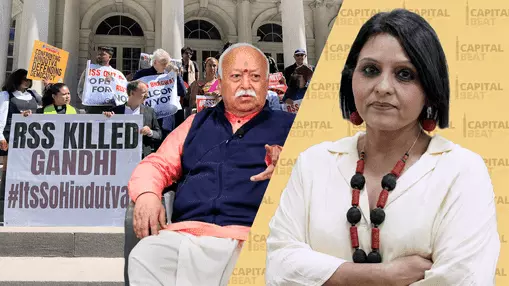
“The Madison Square Garden speech represented an attempt to ‘rebuild’ and ‘refurbish’ the image of the RSS,” said senior journalist and political commentator Vivek Deshpande, as RSS chief Mohan Bhagwat’s 42-minute address in New York triggered a debate over the organisation’s global outreach and public positioning. While Bhagwat spoke of unity in diversity, Hindu-Muslim coexistence, environmental responsibility and the duties of Indians towards their “karma bhumi”, his message unfolded amid protests outside the venue.
Speaking to The Federal on Capital Beat, Deshpande questioned the gap between Bhagwat’s message in New York and what he sees as the RSS’s conduct in India. He argued that an organisation he believes has discriminated against people of different faiths cannot simultaneously present itself abroad as a humanitarian organisation.
Global pitch, domestic contradictions
Deshpande also challenged Bhagwat’s emphasis on environmental responsibility. He pointed to what he described as environmental damage linked to projects, mining and infrastructure in India, arguing that the RSS chief’s environmental message did not sit comfortably with developments on the ground.
He also questioned Bhagwat’s assertion that every nation has a specific duty. Deshpande said the idea raised a larger philosophical question: who had assigned those duties to nations? For him, such claims were part of the RSS’s broader effort to reshape how it is perceived internationally.
Political commentator Pushparaj Deshpande similarly argued that there was a gap between the RSS’s rhetoric and its conduct. He said the organisation was attempting to position itself within the global conservative landscape while presenting a more conciliatory image abroad.
He also pointed to the Indian diaspora supporting the RSS and BJP, saying it represented only a small section of the wider diaspora but was highly organised and resourceful. In his assessment, this gives the organisation an influential base for its outreach beyond India.
RSS and the succession question
The panel also debated whether the RSS was attempting to distance itself from Prime Minister Narendra Modi and prepare for a possible change in political leadership.
Pushparaj argued that the RSS could be repositioning itself ahead of a potential leadership transition. He suggested that Bhagwat’s outreach was part of a broader attempt to separate the RSS’s image from controversies associated with the Modi government and potentially position another leader for the future.
That argument, however, was challenged by Deshpande. He rejected the suggestion that Yogi Adityanath was necessarily being projected as the next prime minister, arguing that such a move would not fit an attempt by the RSS to improve its international image. He instead named Devendra Fadnavis as someone he believed could be better suited to an international political role.
JNU Associate Professor Ajay Gudavarthy said the question of succession was ultimately less important than the larger political challenge. He argued that progressive and opposition forces needed to develop a language capable of speaking directly to ordinary Hindus rather than communicating primarily among themselves.
He said that if there is a growing sense of Hindu identity among sections of society, democratic politics must acknowledge it while ensuring that such identity does not turn into majoritarianism or a theocratic state.
What does oneness mean?
Another major point of disagreement was Bhagwat’s use of the word “oneness”.
Gudavarthy questioned whether the concept of oneness was compatible with genuine pluralism. He argued that when the RSS speaks of “one nation, one culture”, it must explain what that single culture actually means and where diversity fits into that framework.
He also questioned the relationship between the idea of Hindu Rashtra and Bhagwat’s assertion that all religions and human beings have equal dignity. If all religions are equal, Gudavarthy asked, what is the meaning of Hindu Rashtra?
DU professor Tanvir Aeijaz took the discussion towards secularism and constitutional values. He argued that radical and communal elements exist across religions and said there was a need to revisit secularism as a core constitutional principle.
For him, the answer was not to mystify secularism but to explain it to people through a broader public discourse. He also argued that interfaith dialogue alone was not enough if it failed to address communal attitudes within communities.
The discussion ultimately returned to the contrast between Bhagwat’s message in New York and the political realities debated by the panellists in India. While the RSS chief spoke of unity, diversity and equal dignity, the panel questioned how those ideas translate into political practice.
As Bhagwat prepared to leave New York for Canada, the programme ended with the broader question of whether his Madison Square Garden speech marked a genuine recalibration by the RSS or a carefully crafted international outreach effort.