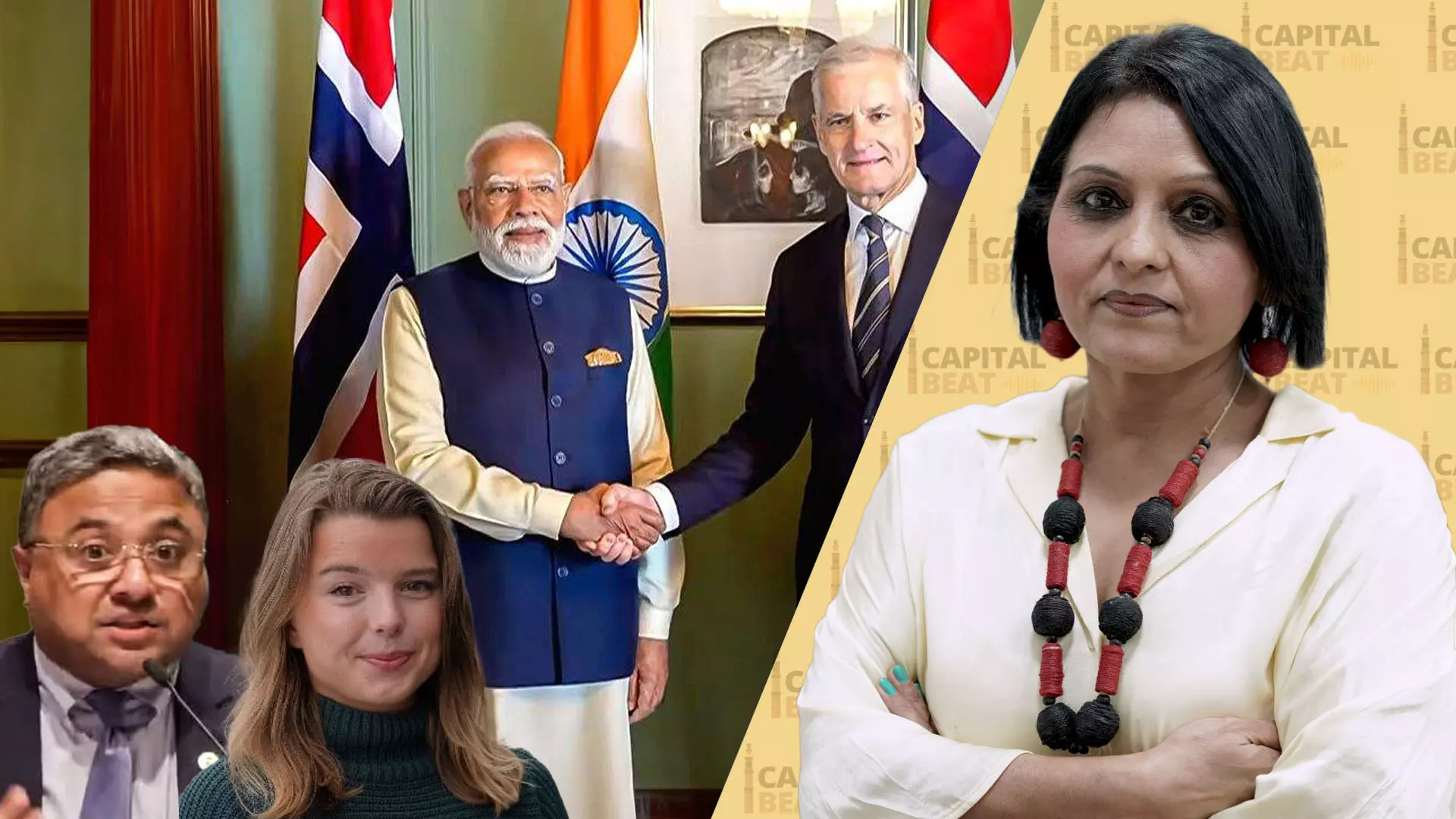
'Modi should have responded to Norwegian journalist's query'
Panellists on the Capital Beat debate Prime Minister Narendra Modi’s refusal to take questions during his Norway visit and the global reaction that followed

In this episode of Capital Beat, senior journalist and author Prem Shankar Jha, senior journalist Anand Sahay, and Middle East expert Professor Aftab Kamal Pasha discussed the diplomatic and political fallout after Prime Minister Narendra Modi declined to take questions from journalists during his visit to Norway. The discussion focused on the viral exchange involving Norwegian journalist Helle Lyng, the response from the Ministry of External Affairs, and the wider questions raised about press freedom and India’s global image.
The discussion opened with footage of Modi walking away from the stage without taking questions from journalists during a joint appearance in Norway. A question shouted by a Norwegian reporter drew particular attention after the clip circulated widely on social media.
The journalist asked, “Prime Minister Modi, why don't you take some questions from the freest press in the world?”
Another clip showed the same reporter following Modi towards an elevator while attempting to continue the exchange.
Media exchange goes viral
The programme highlighted a social media post by the Norwegian journalist after the incident.
The post read: “Prime Minister of India Narendra Modi would not take my question. I was not expecting him to. Norway has the number one spot on the World Press Freedom Index. India is at 157th competing with Palestine, Emirates, and Cuba. It is our job to question the powers we cooperate with.”
The episode also focused on a subsequent media briefing involving MEA Secretary (West) Sibi George.
During the briefing, the Norwegian journalist asked, “I’m wondering, as we strengthen our partnership, why should we trust you? Can you promise that you will try to stop the human rights violations that go on in your country?”
Also Read: Who is Helle Lyng? Norwegian journalist faces scrutiny after questioning PM Modi
She also asked whether the Prime Minister would “start taking critical questions from the Indian press at some point in the future".
In response, Sibi George said, “You know how many stories are up here in India. We have a lot of breaking news every evening. At least 200 TV channels in Delhi alone, in English, Hindi, and multiple languages.”
He added, “People have no understanding of the scale of India. They read one or two news reports published by some God-forsaken ignorant NGOs and then they come and ask questions.”
George further said, “We have a Constitution which guarantees the rights of the people, fundamental rights of the people. We have equal rights for the women of our country.”
'PM should have responded to question'
Anand Sahay described the episode as avoidable, and said the Prime Minister himself should have responded to the question.
“The simplest way to avoid such a situation from arising is for the PM himself to have taken that question at his level,” he said.
Sahay argued that the issue reflected broader concerns about political accountability and engagement with the press.
“The leader of a government elected by the people refuses to answer questions from accredited journalists,” he said during the discussion.
Also Read: Modi receives Norways's highest civilian award, highlights India's 'rapid transformation'
Referring to earlier international appearances, Sahay recalled Modi’s visit to the United States alongside President Donald Trump, where questions on democracy and media freedom were also raised.
“The world has got tired frankly of hearing the same shibboleths about 'we are a democracy, we have a Constitution',” Sahay said. “It does not answer a question that there are daily human rights violations in the country.”
'Modi should use an interpreter'
Prem Shankar Jha described the controversy as “a storm in a teacup” and suggested that Modi’s discomfort with English played a role in the episode.
“Prime Minister Modi is not comfortable in English. Please remember that he is extremely uncomfortable. It’s not his language,” Jha said.
He added, “He is a superb orator in Gujarati and Hindi, but English is not his language. So why does he not take an interpreter with him?”
Jha stated that the Norwegian reporter’s question was “not even an unfriendly question". He described the controversy as avoidable and argued that the Prime Minister could have answered through interpretation support.
The discussion also touched on the online reaction targeting the Norwegian journalist after the exchange. Participants referred to trolling and allegations circulating on social media following the incident.
'Lack of coordination between PMO and MEA'
Professor Aftab Kamal Pasha said the incident exposed a “lack of coordination” between the Prime Minister’s Office and the Ministry of External Affairs.
“The press was told there would be a Q and A session,” Pasha said. “The Norwegian journalists were specially invited to the occasion, and were told there would be a press conference.”
According to Pasha, Modi could have acknowledged the welcome and ceremonial honours while avoiding politically-sensitive questions.
“Even if he wanted to avoid tricky questions about minorities, Manipur, or Kashmir, he could have answered a few things,” he said.
Also Read: MEA blasts 'ignorant, godforsaken NGOs' for Norwegian journalist's questions in Oslo
Pasha also criticised the response delivered by the MEA official.
“The secretary seemed completely off when he was answering the question,” he said. “Instead of lecturing about history, about 1947, about women, this added to the confusion.”
The discussion noted that Modi’s Norway visit included agreements related to LNG shipments and cooperation in green energy and battery technology.
Pasha acknowledged these developments, saying Norway remained “a major oil and gas producer” and that the agreements represented “a major breakthrough".
Debate over India’s democratic image
The panellists repeatedly returned to questions surrounding democracy, press freedom, and India’s image abroad.
Sahay stated that India’s economic rise and its democratic image were being viewed separately on the global stage.
“India has risen economically,” he said, while adding that the country had “slipped” on democracy and press freedom indices.
He further remarked, “The prime minister of India conducts himself as the emperor of India,” while criticising the lack of open press conferences.
Also Read: An Indian PM hasn't been to Norway in 43 years; so why now?
The discussion ended with reference to a social media post by the Leader of Opposition Rahul Gandhi. The post stated: “When there is nothing to hide, there is nothing to fear. What happens to India’s image when the world sees a compromised PM panic and run from a few questions.”
The programme concluded with the panellists debating whether future foreign visits by the Prime Minister would involve tighter media management or greater openness toward questions from international journalists.
(The content above has been transcribed from video using a fine-tuned AI model. To ensure accuracy, quality, and editorial integrity, we employ a Human-In-The-Loop (HITL) process. While AI assists in creating the initial draft, our experienced editorial team carefully reviews, edits, and refines the content before publication. At The Federal, we combine the efficiency of AI with the expertise of human editors to deliver reliable and insightful journalism.)