



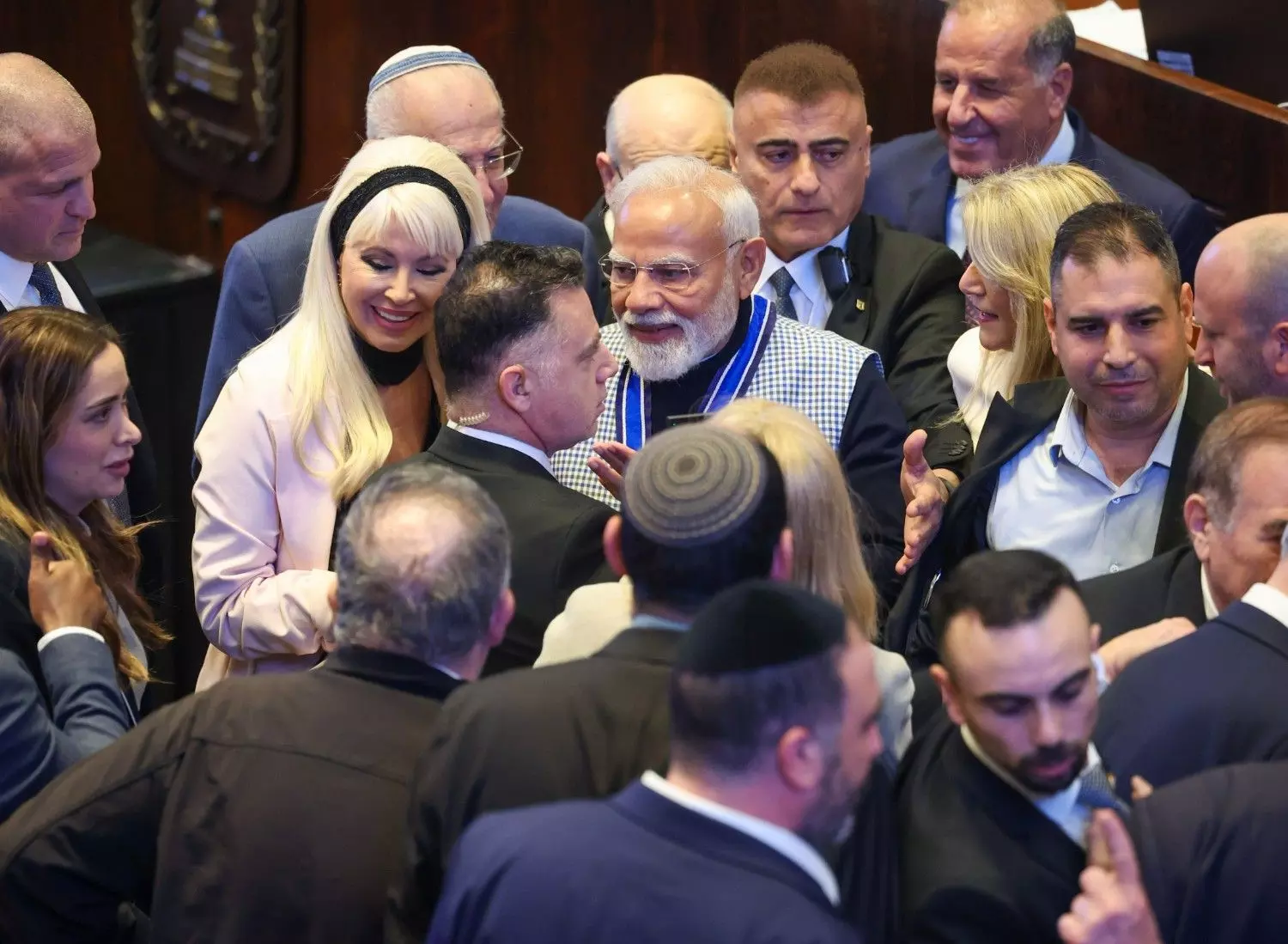
Prime Minister Narendra Modi interacts with officials after being conferred with "Speaker of the Knesset Medal" at the Knesset, Israeli parliament, in Jerusalem, Israel, on Wednesday (February 25). (PMO via PTI Photo)
PM Modi at Knesset: 'We feel your pain, India stands with Israel'
Marking the first-ever speech by an Indian prime minister to the Knesset, Modi showed India's strong resolve to combat terrorism with full force

In a historic address to the Knesset, Prime Minister Narendra Modi on Wednesday (February 25) described the Gaza Peace Initiative as a path towards "just and durable peace" in the region even as he delivered a powerful message of solidarity with Israel, asserting that "terrorism anywhere threatens peace everywhere".
Modi said, like Israel, India has a "consistent and uncompromising policy of zero tolerance for terrorism with no double standards" and called for sustained and coordinated global efforts to counter the menace.
'We feel your pain'
The prime minister's address to the Knesset, Israel's house of representatives, came hours after he landed in the country to a rousing welcome with his Israeli counterpart Benjamin Netanyahu along with his wife Sara receiving him at the Ben Gurion airport.
Also read: Was Modi right to visit Israel now? | Capital Beat
"I also carry with me the deepest condolences of the people of India for every life lost and for every family whose world was shattered in the barbaric terrorist attack by Hamas on October 7 (2023)," Modi said.
"We feel your pain. We share your grief. India stands with Israel, firmly, with full conviction, in this moment, and beyond. No cause can justify the murder of civilians. Nothing can justify terrorism," he said.
Marking the first-ever speech by an Indian prime minister to the Knesset, Modi showed India's strong resolve to combat terrorism with full force.
Evolving situation in Middle East
Israeli Prime Minister Netanyahu and several other senior leaders were among the parliamentarians who attended the event.
"India has also endured the pain of terrorism for a long time. We remember the 26/11 Mumbai attacks and the innocent lives lost, including Israeli citizens. Like you, we have a consistent and uncompromising policy of zero tolerance for terrorism, with no double standards," he said.
"Terrorism aims to destabilise societies, to block development, and to erode trust. Countering terrorism requires sustained and coordinated global action, because terror anywhere threatens peace everywhere." "That is why India supports all efforts that contribute to durable peace and regional stability," he noted.
The prime minister also delved into the evolving situation in the Middle East and referred to Israel signing the Abraham Accords with a number of countries a few years back.
"It was a moment of new hope for a long-troubled region. Since then, the situation has changed significantly. The path is even more challenging. Yet it is important to sustain that hope," he said.
In the current context, Modi explicitly backed the Gaza Peace Initiative, describing the UN Security Council-endorsed plan as the definitive path toward a "just and durable peace" for the entire region.
Gaza Peace Initiative
"The Gaza Peace Initiative that was endorsed by the UN Security Council offers a pathway. India has expressed its firm support for the initiative," Modi said.
"We believe that it holds the promise of a just and durable peace for all the people of the region, including by addressing the Palestine issue," he said.
"Let all our efforts be guided by wisdom, courage, and humanity. The road to peace is not always easy. But India joins you and the world for dialogue, peace and stability in this region," he added.
The prime minister said that there is great admiration in India for Israel’s "resolve, courage, and achievements".
"Long before we related to each other as modern states, we were linked by ties that go back more than two thousand years," he said.
Modi said India and Israel are "democracies shaped by history and focused on the future".
"Our partnership is grounded in shared experience and shared aspirations. Our strong partnership not only serves national interests but also contributes to global stability and prosperity," he said.
India-Israel robust ties
Highlighting robust ties between the two countries, Modi said, "In today's uncertain world, a strong defence partnership between trusted partners like India and Israel is of vital importance." The prime minister also highlighted India's economic growth as well as Israel's technological prowess.
"For the last few years, India has been the fastest-growing major economy in the world. Soon, we will be among the top three economies globally," he said.
"At the same time, Israel is a powerhouse of innovation and technological leadership. This creates a natural foundation for a forward-looking partnership." "We are committed to expanding trade, strengthening investment flows, and promoting joint infrastructure development," he added.
Modi said the bilateral investment treaty signed by the two sides last year will provide confidence and predictability to businesses.
"In the last few years, India has concluded a number of important trade agreements with other nations. To your West, the European Union, and the UK. To your East, the UAE and Oman," he said.
The prime minister said India-Israel bilateral goods trade has grown manifold in recent years.
At the same time, he noted that it does not reflect the "full scope of opportunity".
"That is why our teams are working hard to negotiate an ambitious Free Trade Agreement. It will unlock the vast untapped potential in our trade relationship," he said.
"Israel is often called the 'start-up nation'. In recent years, we have also been working to unlock the innovation and creativity of our youth," Modi said.
"I recall that in 2018, Prime Minister Netanyahu and I inaugurated the iCreate Technology Business Incubator in India. Since then, it has supported nearly 900 such start-ups," he said.
Principle of 'Tikkun Olam'
Modi said India and Israel will also work closely in different formats, such as the India–Middle East–Europe Economic Corridor and the I2U2 framework between India, Israel, the UAE and the US.
"Defence and Security is another important pillar of our partnership. In November last year, we signed an MoU on Defence Cooperation. In today’s uncertain world, a strong defence partnership between trusted partners like India and Israel is of vital importance," he said.
Describing both countries as "ancient civilisations", Modi said, "it is perhaps no surprise that our civilisational traditions also reveal philosophical parallels".
"In Israel, the principle of 'Tikkun Olam' speaks of healing the world. In India, Vasudhaiva Kutumbakam affirms that the world is one family. Both ideas extend responsibility beyond immediate boundaries. They ask societies to act with compassion and moral courage,” Modi said.
“Judaism emphasises Halakha, guiding everyday conduct through law and practice. Hindu philosophy speaks of Dharma, the moral order that shapes duty and right action. In both traditions, ethical life is lived through action, and faith is expressed through conduct,” he added.
Drawing parallels between the festivals of Hanukkah and Diwali, Modi said, "There is an endearing similarity in our festivals as well. You celebrate Hanukkah with the warm glow of candles. Around the same time, we celebrate Diwali, the festival of lights, with the gentle radiance of lamps." "Soon, India will celebrate the festival of Holi, filled with happiness and colour. And around the same time, Israel will also celebrate Purim with enthusiasm and joy,” he added.
(With agency inputs)