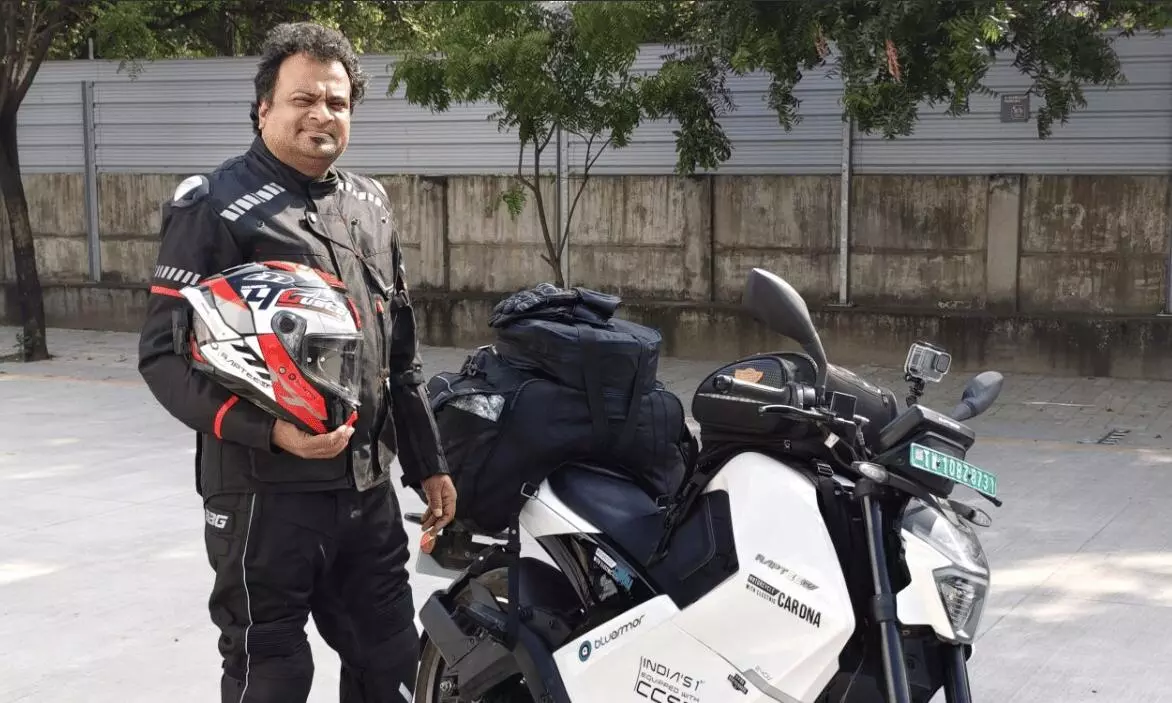
MCC professor travels across 16 states, covering 7,530 km on an electric bike
Crossing 16 states in 19 days on a Raptee HV T30, Baala Manikandan shatters endurance benchmarks, proving India’s EV infrastructure is ready for the long haul

Baala Manikandan, an assistant professor at Madras Christian College in Chennai, has completed a 7,530-kilometre motorcycle ride across India on an electric bike, crossing 16 states in 19 days.
The journey began in Chennai on December 23, 2025, and the professor went on to travel through Odisha, Kolkata, Agra, and Delhi before swinging south through Mumbai, Goa, and Mangalore, all the way down to Kanyakumari. Finally, he returned to Chennai on January 16, 2026, with breaks in between.
The Raptee HV T30 used during the journey is developed by Raptee.HV, a Chennai-based electric motorcycle startup.
Also read | Raptee’s electric bet as Tesla vrooms into India
The journey has been recognised by both the Asia Book of Records and the India Book of Records. The journey also recorded one of the longest rides and the highest average distance achieved on an electric motorcycle in India.
Manikandan averaged close to 400 kilometres per day during the ride, surpassing his earlier endurance record from 2023. During that ride, he travelled 6,727 kilometres across 14 states in 22 days and seven hours, including a challenging journey from Chennai to Leh.
Interestingly, Manikandan says the ride was not originally intended to break records. “This journey was not planned for records,” he said. “I travelled during the holiday window in December around Christmas.”
Journey across regions
The ride began in Chennai and quickly gained momentum. Within the first four days, Manikandan had already reached Kolkata, covering a substantial distance that boosted his confidence about the trip's feasibility. “I initially drove till Kolkata in four days itself, and that gave me confidence,” he shared.
From Kolkata, he continued to Delhi in another three days, followed by a three-day ride to Mumbai. However, a brief pause was required before completing the final stretch of the journey. “I had to return to college on January 5 for signing, so I left the bike in Mumbai. After about a week, I restarted the journey from Mumbai to Goa, then to Mangalore, Kanyakumari and finally Chennai,” he explained.
The ride concluded with a brief stop at Mahabalipuram before the official welcome was arranged the following day. “We took breaks, and on the16th we stayed in Mahabalipuram as they were arranging a welcome for us on the 17th,” he said.
Favourite stretch
Among the many regions he travelled through, one stretch stood out as particularly memorable, he recalls. “From Ahmedabad to Goa, the stretch was very enjoyable,” Manikandan said.
Long-distance riding often brings together elements of road conditions, landscape and travel rhythm. For Manikandan, the experience of covering vast distances on an electric motorcycle across changing landscapes made the journey especially rewarding.
Infrastructure for EVs
Manikandan noted that adoption of electric mobility is becoming increasingly visible, even outside major cities. “Many are adapting to EVs,” he said. “There is the use of e-autos and other vehicles, and we can see cheap Chinese vehicles even in rural areas.”
Also read |Tamil Nadu extends 100 pc EV road-tax exemption till 2027 end
“Every 50 kilometres there is a charging facility, especially for cars,” he added. The motorcycle used for the expedition, the Raptee HV T30, is notable for its compatibility with the CCS2 (Combined Charging System Type 2) charging standard, commonly used for electric cars. This allowed the motorcycle to access public DC fast-charging stations across the country.
“It can be plugged in and from 20 to 80 per cent it charges in about 30 to 40 minutes,” Manikandan explained.
On highways, the motorcycle could deliver a range of around 100 kilometres. This marks a significant improvement compared with his earlier ride in 2023. “For the 2023 journey from Chennai to Leh, I carried the charger with me,” he said. “It could be plugged into a normal 15-amp socket, but it took about five hours to charge.”
Biggest challenge, the climate
Manikandan said climate conditions proved more difficult than the roads themselves. “For me, the challenging part was not the terrain but the climate,” he said.
Travelling during December meant harsh winter conditions in northern India. To avoid traffic, he used to ride at night on several stretches. “From Odisha to Agra we drove at night to avoid traffic,” he explained.
Dense fog reduces visibility drastically, particularly in areas such as Prayagraj. “In Prayagraj we could not see even ten feet ahead because of the fog. We could only see the headlights of other vehicles,” he said.
Journey ahead
Having completed rides along India’s coasts and across several states, Manikandan is already planning his next journey. “My next plan is to travel across the borders,” he said.
The proposed route would cover areas stretching from Guwahati to Himachal Pradesh, Leh, Rajasthan and the Rann of Kutch. “Coastal areas are now done, so I want to travel across the borders from Guwahati to Himachal, Leh, Rajasthan and the Rann of Kutch,” he explained.
Also read |Raptee’s e-motorcycles will be more enjoyable than petrol bikes: CEO
The journey is likely to be supported by his institution. “The college is also supporting me in this,” he said. The proposed expedition may take place around May, although planning is still underway. While the terrain may become more challenging, particularly in remote mountainous regions, Manikandan remains optimistic.
“The mountain terrain may be difficult, but it is possible,” he said. “Till Guwahati it should be fine, but remote areas may be more challenging.”
He also hinted at possible collaborations for the upcoming journey. “I am in talks with Mahindra and Tesla,” he added.
Journeys like Manikandan’s challenge the widespread perception that electric two-wheelers are suitable only for short urban commutes. As charging infrastructure expands and battery technologies improve, long-distance electric travel is gradually becoming more feasible.