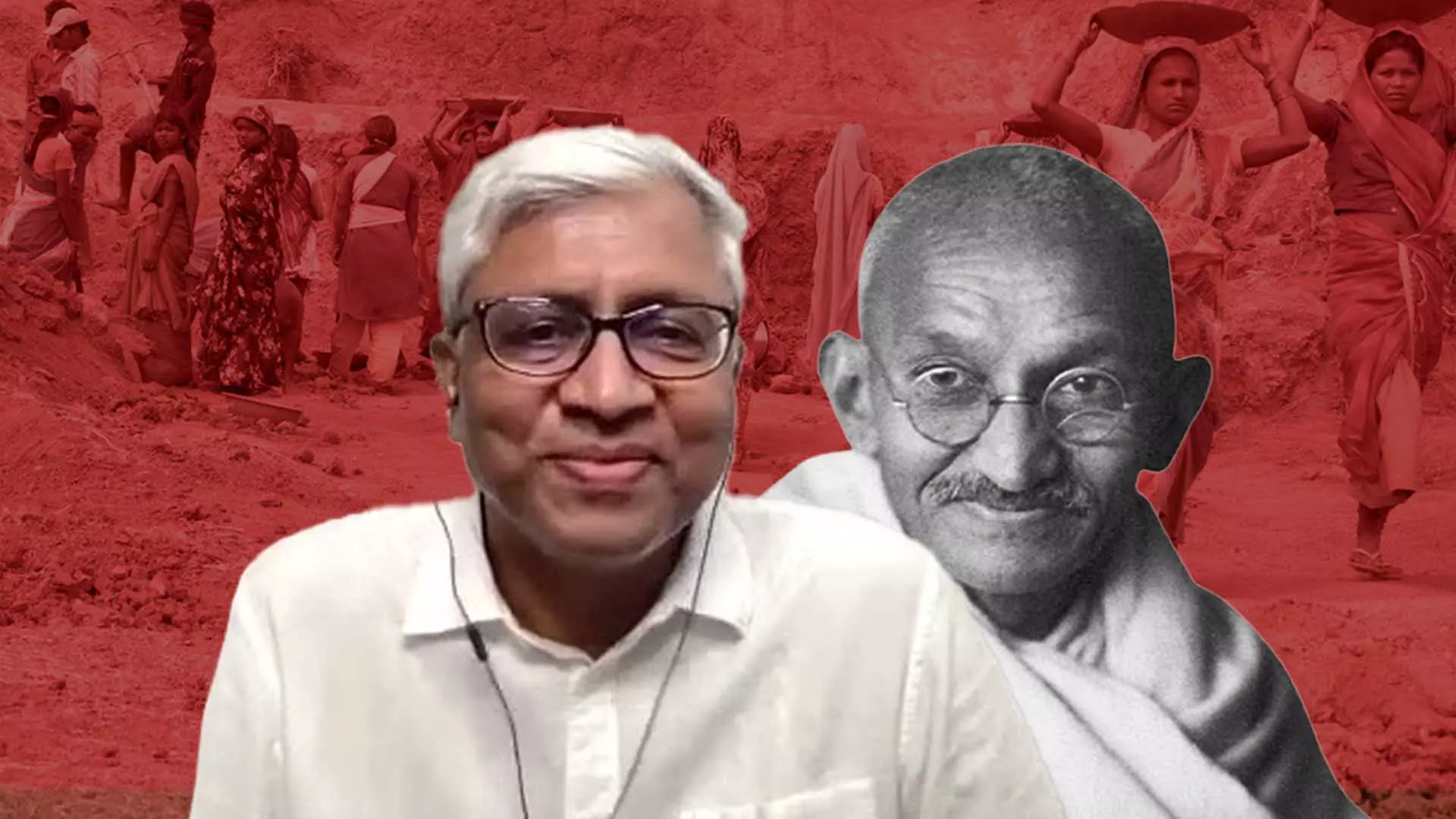
MGNREGA renaming row: Why dropping Gandhi is more than a name change
Journalist Ashutosh on ideology, history, and the deeper politics behind altering a landmark welfare scheme

The renaming and restructuring of the Mahatma Gandhi National Rural Employment Guarantee Act (MGNREGA) has triggered a debate that goes far beyond administrative reform. At its heart lie questions of ideology, history, and the role of Mahatma Gandhi in India’s political and moral imagination.
Also read: VB-G RAM G Bill | Modi govt bulldozed MGNREGA, says Sonia Gandhi
In this wide-ranging conversation, journalist and commentator Ashutosh explains why the move is deeply symbolic, politically loaded, and inseparable from a larger project of reshaping India’s past and present.
The government has removed Mahatma Gandhi’s name from a flagship employment scheme that helped millions survive, especially during COVID. How do you see this move, both symbolically and politically?
There are two angles to this story. One is fairly evident: since Narendra Modi became Prime Minister, he has been in the habit of dismantling the entire edifice created by his predecessors, particularly those associated with the Nehru-Gandhi lineage and Congress Prime Ministers. By doing this, he believes he is dismantling an old consensus and setting a new historical record where his name will be remembered for fundamentally altering institutions and policies.
But the deeper question is ideological. The issue is not about Ram, or about any phonetic rearrangement of acronyms. The core issue is why this government decided to drop Mahatma Gandhi’s name altogether. They could have easily retained the name and reworked the policy framework if they wished. Instead, they chose to change both the structure and the name. For me, the removal of Gandhi’s name is far more important and troubling.
If you look at the ideology of the RSS, there has historically been no genuine affection for Mahatma Gandhi. Publicly, leaders may say Gandhi inspired them, and the RSS may call him the Father of the Nation, but in their hearts, they have never accepted his philosophy. After Gandhi’s assassination, the RSS was banned, its leaders were jailed, and Sardar Patel himself wrote to MS Golwalkar stating that the atmosphere of venom created by the organisation led to Gandhi’s killing. For years, RSS shakhas referred to the assassination as “Gandhivad”.
Over time, they realised that to gain legitimacy, they could not completely dissociate from Gandhi. But ideologically, they never accepted his values. Their worldview holds that Hindus have been in a perpetual state of war for the last 1,200 years, first against Muslims and then Christians. In this reading of history, Hindus became slaves because they were too timid and believed in non-violence. The RSS project is to make Hindus brave, ruthless, and capable of violence so that history does not repeat itself.
Gandhi stands directly in opposition to this worldview. He demonstrated that independence was achieved through non-violence. Savarkar, in his writings, described truth, non-violence, and tolerance as “perverted virtues” and signs of weakness. From this perspective, Gandhi’s memory, philosophy, and values must be erased. They cannot do it overnight, but step by step, they are moving in that direction. Dropping Gandhi’s name from this scheme is deeply ideological and extremely disturbing.
Also read: VB-G RAM G Bill gets President's assent
Do you think the BJP now believes it can dispense with the pretence of respecting Gandhi altogether?
Not immediately. They will do it brick by brick. Gandhi is too central to Indian politics and society, and they are acutely aware of the international repercussions. Globally, India is respected largely because of Mahatma Gandhi. Leaders like Nelson Mandela, Desmond Tutu, Martin Luther King Jr., and even Albert Einstein admired him deeply.
I recently visited the United States and saw Gandhi quoted at the Martin Luther King memorial. People across the world associate India with Gandhi. I remember being in Varanasi years ago when a young foreigner told me, “You are fortunate to have had a leader like Mahatma Gandhi. I wish we had someone like that.” That is Gandhi’s global stature.
Because of this, the BJP and the RSS cannot erase Gandhi abruptly. They have patience — what I often call the patience of an ocean. They waited a hundred years to reach where they are today, and they can wait another hundred to erase Gandhi’s influence. If they remain in power long enough, they will continue this process. I have no doubt about that.
Is this renaming part of a broader effort to rewrite history — changing names of cities, roads, and institutions?
Absolutely. But before answering that, we must understand the sustained attack on Jawaharlal Nehru since 2014. This is not accidental; it is by design. There are two reasons.
First, they want to dismantle the constitutional consensus built around Nehru’s legacy and replace it with their own ideological framework. Second, and more importantly, attacking Nehru is a way of dismantling Gandhian thought. Nehru was Gandhi’s chosen successor. Gandhi himself said that even if they differed at times, Nehru would speak the same language after his death.
Nehru was deeply committed to secularism, inclusivity, non-violence, and idealism — just like Gandhi. They differed on industrialisation and decentralisation, but on the core ethos of India, they were aligned. Discrediting Nehru is easier because he governed for 17 years and inevitably made mistakes. Once Nehru is discredited, the assault on Gandhi becomes easier.
Name changes are part of redefining Indian history and erasing the medieval period dominated by Muslim rulers. Figures like Akbar, known globally as benevolent, are reduced to “foreigners” who supposedly do not belong to Indian memory. The RSS and BJP reject the idea of composite culture that Gandhi and Nehru upheld.
Nehru wrote clearly in The Discovery of India that Muslims who came from outside accepted India as their motherland and became part of its society. India’s economy flourished during the Mughal period, even under Aurangzeb, when it commanded a significant share of global GDP. It was the British who colonised and looted India. The RSS and BJP do not accept this interpretation of history and seek to dismantle everything associated with it.
Does this politics of history impose a sense of historical guilt on today’s Muslims?
That is precisely the attempt. The aim is to make Muslims feel guilty for the past. But in my interactions with Muslims — both elites and the poor — I find a clear understanding that this is political strategy, not historical truth. They distinguish between Hindus and Hindutva.
The BJP and the RSS constantly remind Muslims of alleged past atrocities. Slogans like “Babar ki aulaad” during the Babri Masjid movement were meant to impose collective guilt. But the reality is that the vast majority of Indian Muslims are indigenous. Many converted from Hinduism, often from Dalit and oppressed castes, seeking dignity and equality denied within the caste system.
This project is not just about guilt; it is about revenge — punishing present-day Muslims for perceived historical wrongs. It ignores the fact that the Mughal rulers were autonomous Indian emperors who did not derive legitimacy from Arab or Persian powers. If they had wanted mass conversions, they could have done so easily, but they did not pursue such a policy.
Would you agree that the Mughals did not come with a civilisational agenda, unlike today’s Hindutva politics?
I agree. Babur did not come to India with a civilisational mission. He was driven out of Central Asia, invited by Indian rulers, and eventually found India a good place to rule. The Mughal state included powerful Hindu nobles in positions of authority — figures like Man Singh, Jaswant Singh, and Jai Singh held immense power under Akbar and Aurangzeb.
This was not an exclusive regime. Contrast that with today, where Muslims are conspicuously absent from positions of power. The Mughals came for political power, not to “civilise” India. That distinction is crucial.
What about the use of figures like Subhas Chandra Bose while attacking Nehru and Gandhi?
The BJP is not just fighting Nehru or Gandhi; it is fighting the entire legacy of the freedom struggle. They selectively appropriate figures like Subhas Chandra Bose or Sardar Patel to discredit Nehru. But ideologically, the RSS could never truly align with Bose.
When Bose gave the call of “Delhi Chalo” and raised the Indian National Army, the RSS and Savarkar were recruiting for the British Army. Their commitment to the freedom struggle was negligible. The Vande Mataram controversy, too, was not just about Nehru; it was an attempt to discredit the entire freedom movement, including Gandhi, Tagore, Kripalani, Sarojini Naidu, and Bose himself.
All these leaders differed among themselves but shared the core ethos of the freedom struggle shaped by Gandhi. Anyone who believes in Gandhi’s values cannot be dear to the RSS.
Finally, does this sustained campaign violate Article 51A of the Constitution, which calls for harmony and brotherhood?
Yes, it does. There should be no confusion about that. The RSS has never believed in the Indian Constitution. Even at the time of its adoption, they rejected it, claiming it lacked Indian ethos. They objected to the tricolour, to the national anthem, and to Vande Mataram.
As recently as the 2000s, RSS leaders openly said the Constitution should be scrapped. While they are not in a position to do that today, they believe in slowly transforming society rather than confronting it directly. Since 2014, they have spoken the language of unity and diversity on the surface, but in practice, only one religion is protected by the state.
They project tokenism abroad but avoid genuine engagement with religious minorities at home. Statements questioning the basic structure doctrine, as laid down in the Kesavananda Bharati case, further show their disregard for constitutional sanctity.
They talk about harmony, but their actions promote hierarchy, exclusion, and majoritarianism. That fundamentally violates both the spirit and the letter of the Constitution.
(The content above has been transcribed from video using a fine-tuned AI model. To ensure accuracy, quality, and editorial integrity, we employ a Human-In-The-Loop (HITL) process. While AI assists in creating the initial draft, our experienced editorial team carefully reviews, edits, and refines the content before publication. At The Federal, we combine the efficiency of AI with the expertise of human editors to deliver reliable and insightful journalism.)