What does LPG price hike mean for supply, subsidies, and energy security?
Experts weigh in on the ₹60 domestic cylinder increase, import dependence, and broader implications for households and India’s energy sector

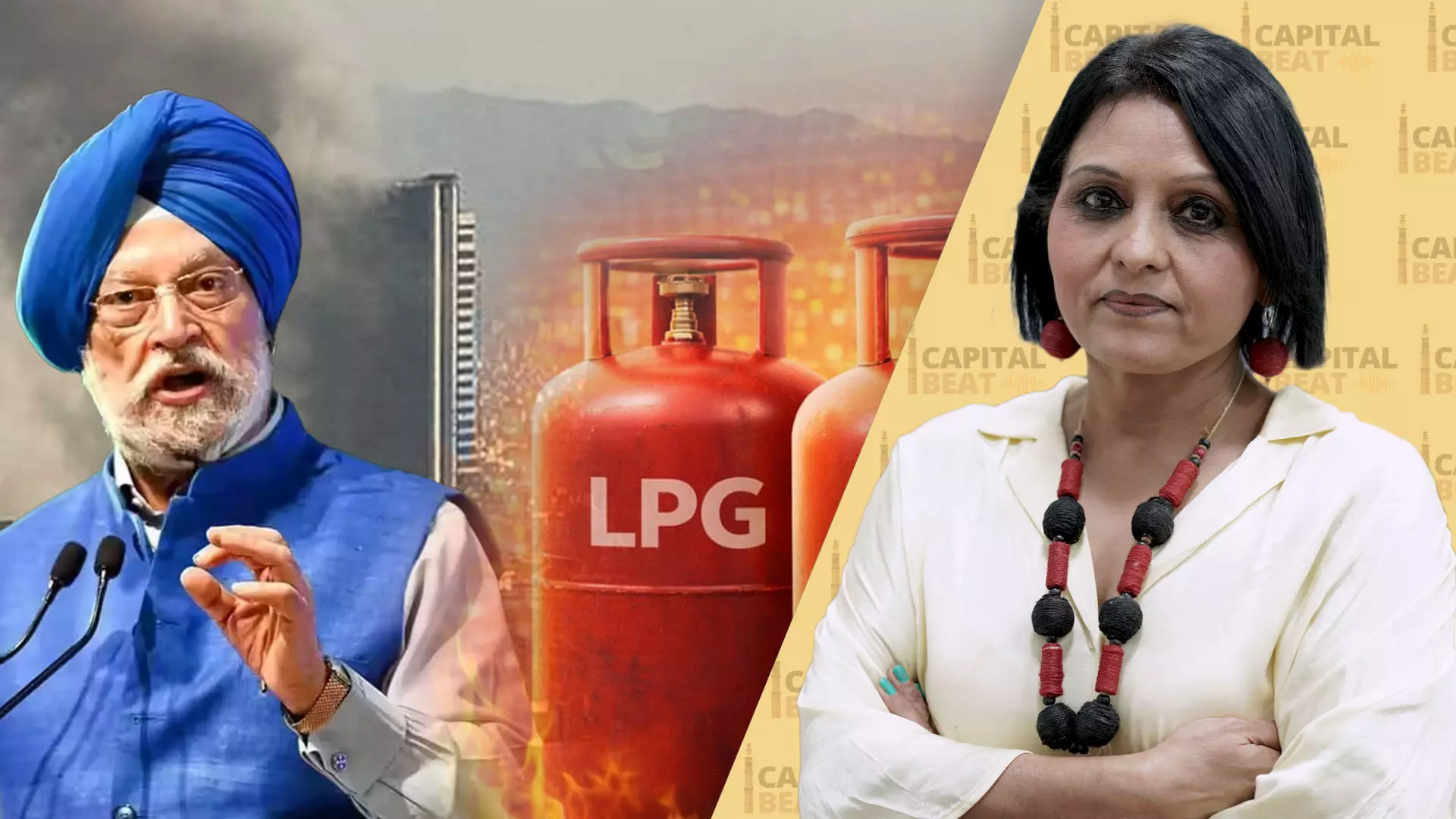
A Capital Beat panel discussion featuring Chandra Prakash, president of the All India LPG Distributors Federation, economist Santosh Mehrotra, and former diplomat Meera Shankar examined the sharp increase in cooking gas prices in India following the escalation of the US-Iran-Israel conflict. The discussion focused on the ₹60 rise in domestic LPG cylinder prices and the ₹115 hike in commercial cylinders, the reasons behind the increase, and its implications for supply, subsidies, and India’s energy security.
The price revision took effect on March 7, with a 14.2-kg non-subsidised domestic LPG cylinder in Delhi rising from ₹853 to ₹913. Similar hikes were recorded across major cities: Mumbai at ₹912.50, Kolkata at around ₹939, and Chennai at ₹928.50 per cylinder. Industry officials cited a surge in global energy costs linked to tensions and disruptions in West Asia as the immediate trigger for the hike.
The increase marks the second revision in domestic LPG prices in less than a year. The previous hike occurred in April 2025 when prices rose by about ₹50. Price variations across states depend on local taxes and VAT, but the latest revision reflects the impact of rising international energy prices during the ongoing geopolitical conflict.
Supply situation and price mechanism
Chandra Prakash emphasised that there is no shortage of LPG supply despite the price increase. He stated, “Jahan tak LPG ka abhi supply ka jo aur distribution ka jo hai koi shortage nahin hai kisi kisam ki bhi… jo registered customer hai unko pehle ki tarah barabar supply milti rahegi.”
He appealed to consumers not to panic book cylinders, adding that registered domestic and commercial users will continue receiving regular supply through the existing distribution system.
Prakash noted that disruptions have occurred in LPG imports from the Gulf due to the conflict but said oil companies are attempting to compensate through increased refinery production and alternate imports. He explained that domestic LPG pricing is based on import parity rates. “Jo import parity ki pricing aayegi uske base par domestic LPG aur commercial LPG ka price set hoga,” he said.
He also highlighted that oil companies have been under financial pressure due to under-recoveries while supplying LPG at subsidised or below-market rates. “International market mein ekdam kaafi tezi se uchhal aaya hai… us wajah se thoda ₹60 badhana pada,” he stated while referring to the recent hike.
Import dependence and domestic production
According to Prakash, India relies significantly on imported LPG to meet domestic demand. He said roughly 60–65% of LPG consumed in the country is imported, while about 35–38% is produced domestically through refineries.
He explained that the disruptions in imports are being addressed by expanding refinery capacity and sourcing LPG from other countries. “Tel companies aur petroleum ministry koshish kar rahi hain ki uski poorti ke liye refinery ki capacity badhai ja rahi hai,” he said.
Prakash also dismissed concerns about black marketing or hoarding of LPG cylinders. He said the distribution network operates under an online system with limited storage capacity at distributor warehouses. “LPG cylinder ki hoarding ka 1% bhi koi chance nahin hai… system online hai aur booking bhi online hai,” he said.
He added that the distribution system does not allow excess stock accumulation, and distributors cannot store large numbers of extra cylinders due to capacity limits.
Diplomatic and energy security perspective
Former diplomat Meera Shankar explained the broader geopolitical context affecting energy markets. She said India has strategic reserves of petrol and crude oil for about 25 days but far less storage for gas. “For gas I think it's about five days to a week because we don't really have much storage for gas,” she noted.
Shankar distinguished between LPG and LNG, explaining their different supply chains and uses. “LPG is liquefied petroleum gas… this is made from petrol,” she said, adding that adequate crude oil imports would allow India to produce LPG domestically.
She noted that LNG, which is used for pipeline gas and compressed natural gas in cities, depends heavily on imports from the Gulf. “Much of it comes from Qatar and some from the UAE,” she said, adding that disruptions in the Strait of Hormuz and damage to gas infrastructure in Qatar had created uncertainty.
Shankar also pointed to the sharp rise in global oil prices triggered by the conflict. “Crude oil prices have risen by almost 30%… starting from around $70 a barrel and moving to over $90,” she said.
Energy transition and supply risks
Shankar described the crisis as a signal for India to accelerate the shift toward renewable energy. She stated, “This is also a wake-up call for India to step up the use of renewable because in the long run that is what will give us sustainability and energy security.”
She also suggested that if the conflict prolongs and gas supplies tighten, policymakers may need to stagger consumption across sectors. According to her, domestic cooking gas could be protected while adjustments are made in other sectors.
“Domestic consumers will probably be protected and it will be the CNG used for vehicles or gas used in power plants where adjustments might be made,” she said.
Shankar further emphasised that India should maintain autonomy in sourcing oil from multiple suppliers. “India should retain the right to buy oil from sources which are cheaper wherever they are,” she said, highlighting the importance of flexibility in energy procurement.
Economic implications and subsidy debate
Economist Santosh Mehrotra focused on the economic impact of the LPG price increase and the government’s subsidy strategy. He highlighted the distinction between LPG used in cylinders and LNG used in pipeline gas.
He explained that the rise in global oil prices has directly affected the cost of producing LPG. “Earlier the price of petroleum in the global market was in the range of $60 to $65 per barrel… it now stands somewhere in the range of $85,” he said.
Mehrotra stated that the government appears to have chosen to pass on some of the cost increase to consumers rather than absorb it through subsidies. “The government obviously is determined not to increase the burden of its subsidisation,” he said.
He also pointed to the sharp reduction in the government’s LPG subsidy expenditure over the past several years. “The government has dramatically reduced its outgo on subsidy from about ₹35,000–₹38,000 crore to around ₹1,800 crore,” he said.
Impact on consumers and political implications
Mehrotra noted that Ujjwala scheme beneficiaries constitute a large number of LPG consumers but account for a smaller share of overall consumption. He cited figures indicating about 10.3 crore Ujjwala consumers compared with roughly 32–33 crore regular LPG users.
He explained that Ujjwala households typically consume far fewer cylinders annually. “Unki consumption 3.5 se 4.5 cylinder yearly hoti hai,” he said, compared with regular consumers who may use roughly one cylinder per month.
Discussing the broader economic impact, Mehrotra pointed to pressures on household finances. “Because real wages are not increasing people are taking a hit,” he said, adding that rising prices affect the consumption capacity of ordinary households.
He also said political parties are likely to raise the issue. “Of course the opposition parties should take the matter up… given that inflation has been significant,” he stated.
Policy constraints and fiscal considerations
Meera Shankar addressed the policy challenges involved in managing subsidies and fiscal resources. She noted that reducing certain subsidies could theoretically create fiscal space but acknowledged the political difficulty of doing so. “There are various critical constituencies that operate, which makes it difficult to make decisions solely on the basis of economic rationality,” she said.
Shankar pointed out that fertilizer subsidies remain politically sensitive due to the importance of farmers. “The farmers’ lobby is an important lobby,” she said while discussing why reducing fertilizer subsidies is difficult.
She suggested that if gas supplies become constrained, policymakers might consider reducing gas allocations to sectors such as power generation or petrochemical units. According to her, these adjustments could help limit the impact on household cooking gas supply.
The content above has been transcribed from video using a fine-tuned AI model. To ensure accuracy, quality, and editorial integrity, we employ a Human-In-The-Loop (HITL) process. While AI assists in creating the initial draft, our experienced editorial team carefully reviews, edits, and refines the content before publication. At The Federal, we combine the efficiency of AI with the expertise of human editors to deliver reliable and insightful journalism.