Migrant exodus during COVID-19 pandemic was a failure of the state I Jyoti Yadav interview
The author of Faith and Fury: COVID Dispatches from India’s Hinterland says India failed its migrant workers during the lockdown and remains dangerously unprepared for another public health crisis

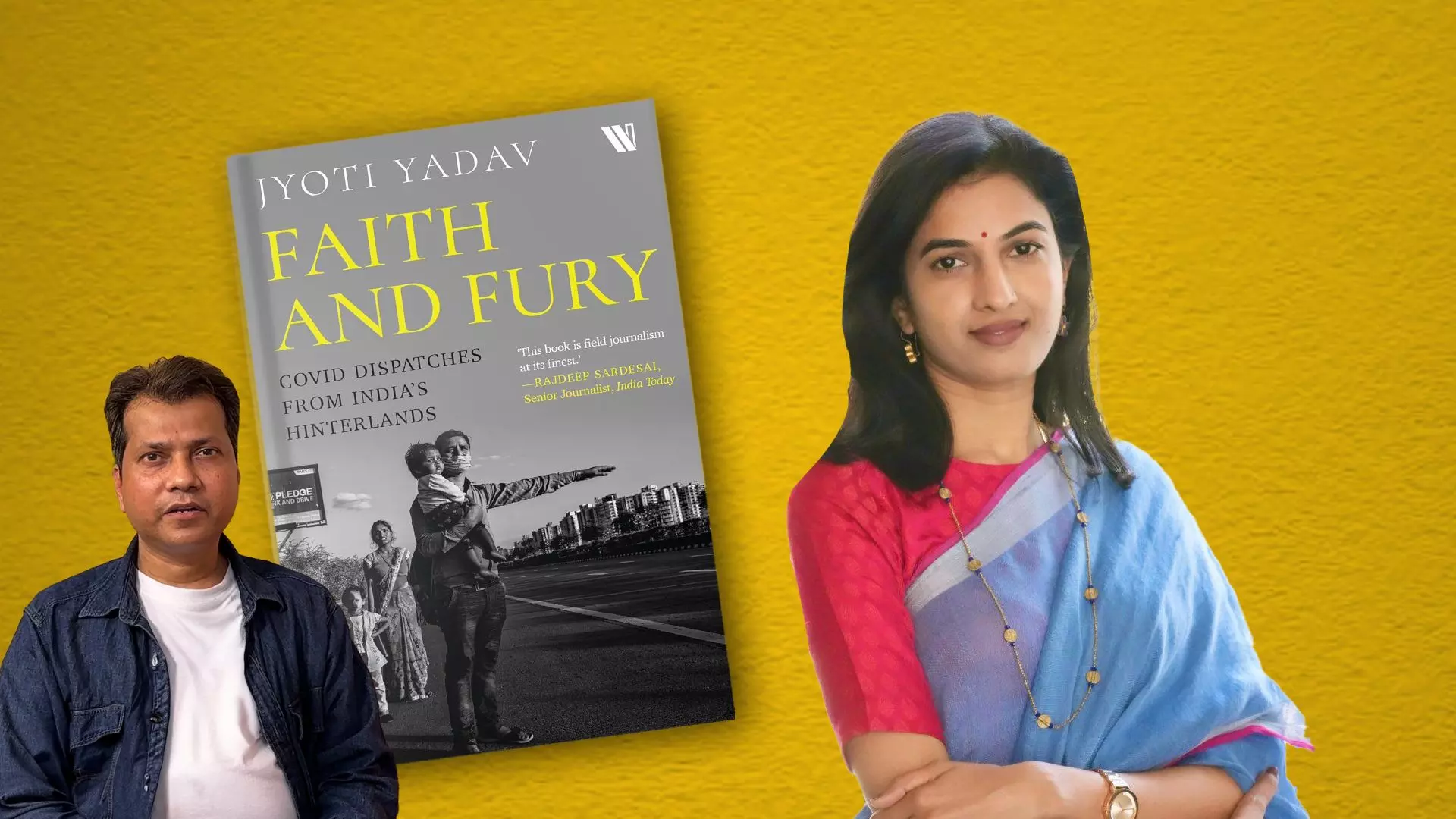
Jyoti Yadav’s Faith and Fury: COVID Dispatches from India’s Hinterland (Westland) is a powerful work of reportage that revisits one of the darkest chapters in recent history: the Covid-19 pandemic that reshaped India and the world. Beginning on 7 May 2020, Jyoti Yadav, a journalist, travelled across Uttar Pradesh and Bihar to document the first wave, the migrant worker exodus triggered by the sudden lockdown, and the collapse of public systems under extraordinary strain. Moving along highways, through villages, towns, hospitals and crematoria, she chronicled the human cost of the crisis while confronting exhaustion, illness, scorching heat, poor sanitation, unreliable data, online abuse and resistance from authorities uncomfortable with scrutiny.
When the far more devastating second wave arrived, Yadav returned to the field, gathering evidence that exposed the undercounting of deaths by several state governments. Through interviews with stranded workers, grieving families, hospital staff, local officials and ordinary citizens, the book builds a vivid account of suffering, institutional failure and the endurance people summoned in impossible circumstances. It is both a record of tragedy and a testament to the courage of those who lived through it, and of journalism that refused to look away.
Yadav is among the most respected voices in contemporary Indian reportage, especially for her ground-level writing on rural and small-town India. Raised in a village in Haryana, she broke through a patriarchal social environment to become the first in her farming family to attend university and pursue postgraduate education in Delhi. Over the past decade, particularly through her work at The Print, she has focused on social realities often ignored by metropolitan news cycles. Her reporting has earned major honours including the Ramnath Goenka Award, Journalist of the Year (IIMC), Thomson Foundation’s Young Journalist of the Year, the Statesman Award for Rural Reporting, the True Story Award, the International Press Institute Award, and the UN Laadli Media Award for three consecutive years.
In this interview to The Federal, Yadav talks about her five-year journey of documenting the human cost of COVID-19, especially among migrant workers in Uttar Pradesh and Bihar, revisiting survivors to understand long-term impacts, the emotional toll of reporting during the crisis, the ethical dilemmas faced on the ground, the importance of capturing both suffering and resilience, and the need to remember these experiences, learn from policy failures, and acknowledge that the country remains underprepared for future crises. Excerpts:
This book has been five years in the making. You hit the road on May 7, 2020, right after the lockdown hit, and drove into the UP and Bihar villages instead of staying safe in Delhi. There’s a sense of fatigue when it comes to stories about COVID-19 now but you tell the story from a human perspective. Did you want to write about people who suffered the most during one of the worst crisis since independence?
The idea emerged from my first travel during the migrant exodus. My editor Meenakshi Thakur at Westland asked me in September 2020 if I could write a book on the migrant exodus. At that time, we were only thinking about it, but then the second Covid wave struck, and it was deadly and horrifying. I am actually glad the first version of the book never took off.
When I returned from the second Covid wave and sat down with Meenakshi, we decided we needed to put faces to these statistics. Ten or twenty years later, we will have data, numbers, and visuals of Covid, but we may not have the stories of those who suffered the most.
Initially, I did not want to write about it because it was too traumatic. Writing about death after witnessing it firsthand was extremely difficult. I struggled with words. I could not use imagery or metaphors. I wrote death as death. There was no exaggeration. I wrote exactly what I saw on the ground.
From 2022 to 2024, I revisited the same villages, cities, and stories. I went back to cases like Jyoti Kumari, the cycle girl, and Harshit Srivastava, whose father live-tweeted his own death. I wanted to examine what happened to them after Covid. I am glad I did that. My editor said this is still a relevant book, and people will continue to be interested in this literature of grief.
What was the biggest difference between the first and second Covid waves for migrants in UP and Bihar?
For the working class who had left for metropolitan cities, the first wave was much harsher. During the second wave, many had already returned to their villages for Holi and were isolated there. So their suffering during the second wave was different.
The first lockdown was brutal. Migrants had to climb onto trucks loaded with iron rods and stones. They travelled on dangerous roads, and those rides were not free.
Families back in Bihar were taking loans of Rs 10,000, Rs 15,000, even Rs 20,000 at high interest rates just to send money so their family members could return home. Many of them never made it. People poured all their money into those rides. So yes, the first wave was far more brutal.
Looking back, do you think the lockdown was imposed without enough thought or empathy?
Yes. Now that we are five or six years into the lockdown, I think it is time to reflect and perhaps even launch an investigation into how such a large population was given just four or five hours to leave cities and return to villages.
In hindsight, it was a very poor decision, and it was costly for the working class.
There was no need to impose a nationwide lockdown in that way. If certain towns or districts were affected, curfews could have been imposed locally.
There is an example from Bihar where district magistrates imposed curfews when they saw rising Covid cases before fairs around Holi. They were worried that lakhs of people gathering would spread the virus.
At that time, the central government was saying this was not a health emergency and there was no need to panic. State governments questioned district officials for creating panic.
But today, I think those district officials were right. They were able to control the spread.
The state needs to learn lessons from that period.
Could the suffering have been reduced if the Centre and states had coordinated better?
Yes, but coordination was poor. Take the example of the Punjab government and the Delhi government during both Covid waves. There were constant tussles over Shramik trains, hospital admissions, oxygen supply. It became a public theatre.
Even where the same party was in power at the Centre and the state, coordination was poor. So even if governments were politically aligned, the tragedies were not prevented.
The lockdown and the migrant crisis were badly coordinated.
What did the urban-rural healthcare divide reveal during Covid?
In villages and small towns, the first line of healthcare is usually a quack — what we call a jhola-chhaap doctor (quacks). People first go there for fever or small emergencies. Then they move to the nearest PHC, then CHC, then district hospitals, and finally medical colleges or state capitals if things get worse.
If someone had mild symptoms, these local doctors could sometimes help. But if the patient became critical, they had to travel long distances.
Many people died on the road before reaching treatment.
In the case of three Covid orphans in Araria, their parents caught the virus during a public gathering in a nearby village. They went to quacks and referral hospitals, but within days both died.
If they had received treatment within one or two days, they could have survived. Mobility was a huge issue. In cities, a hospital may be 10 or 15 kilometres away. In villages, people had to travel much farther.
And many private hospitals were shut or heavily regulated. So the system existed, but it often failed the patient.
What was the hardest emotional part of reporting during the migrant exodus?
One moment from the first wave has stayed with me forever.
We were travelling alongside migrants — me, my colleague Biswajit, and our driver.
As our car moved forward, migrants walking on the road would look at us with hopeful eyes. Some had children. Some had elderly parents. They were exhausted.
There was one empty seat in the back.
Who do you help when everyone needs help?
They had no obligation to stop and speak to journalists. They were pausing in the middle of their suffering to tell us their stories.
We offered biscuits, food, whatever we could. By the end of the day, sometimes we had no biscuits left even for ourselves.
There was also fear. What if we infected them? What if we caught the virus?
People online were calling journalists vultures. We were scared of being blamed for spreading the virus.
So we would tell migrants: please keep distance, otherwise we will all be in trouble.
That emotional burden has stayed with me.
Why did you choose the title Faith and Fury?
Because both existed together. There was rage — people had lost jobs, money, dignity, and were walking home with nothing. But there was also faith. Faith in survival. Faith in people. Sometimes even faith in the system.
That faith kept people going, and honestly, it kept us journalists going too. Every story of hope made me want to stay one more day on the road. Without hope, journalism becomes a vicious cycle of despair. We need stories of resilience to rescue ourselves from hopelessness. In many ways, writing this book was also part of rescuing myself.
Did officials make it difficult to get the real Covid numbers?
Especially during crematorium reporting, yes. Officials were not forthcoming. They were not sharing statistics. But visuals from crematoriums, long queues outside testing centres, and people dying outside hospitals were telling the real story.
The problem was that without data, your reporting becomes easier to question. My editor told me: go and count the dead bodies. That is what we did.
We counted cremations. We checked local crematorium records and district data. The official Covid numbers only counted those who died inside hospitals with positive Covid certificates.
But what about people who died on the way to hospitals? Their test reports often came days later. They were cremated in Covid crematoriums, but never counted as Covid deaths.
That is how undercounting happened. Lucknow became a case study for me, but this was true across India.
Would you say this book is a deliberate stand against India’s collective amnesia about Covid?
Yes, in a way. The further we move away from Covid, the more we risk forgetting the people who suffered the most. We will remember our personal stories, but not the barefoot migrant walking home.
Covid has millions of versions. If you belonged to a marginalised community, your Covid experience was different. If you were learning ukulele in lockdown, your story was different from someone walking barefoot to Bihar. Where you were, who you were, and what you were doing shaped your Covid. This is not one story. It is millions of stories.
Are we better prepared today for another crisis like Covid?
Honestly, no. We are only a shock away. Harshit Srivastava, who lost his father during Covid, told me the same thing. His father died while tweeting his oxygen levels because hospitals refused admission. I asked him if we are better prepared today. He said, “No, I am hopeless.”
I borrow his words. When I visit the same CHCs and PHCs today, they still lack doctors and equipment. After Covid, we should have gone into mission mode. We should have built oxygen plants outside cities, hired more doctors, strengthened the public health system.
Minimum preparation should have happened. But if another crisis comes tomorrow, I am sure we will still be underprepared. The state must first acknowledge where it failed. And migrant exodus remains one of those failures.
The content above has been transcribed from video using a fine-tuned AI model. To ensure accuracy, quality, and editorial integrity, we employ a Human-In-The-Loop (HITL) process. While AI assists in creating the initial draft, our experienced editorial team carefully reviews, edits, and refines the content before publication. At The Federal, we combine the efficiency of AI with the expertise of human editors to deliver reliable and insightful journalism.