



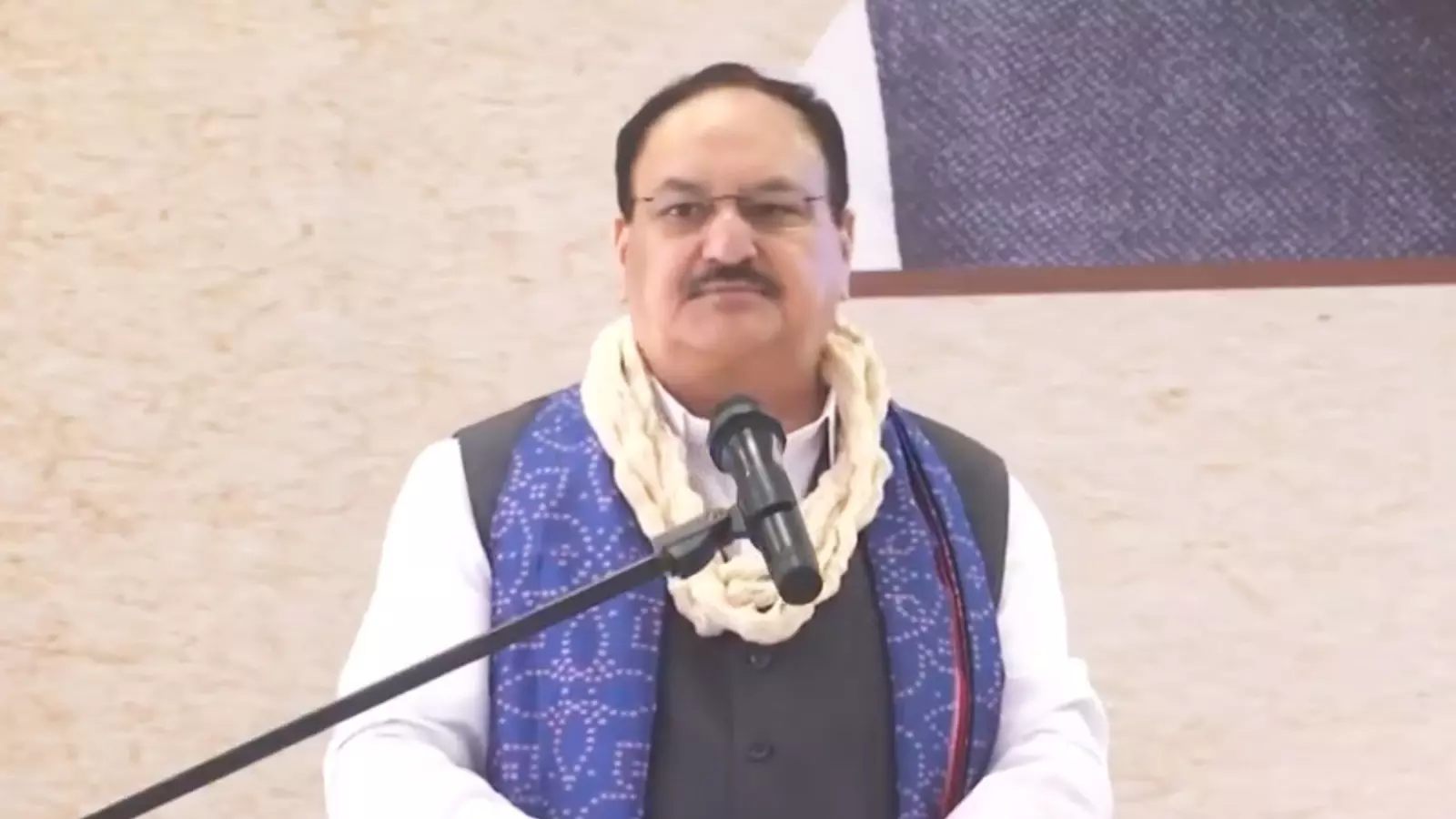
Nadda accuses Congress of trying to erase Sardar Patel's legacy; slams Nehru's J-K policy
The JP president blamed the Congress for delaying the Bharat Ratna for Patel and questioned Nehru's handling of the Jammu and Kashmir issue through Article 370

BJP president JP Nadda on Saturday (November 29) said the Congress had made considerable efforts to erase Sardar Vallabhbhai Patel from history, even questioning the cost and necessity of the Statue of Unity built by the Narendra Modi government in Patel’s honour.
JP Nadda hails Sardar Patel
Nadda, speaking at the ‘Sardar@150 Unity March’ in Atladra village in Vadodara, said the Congress did not want Sardar Patel to be remembered.
He further asserted that India’s first Prime Minister, Jawaharlal Nehru, allowed the Kashmir issue to fester through his policies, while Sardar Patel successfully integrated 562 princely states into the Union after Independence.
Also Read: Congress hits out at BJP-RSS over ‘misappropriation’ of Sardar Patel's legacy
"The Congress, through a conspiracy, deliberately made great efforts to erase Sardar Patel from history. They wanted his name to disappear so that he is not remembered. For a long time, the Congress worked to ensure the Iron Man of India is not recorded in the pages of history," he said.
Nehru’s Kashmir policy attacked
While Sardar Patel passed away in 1950, it was only in 1991 that Bharat Ratna was conferred on him, Nadda said.
"Prime Minister Modi truly remembered and paid tribute to him, in the true sense of what Sardar Patel was, what his personality was. But, when Modi decided to construct the world's tallest Statue of Unity in Gujarat's Narmada district as a tribute to Patel, the Congress raised questions about its cost," he pointed out.
"The Congress asked why so much money was being spent. And when the 182-metre statue of Sardar Patel was installed, Congress members questioned what it would accomplish," Nadda added.
Also Read: PM Modi pays tributes to Sardar Patel at Statue of Unity in Gujarat
While Sardar Patel united 562 states, the then prime minister Nehru said he would take a decision on Jammu and Kashmir, Nadda told the gathering.
"And what did he decide? Article 370 became such a nuisance to the unity and integrity of the country. Sardar Patel integrated 562 states into the country and even got Maharaja Hari Singh to sign the Instrument of Accession. Despite this, Jawaharlal Nehru imposed Article 370 (which gave special status to J-K). This tyranny was carried out by Nehru," he said.
Patel’s legacy recalled
"When we remember Sardar Patel, we should remember who worked for the unity and integrity of the country. We should also keep in mind how the work of weakening the country was done," the BJP national president said.
It is due to Modi's will power and Union Home Minister Amit Shah's policy that Article 370 was finally scrapped on August 5, 2020, Nadda said.
Also Read: Kharge reignites battle over Sardar Patel's legacy, highlights his ban on RSS
"Sardar Patel worked tirelessly to awaken the nation in new ways. We must always remember how he dedicated himself to strengthening the nation through courage, determination, commitment, and public life. He spoke little, but his actions spoke volumes; he was an extraordinary leader," Nadda said.