


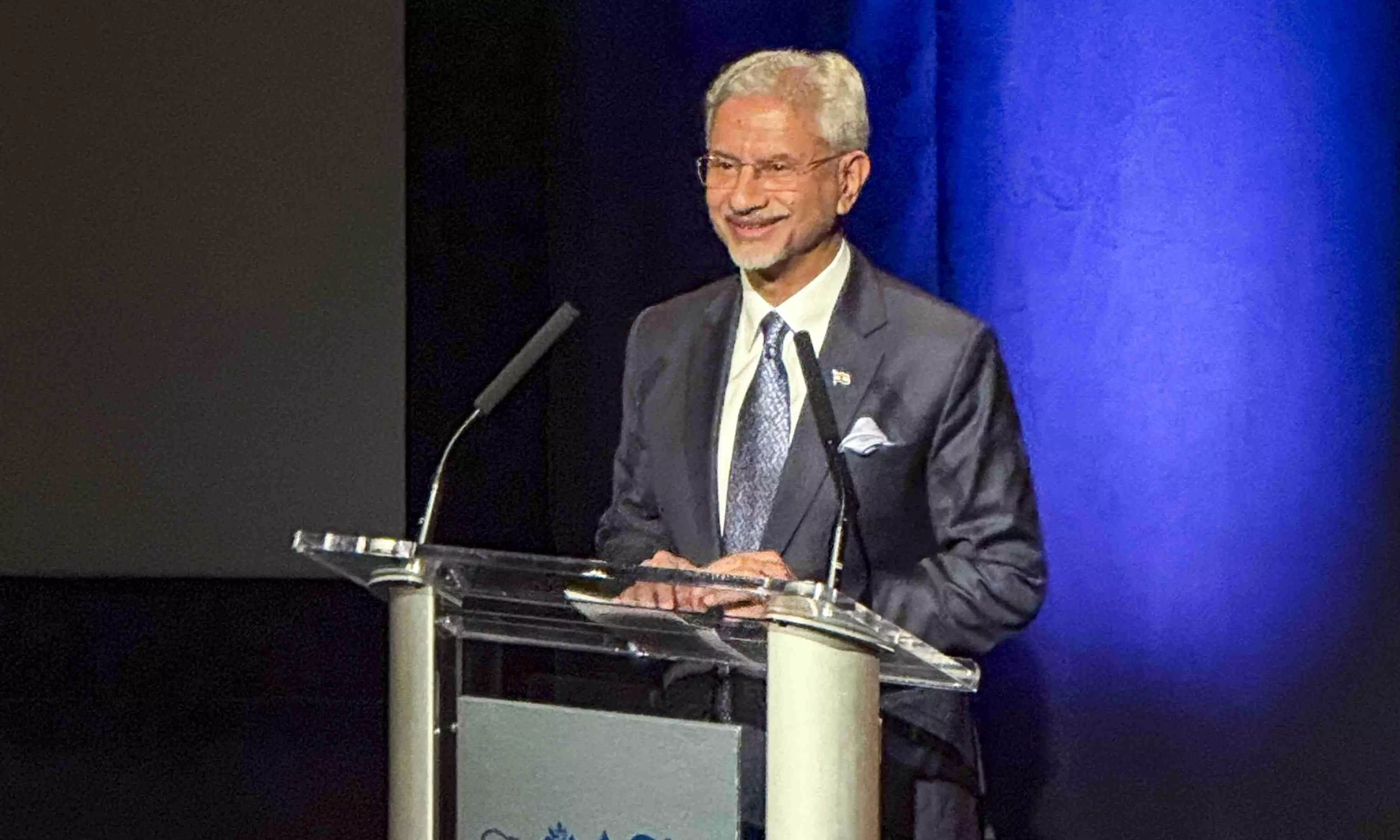
External Affairs Minister S Jaishankar speaks about the changing geopolitical environment and how the US is repositioning itself. File photo: PTI
Jaishankar details Ukraine outreach, defends Russia ties amid shifting world order
From engaging Moscow and Kyiv to navigating a ‘lonelier’ US and rising China, Jaishankar lays out India’s approach to a changing world

New Delhi, Oct 4 (PTI) India has moved beyond advocacy and stepped up its efforts in recent months for the resolution of the Ukraine conflict by engaging in conversations with both Kyiv and Moscow, External Affairs Minister S Jaishankar said on Sunday, in a first public acknowledgement of New Delhi's role in ending the lingering war.
Jaishankar's comments at an event came days after Russian President Vladimir Putin said Prime Minister Narendra Modi has "good ideas" to find a mutually acceptable solution to the conflict. Ukraine Foreign Minister Andrii Sybiha said on Friday that Kyiv received separate proposals from India and three other nations for a possible ceasefire.
Sharing some details of New Delhi's efforts, Jaishankar said it is focusing on ensuring the safety of shipping in the Black Sea as well as on grain exports and energy supplies.
For over four years, India has been consistently pushing for resolving the Ukraine conflict through dialogue and diplomacy.
"Our position on that conflict has been very clear, which is that we would like to see an end to this conflict. This will require dialogue and diplomacy. There has to be negotiations in this regard," he said at the Munich Leaders' Meeting in New Delhi.
"We have been advocating it for many years, and in recent months we have got a little bit more involved beyond advocacy. We have conversations with both Russia and Ukraine in this regard. We are trying to be helpful, starting with the Black Sea safety of shipping issue."
Jaishankar said India is "going beyond that to cover some immediate concerns which both of them (Russia and Ukraine) have on grain exports, energy exports, non-attack possibilities. Those are ongoing conversations right now".
Prime Minister Modi held wide-ranging talks with Russian President Putin in Bishkek on August 31 where he noted that the "endless war must now give way to end of war".
The external affairs minister also delved into India's historical ties with Russia. "India and Russia have historically very good relations, particularly since the 1950s. That history is not forgotten."
He said that the Soviet Union "stood by us in many ways when our security, when our territorial integrity was under threat".
"At a time when much of the world preferred backing a military regime next to us, Russia was a country with which our relations were very good and we are shaped in many ways by that legacy," he said.
Jaishankar said the engagement has significantly widened now.
"It is very much more today an economic relationship as well. There is a military component, there are nuclear components, there is space aspect, but there is a significant amount of trade and investment between the two countries and energy and resources as well," he said.
The external affairs minister also touched upon the changing geopolitical environment and how the US is repositioning itself.
"No one in the room would disagree with the fact that the landscape today is primarily marked by a radical repositioning of the United States. A repositioning which is a posture of choice," he said, suggesting that, in a way, it has "deliberately" become a "lonelier power".
"The second feature of the landscape is, of course, the rise of China. China, which sees itself as a unique country that is, in a way, both its self-perception and, in many ways, also the reality. And we are looking at very sharp competition."
"That competition today, not limited to these two countries, has led to a weaponisation of any leverage that any country has. And that competition coexists with the complexity of interdependence," Jaishankar argued.
The external affairs minister, touching upon the impact of US-China rivalry, said, "We are looking at what is often called the Goldilocks scenario."
"You don't want it to be too hot; you don't want it to be too good; you want it somewhere in between," he said.
Jaishankar said most of the emerging and middle powers are focused on diversifying and de-risking their economy, security, as well as supply chains.
"In many ways, they are working out new arrangements. They are developing agenda-based cooperation. The operating principle for emerging and middle powers should be, and perhaps is already, a reasonable degree of convergence."
"The days when you have to have an identity of views or a very strong congruence of interest, I think that's too high a bar today," he said.
"If you have enough touch points, that is good enough for countries to work together. In this process of de-risking, diversifying and hedging, slowly a new architecture is coming into place."
Jaishankar said the emerging and middle powers have an interest in strengthening their interstate cooperation, but it is also natural that they would have cooperation with both the US and China. PTI