



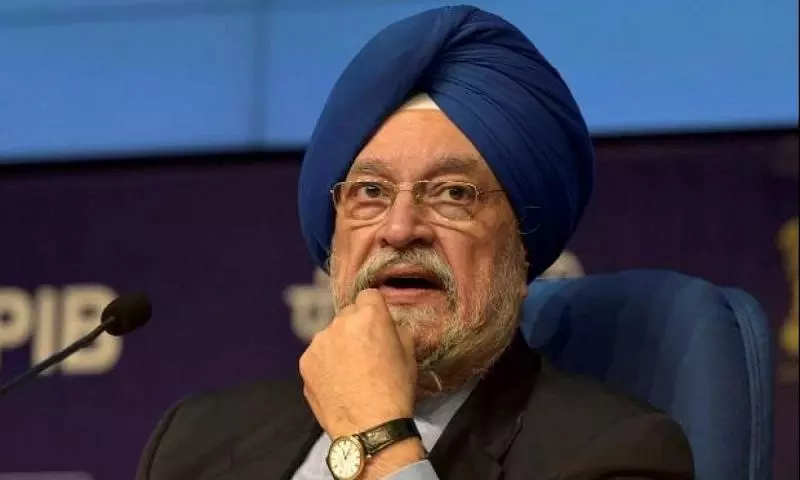
India has 76-80 days of fuel reserves, says Hardeep Singh Puri amid West Asia conflict
India holds fuel reserves sufficient for 76-80 days of consumption and faces no immediate supply risk despite West Asia tensions, Puri said

Amid the ongoing West Asia conflict that has disrupted the global fuel supply chain, Union Minister of Petroleum and Natural Gas Hardeep Singh Puri has said that India has fuel reserves adequate for 76 to 80 days of consumption.
‘No immediate supply risk’
Speaking to CNN-News 18, the Union Minister also addressed the current high fuel prices in the country, and he was hopeful that it coming down. He further stated that there was an immediate energy supply risk in the country.
Also Read: India to roll out 100 ethanol fuel stations, target 5,000 by 2027
“In the midst of all this crisis, in the midst of all this crisis, you have no dry out taking place in any part of the country, and you are still exporting,” said Puri.
“What happens if Hormuz remains closed for another 30 days? We all have domestic situations, we have stocks ... my comfort point used to be 60-60-60, which means 60 days of crude oil, natural gas and LPG - which I do have; I would say that's comfortable,” he added.
Diversifying energy imports
As for the steps taken by the Centre to deal with the situation, Puri said that it has diversified its energy imports from outside the Gulf region, adding that the supply of gas from Mozambique would play a key role in boosting energy security.
Also Read: Govt oil firms face risk of Rs 1 lakh crore loss due to high crude prices : Hardeep Singh Puri
Puri also mentioned his talks with UAE officials and ADNOC Group Chief Executive Sultan Al Jaber.
“But meanwhile, diversified supplies have also started. For instance, you know, we were very fortunate in having friends like the UAE, Sultan Jabbar called me late night, late one evening, and he said, look, you wanted, brother, you wanted more LPG cargoes; I've got them ready, send the ships,” he added.
Risks of wider conflict
However, Puri flagged the possibility of a prolonged disruption in the Strait of Hormuz or a broader regional escalation as key risks that policymakers continue to monitor.
Also Read: Indian firms ready to expand in Venezuela as New Delhi strengthens energy partnership
He stressed that the more alarming scenario would be a widening of the conflict beyond its current geography.
“On the extreme is the possibility that this might not remain a, it's very remote, nobody's talking about it, but it may remain a conflict not confined to that theater, that you know, you could have problems elsewhere; maybe some other theatre starts off, that would be worrying, that would be worrying. The second is that the trade of Hormuz remains closed,” he stated.
Global depression warning
The minister said discussions around potential outcomes often included highly unlikely but severe scenarios. Referring to one such conversation, Puri warned that a prolonged crisis could have consequences far beyond the energy sector.
“Recently, someone was discussing what is the worst-case scenario in the Iran war. Supposing the crisis goes on till March 31, 2027. I replied: ‘Wait a minute, then we are in a totally different ball game. That would be global depression,’” Puri added.