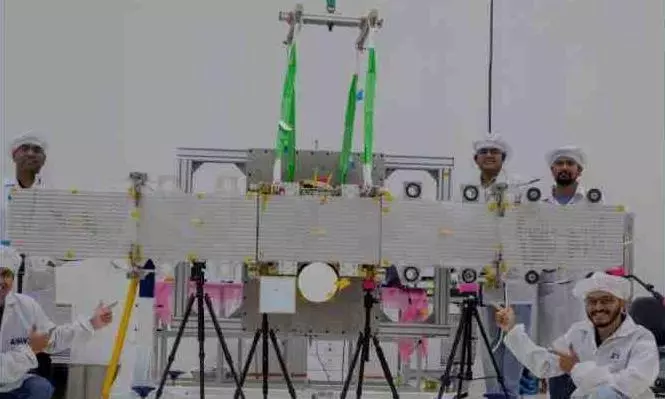
India’s 2-in-1 heaviest private satellite by GalaxEye set for May 3 launch
IIT Madras-incubated startup’s OptoSAR-enabled Drishti mission to lift off aboard SpaceX Falcon 9, marking a major step towards round-the-clock Earth observation

India’s space startup GalaxEye Space Solutions Private Ltd is gearing up for its maiden mission, with its first satellite scheduled for launch on May 3.
The 190-kg spacecraft, part of the company’s Drishti mission, will be carried into orbit aboard a Falcon 9 rocket operated by SpaceX. The launch is associated with the CAS500-2 mission to low-Earth orbit from Space Launch Complex 4E at Vandenberg Space Force Base in California.
SpaceX has indicated a primary launch opportunity on May 2, with a 37-minute window opening at 11.59 pm Pacific Time. A backup launch slot is available on May 3 within the same window.
GalaxEye co-founder and CEO Suyash Singh told The Federal, "The satellite is expected to lift off at 12.29 pm IST on May 3."
OptoSAR capability
The satellite is notable for being the heaviest spacecraft developed by an Indian private space company to date and will employ electric propulsion. It also introduces a novel “2-in-1” or OptoSAR capability, combining optical sensors with synthetic aperture radar (SAR).
This enables Earth observation in all-weather conditions, including during cloud cover and at night.
Drishti constellation of 10 satellites
This mission marks the first step in deploying the planned Drishti constellation of 10 satellites. The network aims to provide continuous global monitoring with the ability to capture high-quality imagery at any time of day.
Designed for a mission life of four to five years, the Gen-1 satellite will operate at an altitude of around 500 km, delivering imagery with a spatial resolution ranging from 1.2 to 3.6 metres. The system is expected to revisit the same location every four days.
Also Read: India’s first private orbital rocket Vikram-1 heads to launchpad in Sriharikota
The Drishti constellation addresses a long-standing limitation of conventional optical satellites, which are restricted by weather and lighting conditions. By integrating SAR with optical imaging, GalaxEye aims to deliver uninterrupted Earth observation capabilities.
Proprietary payload
The company has developed a compact, proprietary payload that houses both an X-band SAR sensor and a seven-band multispectral imager on a single thermally-stable optical bench. This design helps eliminate parallax errors at the source.
In addition, onboard and ground-based software uses artificial intelligence for sub-pixel co-registration and jitter correction, ensuring that data from both sensors is merged into a unified dataset. The system can also translate radar data into optical-like imagery for easier interpretation.
Also Read: In rare feat, ISRO’s ‘Bahubali’ injects heaviest satellite into orbit
Such capabilities are expected to benefit government agencies, defence applications, and commercial users requiring advanced geospatial intelligence.
GalaxEye has partnered with NewSpace India Limited, the commercial arm of the Indian Space Research Organisation, to distribute imagery generated by the constellation. The startup has raised approximately USD 14.5 million so far and plans to initiate its next funding round after successfully placing its first satellite in orbit.
Future plans
Looking ahead, the company is working on a second-generation satellite platform weighing around 300 kg, with the capability to deliver imagery at 0.5-metre resolution. Preliminary design work for this next phase is already underway.
Several systems developed for the first satellite are scalable to spacecraft weighing up to 500 kg, enabling cost efficiencies through component reuse in future missions.
Also Read: How ISRO-NASA’s NISAR satellite will revolutionise earth monitoring from space
While continuing to manufacture satellites in India, GalaxEye is also exploring the possibility of establishing a US subsidiary to expand its global footprint.
The company is preparing to operationalise a new facility in Bengaluru within the next six months.
Challenges faced by deep-tech startup
GalaxEye was incubated at the Indian Institute of Technology, Madras and founded by five students and alumni who previously collaborated in Team Avishkar Hyperloop.
Reflecting on the journey, Singh noted that the satellite represents more than 1,600 days of development, marked by technical challenges and persistent scepticism. He described building a deep-tech startup with limited resources as a constant struggle against both technical and financial constraints.
Also Read: India needs to triple satellites in orbit in next 3 years, says ISRO chief
The young team at GalaxEye now looks ahead with optimism, hoping their efforts will culminate in a successful launch and commissioning of their pioneering OptoSAR satellite.