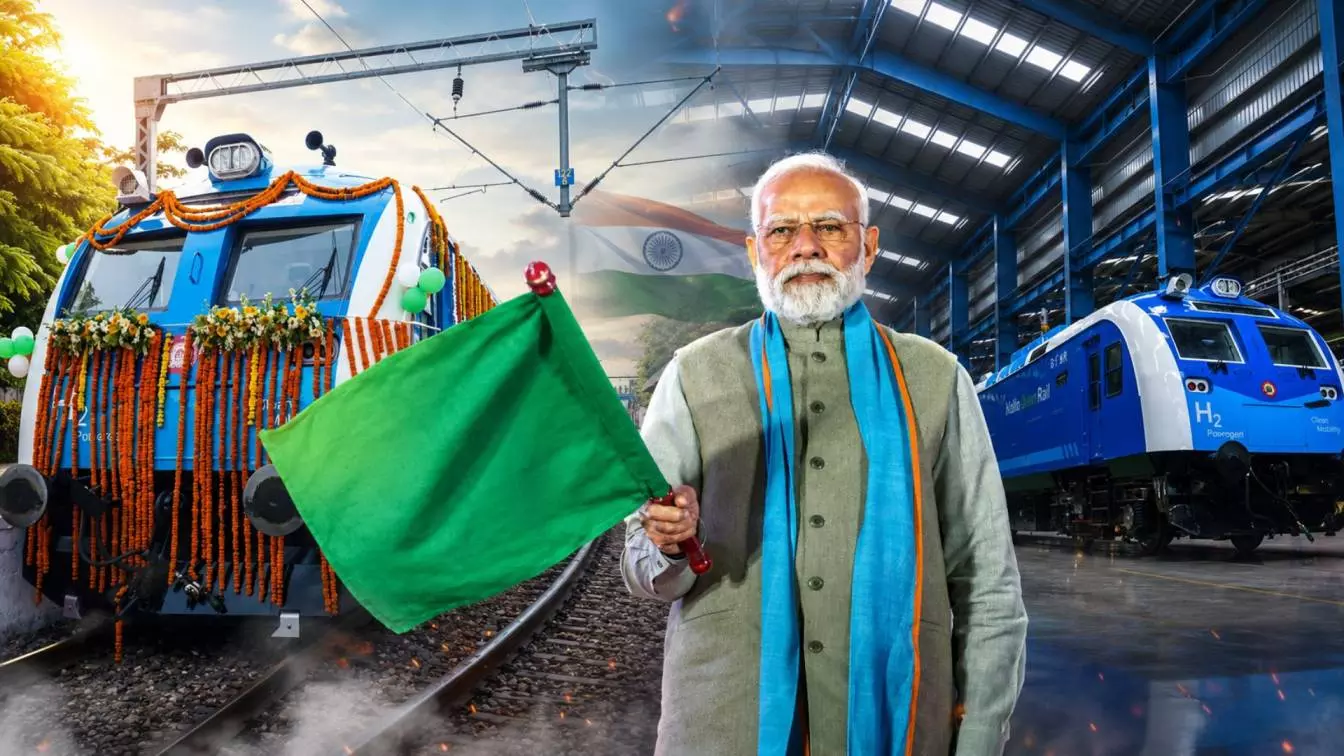
Experts note that the hydrogen-powered train project has been built at a substantial cost as a pilot initiative rather than a commercially viable service.
Can Railways switch to hydrogen-powered trains? Expert weighs in on pros, cons
India's first hydrogen train has begun operations in Haryana, but its lower speed and high costs raise questions over whether it can move beyond a pilot project

India's first hydrogen-powered train, flagged off last week on the Jind-Sonipat route in Haryana, marks a major milestone in the country's Make in India initiative and its push towards cleaner, sustainable mobility. However, even as the indigenous technology has been celebrated, experts remain divided over whether hydrogen-powered trains can emerge as a practical alternative to India's rapidly expanding electric railway network.
Science journalist TR Govindarajan described the project as an important technological achievement but questioned its long-term commercial viability. He argued that conventional electric railways are likely to remain the preferred mode of rail transport because of their significantly lower operating costs.
Also read: India's first hydrogen train: Route, all you need to know
"I don't think hydrogen fuel can become commercially viable in the next decade. Electric power, like the way we are running electric trains, is much cheaper than using hydrogen fuel. So I don't think the scope of making hydrogen the backbone of Indian Railways is anything more than a far-fetched dream," he said.
Commercial viability?
Govindarajan also pointed to the train's relatively low operating speed as another challenge. The hydrogen train has a top speed of 75 kmph, slower than the 110 kmph diesel service it has replaced on the route.
"This is an environmentally friendly technology, and that is one of its biggest advantages. But it has only just become commercially available, and its commercial viability is still unclear. It will take time before we know whether it can truly stand the test of success," he said.
Also read: India's first hydrogen train flagged off by PM Modi in Jind
He noted that the current project should be viewed as a proof of concept rather than a ready-to-scale solution.
Hydrogen storage
"The speed is relatively low because the maximum speed itself is only around 90 kilometres per hour. What is being demonstrated is that the technology is feasible. But if it has to be deployed on a larger scale, it will require substantial subsidies for hydrogen production, storage and utilisation, and each of those comes with its own set of challenges," he added.
Also read: Ex-Japanese minister blames India for bullet train delays; govt says project on track
At the same time, Govindarajan said technological advances in hydrogen storage could improve the fuel's prospects in the future. "Hydrogen is fairly pure and can be stored. Storage technology can improve further, allowing it to be utilised more efficiently. Many developments could still happen, so we have to wait and see whether this technology can eventually take us forward," he said.
Long-term success?
Although the hydrogen train currently offers one of the cheapest fares on the route, experts note that the project itself was built at a substantial cost as a pilot initiative rather than as a commercially viable service.
For now, India's first hydrogen train represents an important engineering milestone and a step towards cleaner mobility. Whether it evolves into a scalable alternative or remains a limited demonstration project will ultimately depend on its ability to match conventional railways on cost, speed, efficiency and operational scale and not merely on its environmental credentials.