



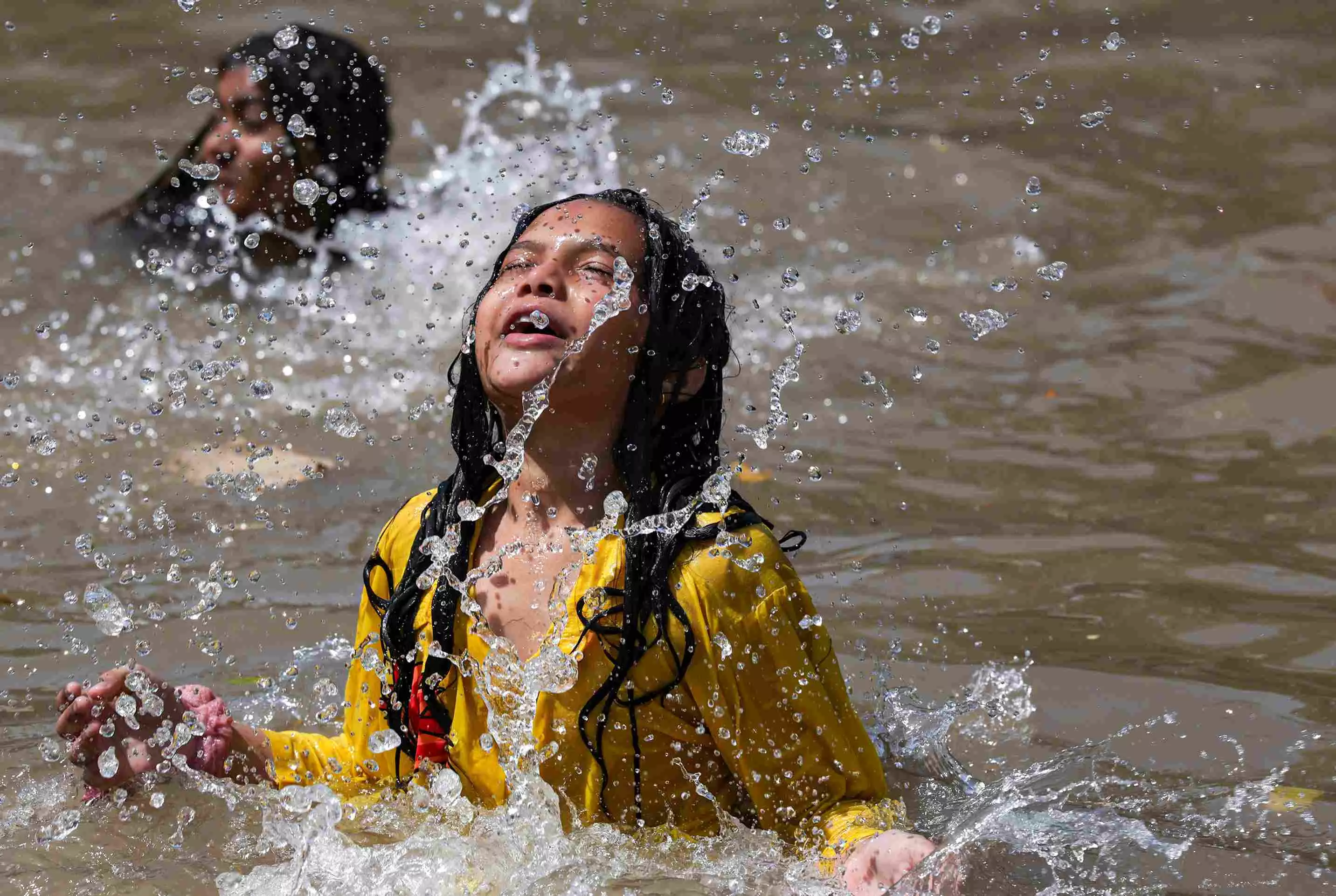
A woman beats the heat on a hot summer day, in Jammu, Jammu and Kashmir, Saturday, April 25, 2026. Photo: PTI
IMD issues advisories as heatwaves scorch north India, Kerala records high UV radiation
IMD issues urgent health advisories across states while Kerala warns of high UV radiation and rare brain infections amid spike in demand for power

The scorching heat, which has been slowly but steadily gripping northern states, showed no signs of abating, as the India Meteorological Department (IMD) released detailed guidelines and advisories on how to combat and survive heatwaves on Saturday (April 25).
Delhi logged its hottest day of the season on Saturday recording a maximum temperature at 42.8 degrees Celsius. Southern states too are not spared from the the intense heat with temperatures in Kerala hitting higher than 40 degrees. Odisha too is reeling under a heatwave.
Also read: Kerala records first suspected heatstroke death this year
What is worrying is that IMD has flagged that temperatures in several regions have been significantly above normal — by five degrees Celsius or more — indicating a developing heat stress scenario across parts of the country.
Meanwhile, India's peak power demand hit a record high of 252.07 GW on Friday following an intensifying heat wave, which pushed up the use of cooling devices like air conditioners and desert coolers, according to the latest power ministry data. The previous record high of 250 GW peak power demand was recorded in May 2024.
Heatwave conditions
Isolated areas in Jammu and Kashmir, Himachal Pradesh, Punjab, Haryana, Chandigarh, Delhi, Uttar Pradesh, Rajasthan, and central India are expected to experience heatwave conditions and warm nights, the weather office observed.
While the IMD had initially classified Friday as the season's first isolated heat wave, the MeT department later clarified on Saturday that it had been the third consecutive day of a heatwave.
IMD classifies a heatwave when at least two stations have met the required criteria.
An IMD official clarified that while Delhi had fulfilled the heatwave condition only in one station on Thursday, the two-step criteria are actually for the entire subdivision of Haryana-Chandigarh-Delhi. "On Thursday, one station, Rohtak to be specific, of Haryana and Ridge of Delhi, had satisfied heatwave criteria, thus making it the first day. Saturday was the third consecutive day of heat waves," an IMD official said.
Delhi's temperature
On Saturday, Delhi recorded its highest maximum temperature of the year so far at 42.8 degrees Celsius, marking the highest maximum temperature in the city since 2022, when it reached 43.5 degrees Celsius. The maximum temperature is expected to reach around 44 degrees Celsius on Sunday, the IMD said.
On Sunday, the capital recorded a minimum temperature of 26.2 degrees Celsius 2.4 notches below the seasonal average, according to the India Meteorological Department. The weather department has forecast partly cloudy sky with an orange alert for heatwave-like conditions at isolated places by the evening. The relative humidity in the capital was recorded at 43 per cent at 8.30 am.
Meanwhile, Delhi's notorious air quality was 'poor' at 9 am, with an Air Quality Index (AQI) reading of 223, Central Pollution Control Board (CPCB) data showed. According to the CPCB, an AQI between zero and 50 is considered 'good', 51 and 100 'satisfactory', 101 and 200 'moderate', 201 and 300 'poor', 301 and 400 'very poor', and 401 and 500 'severe'.
UP, Punjab and Rajasthan
Uttar Pradesh was left reeling from soaring temperatures as Banda logged a scorching 47.4 degrees Celsius. This was followed by Prayagraj at 45.5 degrees Celsius and Varanasi at 45 degrees Celsius.
Also read: IMD warns of above-normal heatwave days in northern, western India this year
Similar blistering conditions were witnessed in Haryana and Punjab on Saturday, with Rohtak and Faridkot baking under the sizzling conditions. Both states recorded above-normal maximum temperatures by up to six degrees.
In Punjab, Faridkot recorded a day temperature of 45.2 degrees Celsius. In Haryana's Rohtak, the mercury settled at 44.6 degrees Celsius, according to the MeT. In Rajasthan, Barmer recorded the highest temperature on Saturday, reaching 45.7 degrees Celsius, as temperatures hit sweltering levels in the state.
Odisha reels under heatwave conditions
Odisha reeled under heatwave conditions on Saturday as at least 17 places in the state recorded a maximum temperature of 40 degrees Celsius and above, officials said.
The industrial town of Jharsuguda was the hottest place in the state at 44.1 degrees Celsius, nearly 2.9 degrees Celsius above normal, followed by Titlagarh at 44 degrees Celsius, according to the evening bulletin of the Bhubaneswar Meteorological Centre.
The places which recorded temperature above 40 degrees Celsius were Bolangir (43.5), Nuapada (43), Sundergarh (42.8), Rourkela, Sambalpur and Hirakud (42.6), Bhawanipatna and Boudh (42). State capital Bhubaneswar recorded a high of 36.8 degrees Celsius, while Cuttack 36.6 degrees Celsius. The relative humidity in Bhubaneswar and Cuttack was 77 and 79, respectively.
Also read: Yellow alert in Odisha as temperature peaks at 41.7 degrees Celsius
In a forecast for Sunday, the IMD said that hot and humid conditions are very likely to prevail at isolated places over 15 districts of Balasore, Bhadrak, Jajpur, Kendrapara, Cuttack, Jagatsinghpur, Puri, Khurda, Nayagarh, Ganjam, Gajapati, Jharsuguda, Bolangir, Sambalpur and Angul.
It also forecast thunderstorms accompanied by lightning and gusty surface winds are likely to occur in the afternoon/evening hours of Sunday at one or two places over the districts of Ganjam, Gajapati, Koraput, Rayagada, Keonjhar, Mayurbhanj and Malkangiri.
Slight relief in HP, Kashmir, Jharkhand
Although Himachal Pradesh is also enduring above-normal temperatures and heatwaves, the Shimla Meteorological Office predicted a wet spell for the state from April 27 to April 30, which is expected to provide some relief. Intermittent rains in Kashmir on Saturday brought a respite from heatwave conditions, with light snowfall reported at Zojila Pass.
Following the rainfall and overcast skies, temperatures dropped to 21.2 degrees Celsius—approximately seven degrees lower than the previous day. However, Jammu remained hot, with the city recording a high of 39.5 degrees Celsius, which is 5.1 degrees above normal, officials noted.
Also read: World's heat capital: Why India is becoming the hottest place on Earth
Jharkhand, which has been reeling under intense heat, is likely to get some respite as the IMD predicted rainfall from Monday.
Daltonganj recorded the highest maximum temperature in the state on Saturday at 44.6 degrees Celsius, while Saraikela simmered at 42.6 degrees Celsius.
Jharkhand's capital Ranchi, once considered the summer capital of undivided Bihar, registered 40.8 degrees Celsius, 3.8 notches above the normal.
"Change in weather is likely from Sunday, with a forecast of cloudy weather and rain in parts of the state. Relief is expected in major parts of the st from Monday," Ranchi Meteorological Centre Deputy Director Abhishek Anand told PTI.
A worker waters plants amid heat during the summer season, in Bengaluru, Karnataka, Saturday, April 25, 2026. Photo: PTI
He said the inclement weather is likely to be caused by an upper air cyclonic circulation over east Bihar and the neighbourhood. An orange alert (be prepared) of lightning, hailstorm and gusty winds have been issued for the northeast and central parts of Jharkhand from April 26 to 28, he added.
"Due to a change in weather, the maximum temperature may drop by up to 4 degrees Celsius over the subsequent three days from Monday," he added. The weather department has advised people to stay hydrated, wear light-coloured, loose-fitting cotton clothes, and cover their heads with a cloth, hat, or umbrella when outdoors.
In Uttarakhand, too the heat is not hit in a big way as yet. Maximum and minimum temperatures hover around 39 degrees Celsius and 22 degrees Celsius, respectively. However, Pantnagar recorded a high of 40.4 degrees Celsius.
Kerala records high UV index
Southern states are also feeling the effects of the extreme weather. In Kerala, high levels of ultraviolet (UV) radiation are being reported, with maximum temperatures ranging between 37 and 40 degrees Celsius.
Chief Minister Pinarayi Vijayan held a high-level meeting on Saturday, issuing several recommendations to address the issues caused by the heatwave, including ensuring an uninterrupted power supply. Vijayan also warned of a potential increase in cases of amoebic meningoencephalitis — a rare brain infection caused by Naegleria fowleri, a "brain-eating amoeba" found in warm, freshwater sources. He advised against bathing or washing one's face in unclean water and using stagnant water sources.
Meanwhile, the Kerala State Disaster Management Authority (KSDMA) on Sunday issued a public caution advisory after high ultraviolet (UV) index levels were recorded in the state over the past 24 hours. According to data shared by KSDMA on Sunday, UV index levels above 8, denoting an orange alert, were reported at Kottarakkara in Kollam district, Konni in Pathanamthitta district, Chengannur in Alappuzha district, Changanassery in Kottayam district and Munnar in Idukki district.
Similarly, a yellow alert, corresponding to a UV index of 6-7, was reported at Kalamassery in Ernakulam district, Thrithala in Palakkad district, Ponnani in Malappuram district and Mananthavady in Wayanad district.
How UV rays harm?
Prolonged exposure to ultraviolet rays may cause sunburn, skin diseases, eye ailments and other health issues.
“High UV index levels are generally recorded between 10 am and 3 pm, and people have been advised to avoid direct exposure to sunlight for long durations during this period,” the KSDMA said.
UV rays can cause sunburn, skin disease, eye ailments
UV levels between 10 am to 3pm
Use hats, umbrellas, sunglasses
Wear cotton clothing
Those engaged in outdoor work, fishermen involved in marine and inland fishing, water transport workers, bike riders, tourists, persons with skin diseases, those with albinism, people with eye ailments, cancer patients and individuals with weakened immunity have been asked to exercise special caution, it said.
KSDMA advised the public to use hats, umbrellas and sunglasses while going outdoors during the daytime and to wear cotton clothing that fully covers the body. People have also been urged to take rest in shaded areas during breaks while travelling or engaging in outdoor activities.
The advisory noted that UV index levels are generally higher in high-altitude and tropical regions, and that clear skies without clouds can also result in elevated UV exposure.
Also read: Telangana braces for summer woes as winter retreats; IMD warns of El Nino effect
The Andhra Pradesh State Disaster Management Authority has warned of severe heatwave and heatwave conditions in several mandals across the state, with temperatures crossing the 42-degree mark in several districts.
IMD's advisory
In its guidelines, the IMD advised avoiding prolonged exposure to direct sunlight, especially during peak afternoon hours, staying adequately hydrated, wearing light and breathable clothing, and avoiding strenuous outdoor activities during high-temperature periods.
The weather body has advised special care for vulnerable groups such as children, the elderly, and individuals with pre-existing health conditions.
"The department emphasised that early awareness and preventive action are critical in reducing heat-related illnesses such as heat exhaustion and heat stroke," an IMD official said.
(With agency inputs)