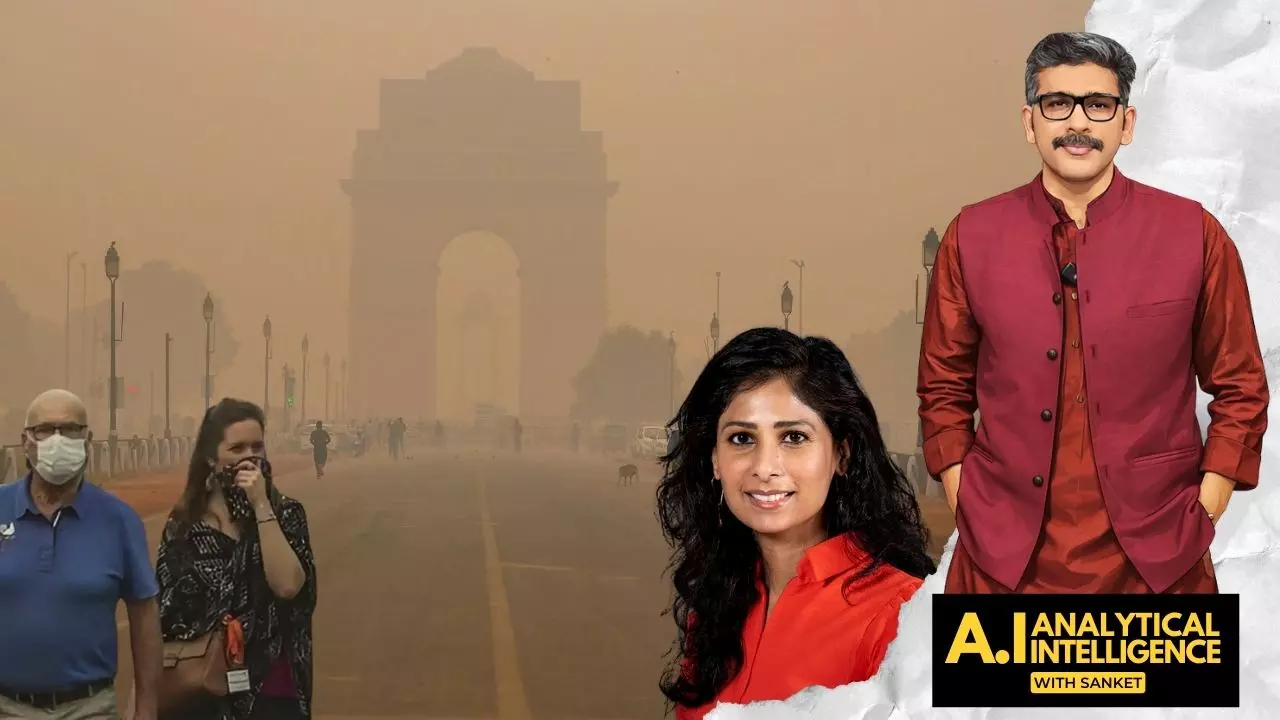
Gita Gopinath’s pollution warning to India: Will bad air hurt investments? AI With Sanket
Experts say pollution is killing lives, cutting GDP, and hurting India’s global image — can India still sell itself as an investment hub?

Air pollution in India has become a crisis that returns to public attention mainly when schools shut, offices shift to hybrid work, or winter smog peaks.
Also read: How India ‘subsidises’ the poisoning of air and water through fertilisers
But on AI with Sanket on The Federal, the discussion widened beyond episodic outrage to a larger warning delivered at the World Economic Forum's (WEF) Annual Meeting 2026 in Davos, Switzerland, by former IMF chief economist Gita Gopinath: the economic damage from pollution is “far more consequential” than the impact of tariffs imposed on India so far.
The programme placed that statement at the centre of a debate on what India is losing in GDP and lives, and why the issue still struggles to become a sustained national priority.
Also read: Chronic air pollution | Uttar Pradesh, Rajasthan top list of states: CREA study
Environmentalist Vimlendu Jha and economist Nirupama Soundararajan joined the discussion to respond to the Davos remarks, and to argue over policy intent, implementation gaps, and the political reluctance to even acknowledge mortality linked to polluted air.
Davos warning
Gopinath flagged both the annual cost to India’s GDP from pollution and the scale of deaths. She referred to a World Bank study published in 2022 and cited around 1.7 million lives lost each year due to pollution, describing it as about 18 per cent of deaths in India.
Also read: Delhi spent just 17 pc of NCAP air pollution funds in 5 years: RTI
The message was direct: India’s biggest economic risk is not tariff pressure but the sustained loss caused by polluted air, which also harms the country’s global reputation as an investment destination.
The discussion then asked whether India has treated air pollution too lightly, and whether the Davos intervention delivered the “rude shock” the country needed.
GDP and lives
Jha backed Gopinath’s core argument, saying the cost of inaction is higher than the cost of action. He pointed to estimates suggesting pollution-related GDP loss can be as high as around 9 per cent, and said that translated into roughly Rs 30 lakh crore in losses using 2022 data. He argued that even if India invested half of that amount annually into pollution control, outcomes could look very different.
On deaths, Jha said Gopinath cited the World Bank, but he referred to the Lancet for the annual mortality figure, putting it at around 17 lakh deaths a year in India due to air pollution. He also stressed that the number does not capture morbidity, and that death certificates do not list air pollution as the cause, even when it is a major underlying factor.
Jha framed this as a governance failure with global consequences: India may reach big economic milestones, he said, but it risks becoming a “sick nation” if nearly a fifth of deaths are tied to bad air.
Policy and implementation
Soundararajan agreed that the economic cost is high and said the mortality figures being discussed are not new. She said similar numbers appeared as early as 2019 in multiple studies, including studies involving government institutions and external funding support.
She referenced the National Clean Air Programme (NCAP) as a policy response aimed at reducing particulate matter — PM10 and PM2.5 — with targets that she said were set around 35 per cent by 2024 and later increased to 40 per cent by 2026. But she argued that outcomes remain mixed and uneven, and that while policies exist, the shortfall is in coordinated, consistent implementation.
Soundararajan added that pollution is structurally hard to tackle in India’s federal system because it crosses jurisdictions. She referred to the need for airshed-based approaches, and said lag periods between policy and measurable impact can be long — unless activity shuts down sharply, as seen during COVID lockdowns when air quality improved within days.
'Episodic problem' argument
Jha pushed back hard on the idea that government action has been meaningful. He listed three major governance issues:
Air pollution is treated as an October-to-January problem, when it is actually 365 days.
It is treated as a Delhi-NCR issue, when it is a wider national problem — and he said 60 per cent of India does not even measure air quality.
Solutions tend to be stopgap and seasonal.
He questioned political intent using budget and spending examples. Jha cited the NCAP allocation over six years for around 120–130 cities, calling it inadequate per city per year. He also cited an RTI-based claim related to Delhi-NCR allocations and low utilisation, saying a large share of spending went into water sprinkling, which he mocked as a superficial measure.
Jha argued that governments often shift blame across political opponents while avoiding accountability at the level required for a national health and GDP crisis. For him, the key point was not “international shame” but death and long-term systemic damage.
FDI debate
The show's anchor Sanket Upadhyay connected pollution to investor confidence, saying Gopinath’s argument was simple: who will invest and relocate to a country where polluted air can cut life expectancy and quality of life?
Soundararajan said the point is valid, but added a technical caveat: she had not seen detailed academic work directly quantifying the immediate impact of pollution on FDI flows, even if long-term correlation is likely. She argued that India should prioritise attracting investment in clean technology and solutions-oriented sectors, rather than treating FDI as a separate track from environmental repair.
Jha, however, broadened the meaning of “FDI impact” beyond capital inflows. He referred to examples of senior executives leaving Delhi due to pollution and argued that an economy cannot sell itself as a global hub if professionals avoid postings because of health risks. He also cited studies on life expectancy loss in Delhi, and said embassies and postings increasingly treat severe pollution as a high-risk condition.
Admission gap and 'bandage' fixes
The programme returned repeatedly to a central idea: the first step to fixing pollution is admitting it is a crisis of deaths and GDP loss. Sanket underlined that even rain often fails to bring AQI down dramatically, using the day’s AQI readings as an example of how entrenched the problem has become.
The closing argument echoed the show’s theme: India may pursue global investment showcases and economic targets, but without sustained action on pollution, the country risks both health and economic decline. Sanket summed up Gopinath’s warning as: pollution is the bigger problem than tariffs, and India cannot pretend the world does not see it.
(The content above has been transcribed from video using a fine-tuned AI model. To ensure accuracy, quality, and editorial integrity, we employ a Human-In-The-Loop (HITL) process. While AI assists in creating the initial draft, our experienced editorial team carefully reviews, edits, and refines the content before publication. At The Federal, we combine the efficiency of AI with the expertise of human editors to deliver reliable and insightful journalism.)