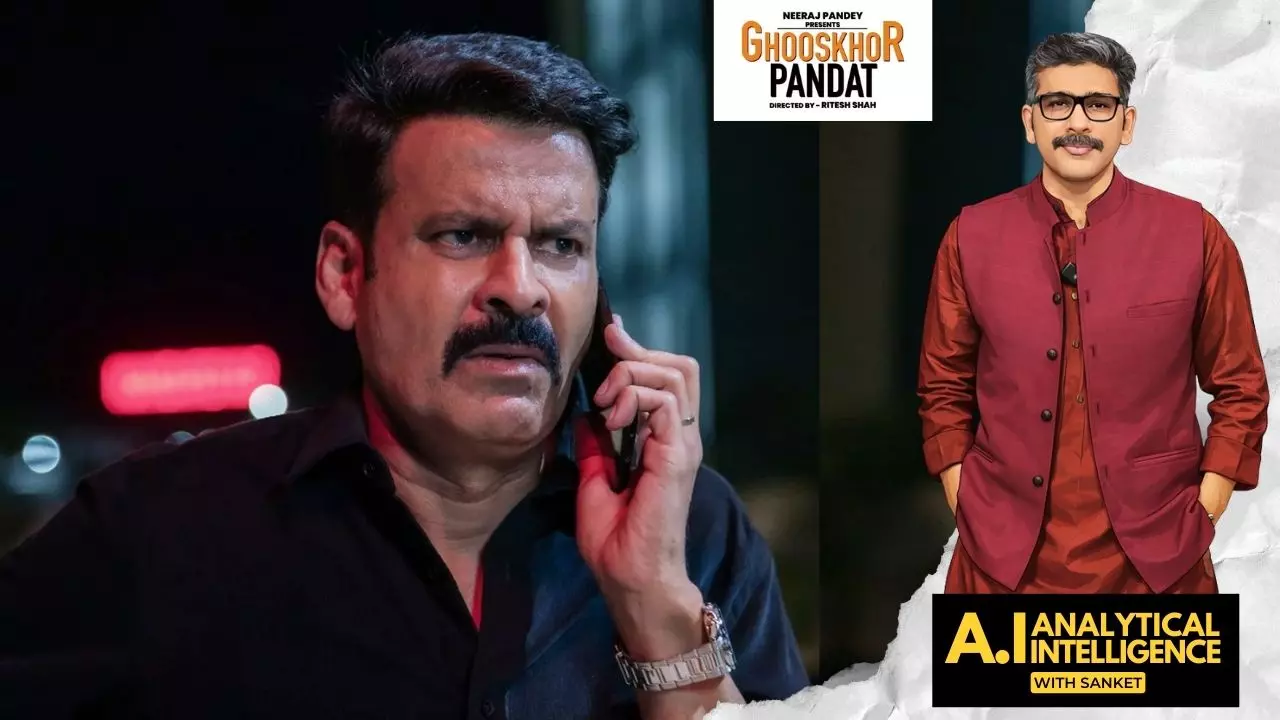
AI With Sanket | ‘Ghooskhor Pandat’ row: Genuine grievance or heckler’s veto?
A Delhi High Court plea calls the title of Hindi film ‘Ghooskhor Pandat’ defamatory, while critics call it a heckler’s veto. Where does creative freedom end?

A proposed film title, Ghooskhor Pandat, has triggered a legal challenge and a wider debate on caste sensitivity, creative freedom, and the growing use of courts to contest cultural expression.
The controversy centres on whether the term “Pandit”, when paired with “ghooskhor” (corrupt), amounts to a caste slur against Brahmins or is being misread beyond its dictionary meaning.
The Federal spoke to Vineet Jindal, advocate and petitioner in the case, and Girish Wankhade, film trade analyst, on a panel discussion examining whether the row reflects genuine grievance or a larger trend of what critics call a “heckler’s veto” shaping Indian cinema.
The dispute has emerged around a Netflix-commissioned film associated with filmmaker Neeraj Pandey, even before audiences have seen its content. With the petition listed before the Delhi High Court, the case has reopened questions around OTT regulation, artistic intent, and the threshold for legal intervention.
The legal objection
Vineet Jindal, who has moved the Delhi High Court, said his primary objection lies with the use of the word “Pandit” alongside “ghooskhor,” which he described as defamatory. According to him, attaching a term meaning “corrupt” to a word commonly used as a respectful address risks portraying an entire community in a negative light.
Jindal argued that the concern is not limited to semantics but extends to the absence of prior content certification for OTT platforms. Unlike theatrical releases, films released online do not require clearance from the Central Board of Film Certification, allowing content to reach viewers without regulatory scrutiny.
Also read: ‘Ghooskhor Pandat’ row: The heckler’s veto and test of India’s democracy
He said the petition seeks judicial intervention precisely because the title itself raises questions about the nature of the content. In his view, verification should precede release to ensure that no community is targeted or defamed.
Meaning of “Pandit”
The discussion turned to whether “Pandit” is intrinsically a caste marker. Dictionaries in both English and Hindi define the term as a scholar, a learned person, or someone proficient in scriptures, music, or philosophy. The definition does not explicitly equate the word with Brahmins.
Girish Wankhade supported this reading, arguing that “Pandit” is used widely as a surname, an honorific, and even as slang, without necessarily denoting caste. He pointed out that Indian cinema has historically used similar constructions, citing the 1975 film Ponga Pandit, which did not provoke comparable outrage at the time.
Also read: Ghooskhor Pandat: Why row over Neeraj Pandey-backed Manoj Bajpayee cop drama is a non-issue
Wankhade said assuming malicious intent without viewing the film reflects rising social intolerance. He described the character in question as a corrupt police officer and argued that the name could simply be a nickname or surname, not a commentary on an entire community.
Sensitivity and cinema
According to Wankhade, the current climate encourages audiences to judge films based on titles and promotional material rather than content. He noted that over the past decade, filmmakers have increasingly altered titles or scenes following protests, even before release.
He argued that filmmakers today operate in an environment where every creative decision is scrutinised through identity lenses. This, he said, has made the industry risk-averse, with producers prioritising commercial safety over artistic expression.
Wankhade also stressed that filmmakers like Neeraj Pandey, Manoj Vajpayee, and Ritesh Shah are established professionals unlikely to court controversy deliberately. As a commissioned Netflix project, he said, the film would have undergone internal scrutiny, particularly given the platform’s sensitivity to global markets.
OTT regulation debate
Jindal repeatedly returned to the issue of OTT oversight, arguing that online platforms allow content to bypass checks applicable to theatrical releases. He cited earlier petitions and Supreme Court observations calling for clearer regulatory frameworks for streaming platforms.
Also read: AI with Sanket | ‘Threat’ to Modi in Lok Sabha a security breach or evasion excuse?
In his view, the choice of OTT release heightens the need for caution, as content can reach international audiences instantly. He maintained that his legal action focuses on regulatory gaps rather than suppressing creativity.
Wankhade countered this by explaining that release format decisions are commercial, not ideological. He said OTT commissions are planned at the inception stage and have no bearing on a filmmaker’s intent to provoke or malign.
Heckler’s veto concern
The panel examined whether such controversies reflect a broader pattern of what is termed a “heckler’s veto” — where loud objections lead creators to alter or withdraw content. Wankhade argued that this phenomenon has become routine, citing examples from Padmavat to more recent OTT titles.
He said that production houses increasingly concede to pressure to avoid financial risk, eroding creative freedom. According to him, this trend is not confined to any one community and reflects a wider culture of offence-taking.
Jindal disagreed with the characterisation, saying public empowerment to raise objections is not inherently negative. He maintained that legal recourse is appropriate when creative choices cross into defamation or discrimination.
Discrimination debate
The discussion also touched on comparisons with caste-based discrimination faced by marginalised communities. The host noted that while individuals from upper castes may feel targeted in specific instances, systemic discrimination continues to affect SC, ST, and OBC communities as a class.
Also read: Ghaziabad teen deaths: What will stop the next tragedy? | AI with Sanket
Jindal responded by stating that discrimination can occur against anyone and should not be viewed as exclusive to particular groups. He rejected suggestions that his petition was part of a broader political mobilisation, framing it instead as a legal challenge to a specific title.
Awaiting judicial view
As the matter heads to court, both panellists agreed that judicial scrutiny will determine whether the petition merits consideration or is deemed premature. The outcome could set precedents not just for this film but for how titles and content are challenged in the OTT era.
The debate underscored the tension between artistic freedom and community sensitivity in contemporary India, with courts increasingly being asked to arbitrate cultural disputes before audiences even see the work in question.
(The content above has been transcribed from video using a fine-tuned AI model. To ensure accuracy, quality, and editorial integrity, we employ a Human-In-The-Loop (HITL) process. While AI assists in creating the initial draft, our experienced editorial team carefully reviews, edits, and refines the content before publication. At The Federal, we combine the efficiency of AI with the expertise of human editors to deliver reliable and insightful journalism.)