



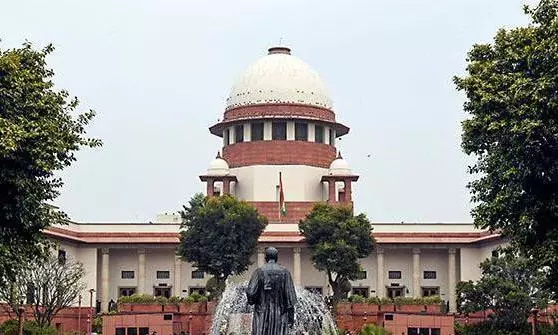
Domestic abuse persists not as aberration but as indication of disease-afflicted social order: SC
The apex court said India has experienced significant economic growth, rising literacy and increased participation of women in education and workforce, yet patriarchy remains a facet of everyday life in rural and semi-urban scenarios

New Delhi, Apr 4 (PTI) Practices like domestic abuse persist not as aberrations but as indications of a "disease-afflicted social order" and empirical data of crimes against women in the country presents a "sobering picture", the Supreme Court has said.
The apex court said India has experienced significant economic growth, rising literacy and increased participation of women in education and workforce, yet patriarchy remains a facet of everyday life in rural and semi-urban scenarios.
The observations came from a bench of justices Sanjay Karol and N Kotiswar Singh which upheld the conviction and life sentence awarded to a man for killing his wife by setting her ablaze in October 2012.
The bench said the Constitution promises equality, non-discrimination on the basis of sex and the right to life and liberty amongst others but such cases demonstrate that even after so many years, rights enshrined in the founding charter were still elusive for many.
It said parallel to legal reform, the State has invested in welfare and social transformation schemes and programmes such as 'Beti Bachao, Beti Padhao' are aimed at correcting gender imbalances and improving girls education, while initiatives like 'Sukanya Samriddhi Yojana' and 'Ujjwala Yojana' aim to enhance financial security and improve living conditions for women.
"Yet, despite this sustained intervention from different branches of government, empirical data shows that all is not well. It presents a sobering picture indeed. As per the National Crime Records Bureau, more than 4.48 lakh crimes against women were recorded in 2023," the bench said.
"Dowry-related violence continues to claim over 6,000 lives annually, revealing the persistence of practices that have long been outlawed," the top court said in its April 2 verdict.
It said complaints before the National Commission for Women also consistently show domestic violence as one of the most reported grievances.
The bench observed what makes this reality particularly troubling is the context in which it exists.
"India has experienced significant economic growth, rising literacy, and increased participation of women in education and the workforce. Gender roles do not apply strictly anymore in many urban areas. One cannot assume that all house-hold related work falls to the woman, whereas it is only the male who is tasked with bread winning," it said.
"Yet, in rural and semi-urban scenarios, patriarchy remains a facet of everyday life. Authority within the household is still overwhelmingly male, and women's autonomy is often conditional and constrained," it said.
The bench noted that even if the woman earns, it would still be expected of her that she would set the house right before leaving for work, and busily engage herself in similar work including preparation of meals, when she returns from work.
"The coexistence of progress and violence signals to a paradox. Legal and economic advancements are visible on a macro-level, but patriarchy still permeates the everyday," it said.
It said dowry is outlawed and has been for decades but the social legitimacy that sustains it is yet to be dismantled.
The bench observed that welfare schemes can incentivise education, but cannot alter long-held beliefs about women's roles within marriage and family.
"As a result, practices such as domestic abuse or even extreme acts like burning a wife (such as in this case) persist not as aberrations, but as indications of a disease-afflicted social order," it said.
The bench said, "After decades of laws, schemes, reforms, and judicial recognition of equality across workplaces, homes, personal relationships, and even the armed forces, why does the control over women's bodies, choices, and lives still persist so deeply within society? Perhaps, the answer lies only with 'We, the People of India'".
Dealing with the appeal filed by the man challenging his conviction in the case, the bench noted the courts below had relied on the dying declaration of the deceased.
"Generally speaking, these declarations enjoy a special position given the timing and the nature thereof. This position rests on a philosophical understanding that when a person is about to meet his maker or in other words the oncoming of death and its finality is imminent, considerations which may force a person to speak other than the truth pale into insignificance and what does fall from them would, therefore, be only the truth," it said.
The bench said they are exceptions to the rule of hearsay and if a court finds them consistent, believable and free of tutoring, it can convict the person named in it. PTI