







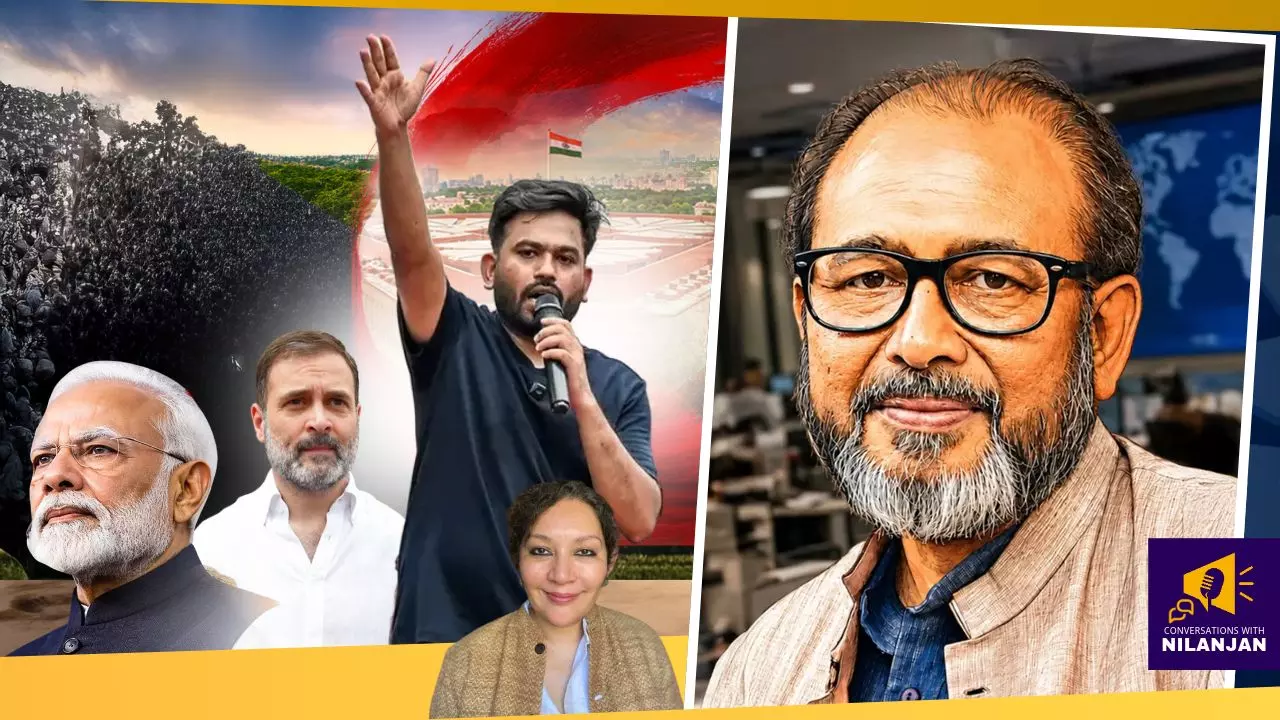
CJP, election exposes have dented Modi's political dominance: Saba Naqvi
Naqvi says the CJP's emergence and revelations about electoral anomalies have weakened the government's grip on the political narrative, while the BJP faces a succession question

The genie is out of the bottle, and there is no putting it back. A generational shift in the politicisation of Indian politics is underway, even as the government appears to be losing its grip on setting the national agenda.
With major state elections approaching and debates over delimitation and leadership succession gaining ground, political alignments across the country are shifting rapidly. Against this backdrop, The Federal’s Nilanjan Mukhopadhyay spoke to veteran author and journalist Saba Naqvi to decode these developments and examine what lies ahead.
Edited excerpts:
The CJP appears to be shifting from street agitation to seeking broader institutional accountability through programmes such as those held on Constitution Day. Where do you see this movement heading, particularly given its stated disinterest in electoral politics?
Having spoken to some of them, elections are not in the frame, but becoming a political influencer is very much on the cards, not in terms of choosing a party, but in terms of setting an agenda for the country. They do see themselves as having a role in that, and they did have a role in the movement; we must accept that.
Also read | Modi’s Constitution Day op-ed: PM rakes up Emergency, flays Congress, pats NDA on the back
If you recall the events in May, when the election results in Bengal came, the bandobast under which the voting took place, everything, it seemed there was no room for the Opposition at all. At that time, I thought elections had become pointless.
And then suddenly an odd sequence of events begins. Abhijeet Dipke is sitting in the US, he makes a meme, he makes a cockroach, and 20 days later, an odd series of events gets triggered. It is absolutely like a tsunami or a dam burst in Delhi, and they kicked open the political space which was closed. They were not an opposition party, so now it's up to others to go along with that.
Some people have said the cockroach is over, the cockroach is finished. But I do believe some errors were made in signing some bonds and all of that, partly because of poor legal advice and their own folly. However, they also have a certain connect, which I think can be used again. I think it's like an energy now. They have shown the energy. I don't think it's over.
I think they can be setting an agenda for young people, especially at a time when there are so many gaps in meaningful agenda setting in our politics. Anything which is able to break the chains, as it were, is good for democracy, good for young people, and a generation which we thought was just going to look at their phones and not engage. About that, I am hopeful that they will be for good.
Rahul Gandhi appears to have undergone a significant political transformation since the Bharat Jodo Yatra, particularly over the past three months. How do you assess his evolution since 2004, and can his growing resonance with people translate into electoral support?
Let's look at the last few weeks. Look at how much Rahul Gandhi has managed to be in the news. The whole Gandhi family—Sonia Gandhi's bestselling book, which I have read, perpetuates the dynasty to such an extent that she comes across as a fierce protector of it. It's not a critique; it's an observation that, at the end of the day, more than being her personal love story, it's also the story of her family. What I find notable is that while an elected person should say my people are important, Indian politics is really just full of this focus on family.
Within that framework, yes, I do think Rahul Gandhi is doing much, much better than he used to. What is also important is that he is able to control the generation of news, willfully or otherwise. It is all about him, his mother, his remarks at her book launch, and then his trip to the US, where he said things that again kept him constantly in the news cycle.
I don't agree with everything he says, but yes, he is certainly gaining traction. Ultimately, if you ask me what I think is his greatest weakness, it is that he does not talk to others in the opposition. I know this as a reporter: you can't get the phone to him, they can't get through and talk to him. If you talk to other parties, they will tell you about the problem they have in accessing him. They even sit next to him and he doesn't speak much to them.
This is a huge disadvantage, and some of them, especially the Hindi belt leaders, don't like it. They are used to a casual sort of style. This lack of direct communication is going to be a hindrance, but let's hope he overcomes it. He is definitely much better, and he's in the news cycle in a positive way. His social media is getting traction, and in South India he always had a better rating than he did in the North, I imagine.
Since 2014, Narendra Modi has largely dictated the political agenda. But with the rise of the CJP and questions surrounding the Election Commission and electoral rolls, has he lost that ability, at least for now? How might this affect the government's push for delimitation?
There is no doubt that Narendra Modi is not setting the agenda now. You give me the realm in which positive stories have come. Even in the United States, the tariffs and the terms being imposed on India reflect on him and the mythology and ambition of a leader. If you are being treated worse than China and punished for buying oil from Russia, which is in your national interest, there is definitely a loss of face. Something is wrong with the way India has been treated by the American establishment, and some of it does indeed come from this loss of stature.
Whatever the reasons are, we are just not in a good place and we are not getting a good deal from the world. We have also messed up our standing on the two major conflicts in the world, Russia versus Ukraine and Israel's assault on Gaza after the Hamas attack. Condemning Hamas was one thing, but the continuing, endless assault in Gaza is something which needs to be condemned, which the government has not done.
Within the country, as far as national politics is concerned, it's not just the cockroach movement. Another thing that's happened is the SIR and the whole careful choice of Gyanesh Kumar, and the change in the laws to keep the fourth person out of the decision on choosing the Election Commission. So if you have lost the entire narrative because everybody is saying you are cheating your way to defeating other people, how will you overcome that?
In Modi's case, it's not just the CJP's movement; it's the exposes on the Election Commission, the alleged rigging of elections and the loss of credibility of Indian elections. These are two things.
So all that they're doing now is using intimidation, money, everything to somehow get a delimitation exercise passed so that they can curate constituencies like they did in Kashmir and Assam, at the state level and beyond that.
As India moves into 2027, do you think this will be the year when the question of 'after Modi, who?' enters mainstream political discourse?
Yes, I think it's already happening. Everybody is consumed by it, including the BJP. Nobody knows what will happen, and the reason is not just a question of leadership or which of the four faces will win on the ground. It's not that simple.
Each one has a shadow game behind them: big corporations behind one, a sort of Hindu thought well behind another, and then the third one. As you said to me in our phone conversation, which was very insightful, when I asked whether Amit Shah could become prime minister, Amit Shah and Modi are almost like two sides of the same coin. I have not found any evidence to suggest that they are not together.
Also read | Modi vows nothing can stop Nari Shakti from entering Parliament, state assemblies
In that case, as Modi gets older, he also appears fitter, while Amit Shah is older. Would Modi simply want Amit Shah to succeed him so that the existing arrangement continues? Amit Shah is the least charismatic of all of them, let's face it. Yogi Adityanath has carved out a niche for himself through his emphasis on law and order and his speeches and remarks about Muslims. Devendra Fadnavis operates at a different, more sophisticated level as the RSS's candidate for the future. If a change does come about immediately, Nitin Gadkari could emerge as the dark horse because he is the closest to Nagpur. But we are getting into the realm of possibilities here; we really do not know.
Watch full interview here: