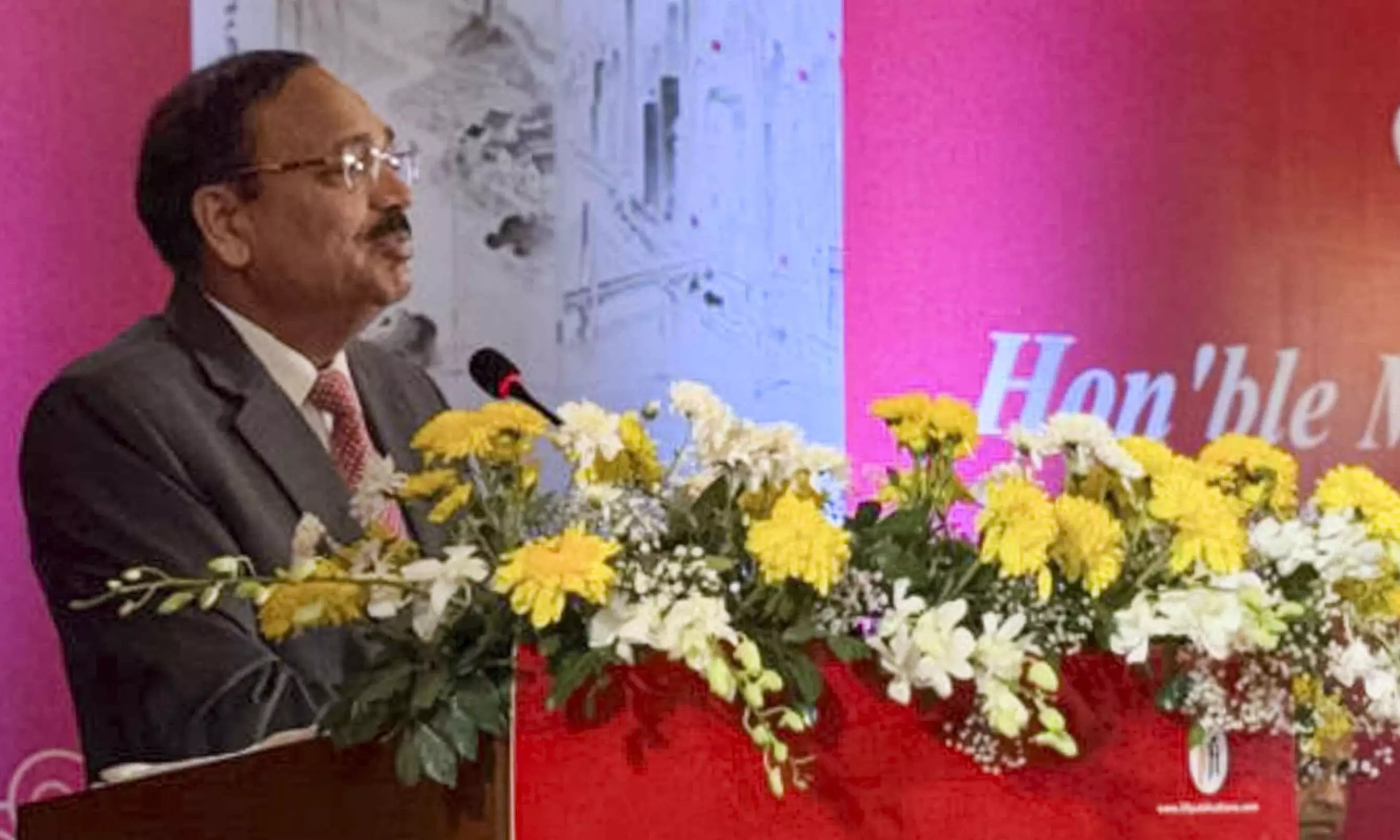
Chief Justice of India Surya Kant said law schools must evolve their assessment methods to ensure that students demonstrate their own understanding. File photo: PTI
AI should assist law students, not substitute their reasoning: CJI
CJI calls for clear rules on AI use, more oral assessments and cautions against relying solely on AI-detection software

Chief Justice of India (CJI) Justice Surya Kant has cautioned law schools against allowing artificial intelligence (AI) to undermine academic integrity, asserting that technology should assist students in learning rather than substitute their own reasoning and understanding of law.
Addressing the inaugural session of the first annual international conference on legal education organised by the Commonwealth Legal Education Association (CLEA) at Novotel, Hyderabad, on Saturday (November 21), the CJI said law schools must evolve their assessment methods to ensure that students demonstrate their own understanding, even as they adapt to the growing use of generative AI in the legal profession.
"The question, therefore, is no longer whether students will use these tools, but whether the work they submit still reflects their own reasoning, understanding, and appreciation for the law," he said.
Responsible use of AI
Rejecting a blanket prohibition on AI tools, Justice Surya Kant said such an approach would neither be practical nor wise, as students would enter a profession that was already using them. Instead, institutions should set clear rules for their use and teach students to adopt the technology responsibly.
Also read: Karnataka’s AI push: Should students give up third language?
He also issued a strong warning against relying solely on AI-detection software to establish academic misconduct. Citing a 2023 study that found widely used detectors wrongly flagged more than three in every five essays written by non-native English speakers as machine-generated, he said no student should be held guilty of misconduct on the word of a machine alone.
The CJI suggested that written assessments be supplemented by oral explanations, defence of legal authorities relied upon and exercises requiring students to identify errors in machine-generated answers.
Bridging theory and practice
Emphasising the need to bridge the gap between classroom learning and courtroom practice, he advocated integrating clinical legal education into core law subjects rather than confining practical training to separate courses. Students studying contract law could draft and negotiate agreements, while those pursuing constitutional law could trace denied entitlements to available remedies and family law students could participate in mediation exercises, he suggested.
Justice Surya Kant also proposed making a minimum period of legal aid work compulsory for law students to graduate. Legal aid clinics should become centres of continuing education, bringing together students, panel advocates and legal services officers for regular case discussions and practical learning, he said.
Also read: Why Indian graduate students cannot afford to boo at AI
Calling for greater reliability in legal research, the CJI favoured developing a common minimum citation framework across Commonwealth jurisdictions, without replacing their existing citation systems. He also urged CLEA to develop model guidelines on disclosure of AI assistance in legal research, which law schools and journals could adapt.
Professional preparedness
Supreme Court judge Justice PS Narasimha said AI would bring significant changes to the legal field and that both lawyers and law students should prepare themselves for the emerging legal ecosystem.
Solicitor General of India Tushar Mehta stressed the need to prepare Indian lawyers to compete in international legal forums as cross-border disputes increasingly involve international treaties, arbitration and multiple jurisdictions. With foreign lawyers permitted to practise foreign and international law in India subject to reciprocity, Indian lawyers must also equip themselves to compete abroad, he said.
Emphasising professional integrity, Mehta said the credibility of an advocate was built over a lifetime and could be lost through a single careless sentence. He also called for greater involvement of practising lawyers in law school teaching and for students to gain practical experience in chambers, tribunals and litigation.
Telangana Acting Chief Justice P Sam Koshy said law schools must transform themselves from institutions of instruction into institutions of intellectual inquiry, critical thinking and practical engagement. A lawyer cannot outsource professional judgment to an algorithm, just as a judge cannot surrender adjudication to a machine, he observed.
He stressed the importance of clinical legal education, legal aid programmes, moot courts, negotiation exercises, mediation training and internships, saying students must experience the realities of the justice delivery system before entering professional life.
Common citation framework
Supreme Court judge Justice Aparesh Kumar Singh, chairing a session on uniform citation for the Commonwealth, emphasised the need for a common framework to identify, locate and verify legal authorities across jurisdictions. He said harmonisation should not be confused with homogenisation and that different legal systems should retain their established citation practices.
Also read: Meet Vikas and Anuradha Sinha, who gifted $20 million to US varsity for AI project
He also cautioned that AI could generate convincing but fictitious legal references, making verification of every authority the responsibility of lawyers and researchers. Open access to judgments and primary legal materials was equally important to ensure that smaller and less-resourced jurisdictions were not marginalised, he said.
The two-day conference, held under the theme 'Globalising Legal Education: Reimagining Law Schools, Legal Learning and the Future of the Legal Profession for a Commonwealth in Transition,' brought together judges, legal scholars, academicians and delegates from across Commonwealth jurisdictions.