



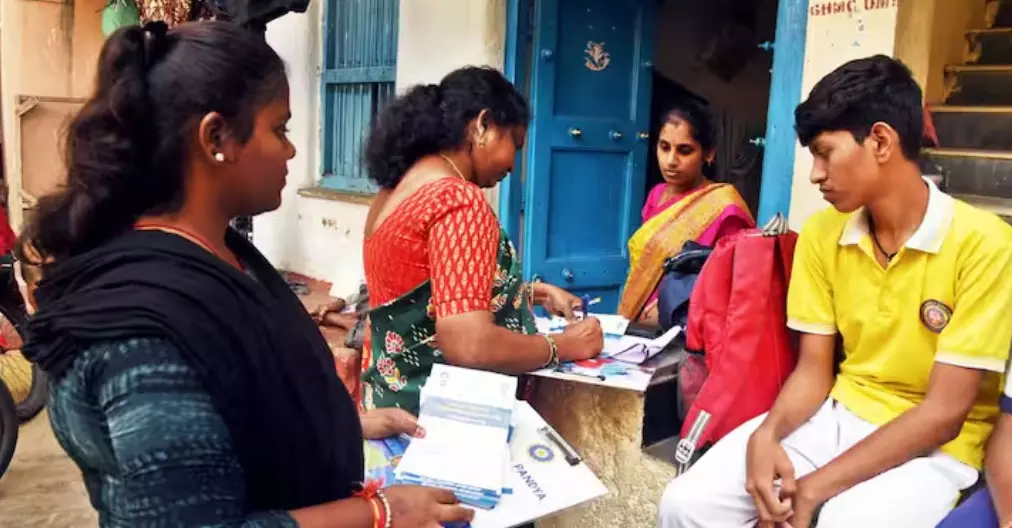
Census 2027: Online self-reporting, mobile apps, and what it means for households
Census 2027 will include online self-enumeration, app-based surveys, and updated household classifications in a major digital shift.

The 2027 Census is being framed as both a continuation and a departure. The structure-two phases, nationwide enumeration, a fixed reference date-remains intact. The method, however, is shifting, with digital systems now built into nearly every step of the process.
A parallel, online route to enumeration
For the first time, respondents will have the option to submit their Census details online before an enumerator visits. The self-enumeration system allows individuals to log in, complete the schedule, and generate a unique ID for verification during the field survey.
Also Read: Census 2027 to go digital with self-enumeration; 2-phase rollout from April 1
Officials have described this as “a secure web-based facility through which respondents can enter their information online in 16 languages before the door-to-door survey.”
The conventional house visit remains part of the process, but in cases where households have already submitted their data, the interaction may be limited to confirmation.
A fully digital field operation
The digital shift extends to the field itself. Enumerators will no longer rely on paper forms; responses will be entered directly into a mobile application.
As outlined by the government, “enumerators will collect and submit data directly through Mobile App, using their smart phone.”
Also Read: Assamese community will become minority in 2027 census: CM Himanta Biswa
This is tied to a wider backend system for monitoring progress and managing logistics. Authorities have stated that “all necessary provisions have been made to ensure data security,” though the scale of the exercise means those systems will be tested in real time.
The Census will proceed in two clearly separated stages.
Phase I: Houselisting and Housing Census (from April 2026)
This phase focuses on households as units. The notified questionnaire includes 33 questions covering:
Building materials used in homes
Condition and use of the dwelling
Access to water, sanitation, and electricity
Household assets and amenities
Number of residents and household composition
Phase II: Population Enumeration (early 2027)
The second phase moves to individual-level data, including demographic, educational, and economic characteristics, along with migration and fertility patterns.
Caste enumeration is expected to be included at this stage, though the methodology is yet to be specified.
Changes in how households may be classified
Guidance accompanying the questionnaire suggests some flexibility in how relationships are recorded. Couples in live-in arrangements may be counted as married if they describe their relationship as a stable union.
The approach does not alter legal categories, but it widens how household structures can be reflected in Census data.
Scale, schedule, and coverage
The exercise begins with the first phase in April 2026 and moves to population enumeration in early 2027. The official reference date, the point at which the population is counted, is March 1, 2027, with separate timelines for certain remote regions.
Also Read: Census 2027: Houselisting from April to Sept; population enumeration next year
Described by officials as the “world's largest census,” the operation will involve more than 3 million personnel across all states and union territories.
The experience will not be uniform. Some households may complete most of the process independently through the online system. Others will interact with enumerators in a manner similar to previous censuses, though with responses recorded digitally rather than on paper.
Same objective, different method
The underlying objective remains unchanged: to produce a comprehensive statistical account of the population. The difference lies in how that account is assembled, through a combination of self-reporting and field verification, supported by a nationwide digital infrastructure.
Also Read: India to hold Census after 6-year-delay in 2027: Govt approved Rs 11,718 cr, says Vaishnaw
Census 2027 does not alter the basic premise of the exercise: a full count of the population and its living conditions. What it does change is the manner of collection, which includes introducing self-reporting, replacing paper with handheld devices, and expanding how certain social arrangements are recorded.
For respondents, the shift is less about new obligations than new options. Participation remains mandatory under the law, but the route to providing that information is now more varied. The success of the exercise will depend less on the design of these systems than on how consistently they work across regions, languages, and levels of access.