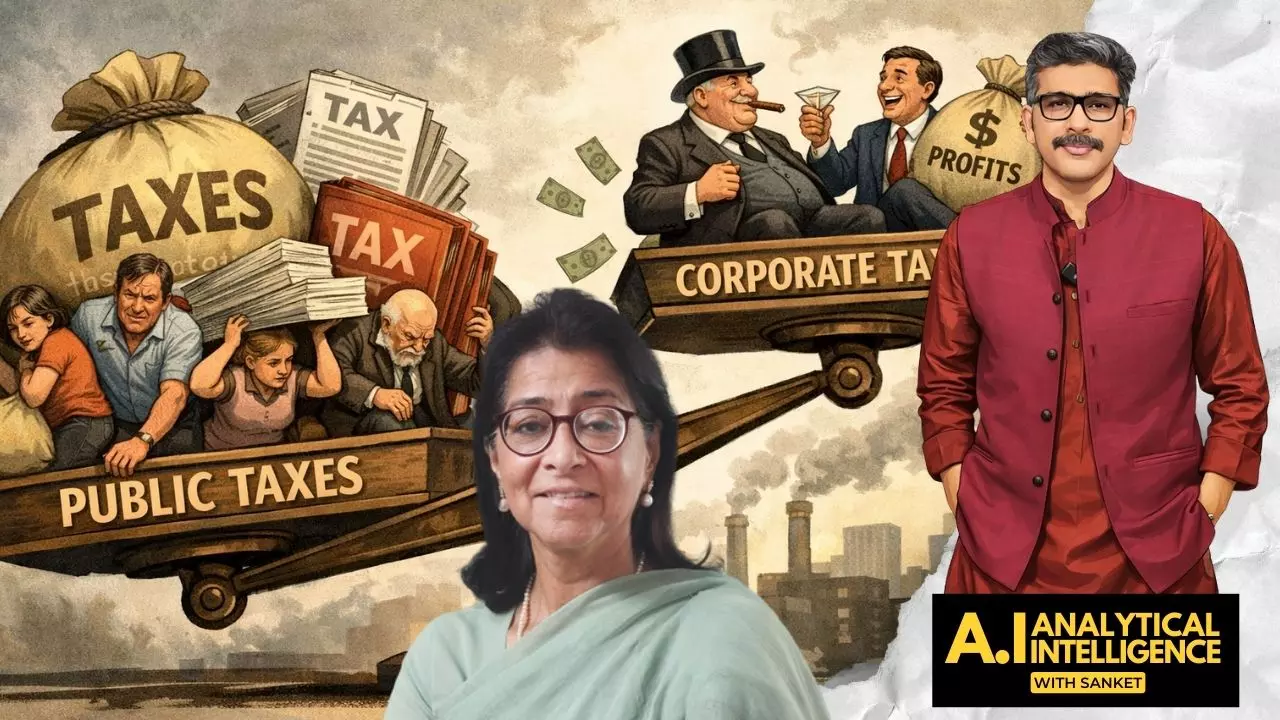
Why lower corporate taxes haven’t spurred private investment | AI With Sanket
Budget 2026 arrives amid growth optimism, tax imbalances and weak private investment —what should the government fix next?

Naina Lal Kidwai, chairperson of the India Sanitation Coalition and former FICCI president, argued that India’s tax policy faces a “tough balancing act”: keep rates competitive to attract investment, but raise enough revenue to fund public services, warning that if rates are uncompetitive, “you lose both the wealthy and the corporate” to offshore destinations. The Federal spoke to Kidwai on Budget 2026 expectations, the widening gap between personal income tax and corporate tax contributions, pressure on the rupee, and why demand, jobs, and exports still dominate India Inc’s priorities.
What is your overview of where the Indian economy is, and what do you expect from the Budget?
I believe we are entering the next year with pretty strong macroeconomic fundamentals. Growth, most projections are showing around 7% for the forthcoming year, which is not a bad rate at all. I’d love to say we could be at 9 or 10, and maybe we get there, but 7 is a good number.
It is also with a fiscal deficit glide path that is being met, so it’s without overspending—moving from 4.8 down to 4.4, well achieved. I do believe we’ve got a good story to tell despite the volatility and headwinds that come with tariffs, which have certainly impacted some key sectors in India—namely apparel, diamonds, leather—sadly very job-intensive sectors.
Overall, the analysis shows that the impact of tariffs—even if they were to continue as is at the 50% level, including that 25% Russian oil addition—if it were to continue over the years, the impact on India’s GDP would be somewhere between 0.4 to 0.8. And of course, there is an expectation that there would be some rationalisation of this in terms of an India–US FTA getting signed, but we have waited and waited for that.
The concerns really have been around the currency. The currency is a chicken-and-egg situation, but as the currency depreciates, particularly the FII money—the foreign institutional investor money—flies away because they look at dollar returns. The more it goes out, the less we see of those funds coming in, and therefore more pressure on the rupee.
That cycle is quite hard to break. The RBI view has always been that they can’t support the rupee at a level for a very long period of time, but what they will and do try to do is manage the volatility—so that it’s a measured way going down. That also is very hard given that we get announcements from the US—especially from the US President—which are unanticipated and cause a lot of volatility for the day, so it’s quite hard to plan.
So the currency remains an issue, but it can work to India’s advantage because it makes exports cheaper. Our push for manufacturing has to be to get domestic demand up and therefore capex up, but also to get exports off the ground, where India’s story has so far remained weak.
Although we have had great success on electronics, and we have seen how the iPhone markets out of India have developed—both for the domestic market but also for exports. If we can continue this push on exports, however selective it be, and our strength in services exports, I think we actually benefit from a depreciating rupee.
The Economic Survey says potential growth is up to 7.5%. Critics say the numbers are “romantic” or “dicey”. What’s your view?
I have been interested in understanding what these discussions are about. Without being a statistician, I think the cause for concern is how some of these “bundlings” happen in order to create the GDP, and the argument being made is that it is being better aligned with the way many other countries do it.
But what it does cause is concern about how you compare a fresh bundle today with an older bundle tomorrow—unless you also give us the figures as they may have looked in terms of the newer bundling that happens. For this, we will have to rely on experts to explain exactly what is happening.
That said, I think anecdotal data—just the pulse of the nation—suggests there is optimism. In fact, a FICCI survey done across 100 CEOs shows a very high level of optimism around the 7% number being achieved. So in terms of the pulse of the nation, I think the mood is clearly up, and that should hopefully help us achieve where we want to go.
Interestingly, in the same survey, the three biggest areas CEOs want the government to focus on are job creation, capital expenditure and exports, in that order.
So if we look at how the messaging must happen through the budget—given that the finance minister does give a keen ear to what industry’s requests and demands are—I think we should see focus on more job creation. That can happen whether it’s manufacturing or services, or I would really like to believe the whole area of tourism, because it is such a big job creator and where India is really punching well below its weight.
But equally, as we look at job creation, there is the whole area of job skilling. There is no point having jobs out there which people can’t fill. So what do those jobs look like? How do we provide that skilling? It’s not about education in degrees alone; it is about the skills themselves. Some government programmes like the apprentice programme that got announced in the last budget—which haven’t quite taken off—may need tweaking and sorting out as we take them forward.
The second is capital expenditure—much needed. The government has been very disappointed that the private sector’s capex has not happened. The government itself has done very well in terms of infrastructure and capital expenditure. The reason it doesn’t happen from the private sector is demand, where capacity utilisation is below 75%, which is the level we have been seeing.
The need to expand capacity is not felt. The sweet point is at that 80–85% level—when companies begin to see their capacity is filling up, then they begin to plan for that next wave of capital expenditure. That can only happen through demand—domestic demand. Some GST breaks were very helpful. Income tax reductions—putting money in the hands of people—always helps domestic consumption. We saw rural consumption come back as well.
But equally, you fill capacity with exports. So the thrust and push on exports would be very important. The capital expenditure–export cycle becomes important, and encouraging exports will be key.
The CEA has “nudged” India Inc: corporate tax was cut, profits are up, but investment isn’t. Is demand the only constraint—and how should this be addressed?
It is a major concern. Why would you put new capacity if your old capacity is not full? So the only way is to utilise that capacity.
To a lesser extent, if there are concerns about ease of doing business and the time it takes to get a new unit up—because acquisition of land and organising the factors of production take time—then we could look to reduce that and ease how you set up and run a business.
But I think that’s a lesser reason. There are some states that are very friendly. I would love to think every state in India is friendly to business. Competition between states—which the government has encouraged—is very good because it makes them compete to be more efficient.
The manufacturing story is still very checkered in India, where concentration happens mainly in the southern states. It would be good to see that being more spread out. But other than that, demand—whether domestic or exports—has got to be key.
Guidance from government through PLI schemes is helpful because it encourages companies to look at areas they may not otherwise have looked at. The push for semiconductors, for electronics, and now defence—these are all incentives that get industry to look at newer businesses.
So then it’s not about filling old capacity; it’s about investing in new spaces important for the country, and where companies are encouraged to invest. Defence has been a big one. We are seeing big companies—and therefore MSMEs that are part of the supply chain—come forward because the story in India of buying defence equipment from offshore is shifting to manufacturing onshore. That becomes a new area.
Not all companies want to be just a supplier to the Indian government, so exports of those products also provide an avenue for us to increase exports.
Personal income tax collections are rising faster than corporate taxes. People feel “individuals pay more while big corporates pay less.” What do you make of this?
One, the marginal tax rate—corporate tax rates are 25%. The marginal tax rate at the personal level can be as high as 40-plus percent given all the surcharges.
At the end of the day, it’s about being competitive vis-à-vis the rest of the world.
How do you get investment going in the country—whether by Indian business or foreign companies looking at the China-plus-one story?
If you take Dubai, Vietnam, etc., where a lot of investment is happening, even our corporate tax rate is high. It is about competition, and capital will go where it works best in terms of returns.
On personal tax rates, at the lower levels we are competitive with some countries, but our barriers—where the next level kicks in—are very low. Particularly for the wealthy, it is no surprise many have set up homes and businesses offshore—Dubai in particular—with a view to minimising tax.
It is very important that while the country has to raise taxes—the tax-to-GDP ratio at 6% is low and we need to fund growth—if you don’t encourage investment and your tax rates are not competitive, you lose both the wealthy and the corporate, who go elsewhere to minimise tax and maximise returns.
We also have to keep an eye on what external rates look like. Comparing ourselves to the developed world is not good enough. In Nordic countries such as Sweden and Norway, tax rates are very high, but all the wealthy get covered for medical, education is free, services are provided, and quality of living and government offerings are much higher than what we provide. So these factors matter.
It’s a tough balancing act for a government that may be happy to reduce taxes, but also needs money to come in.
I think this is why GST played such a key role, because it captured money that was leaking out of the system. Thanks to robust GST returns, we have had funds for infrastructure—an important part of India’s growth story. Not only has it given much-needed infrastructure, it helps industry enormously. Logistics costs have come down, though they are still not where they need to be. We need another 4–5% cost reduction in logistics, but it’s certainly better than it was a decade ago.
If corporate tax is now “at par” globally, but private capex still doesn’t rise, what else can be done?
Demand and exports. To the extent the Indian government is also playing with rates on imports to feed the domestic market, that is changing in electronics. The government made it well known to companies that if they wanted to access the domestic market, they needed to establish a base here. That is good.
I think we could do more to encourage Chinese companies to set up a base here, because imports continue, particularly in capital goods. Indian industry—and industry around the world—is reliant on Chinese equipment for manufacturing.
Can we encourage them to set up shop here, where we can control what’s happening better than just imports, and not be over-dependent on geopolitics? Through all the scuffles we have had with China over the last five-six years on our borders, interestingly trade with China has only gone up. It tells you how dependent Indian business is for raw material supply, capital goods, etc.
Visas are still an issue for technicians, with industries crying out to get equipment serviced by Chinese technicians. There has been some easing, but it’s still not where it needs to be. That could be an area of Chinese investment.
If you look at the last quarter, the last two-three months, we have seen large investment in our banks. We have seen two large Japanese banks investing, and Emirates NBD coming in—offering large capital to our domestic banking industry.
It’s not just about the capital. Having these banks here, they have customers and clients in their markets which they then hand-hold into India. They become a catalyst for change. I know this from my days at HSBC—the number of foreign companies we hand-held into India, helped them understand India, and eased their way here.
These are important steps. The pragmatism on the RBI side—to allow higher percentages than earlier caps, to relook at voting rights and the time period at which they need to dilute down—are important aspects of tackling concerns in industries and enabling FDI.
It’s a mix of pragmatism, ease of doing business, and regulation—at the centre and state levels. The inspector raj and these issues are not easy.
Provide plug-and-play mechanisms. One of the asks that FICCI had was: why don’t we set up a huge electronics park the way Shenzhen and Vietnam have, where OEMs and suppliers can be under one large umbrella? Getting that land mass is not easy, but if government provides it with electricity, water, effluent controls—everything in place—people can pay a rental and work together, following the style of large industrial parks abroad.
Equally with SEZs—plug-and-play exporting zones—large SEZs have come up but are still not fully utilised. SEZs have asked that while they are still building for export, they be allowed to use their capacities to access the domestic market—paying back whatever tax incentives were provided for export, but at least allowing domestic access.
These are the tweakings that have to keep happening. Even as policies move in the right direction, they don’t always take off the way we want, so we have to be pragmatic and tackle problems one by one.
The Economic Survey talks about ultra-processed food, obesity, and phone addiction as risks to the economy. Critics call it a “moral science lesson.” What’s your view?
I do believe the demographic dividend—much hyped, much talked about—only works if we have productive workforce, and productive workforce must mean healthy workforce. Attending to the health of our citizens is very important.
It is no surprise liquor and tobacco see the taxes they do across the world. It is with the desire to make them less accessible, more expensive, and reduce utilisation.
What you are seeing through this document is putting processed foods in that same category to some extent. I don’t think it’s a bad thing that we think twice before we drink that third bottle of carbonated beverage, or live on processed foods at home.
The price differential is something the budget, being a financial document, can impact through taxes. The taxes and duties put on products can be a disincentive because it makes them more expensive.
So providing that guidance through the Economic Survey may give an indication that the budget may see the price points of some of these products go up—from the desire of a government to ensure citizens think twice. You are not closing it out, but you may think twice about doing things that affect your health and eating poorly.
I work a lot in behavioural change and sanitation. You can have toilets—which we have done effectively as a country. We went from just 40% access to toilets to 98% access. But utilisation, unless you keep reminding people why it’s important for the health of their surroundings to be open-defecation-free—the toilets are there to be used—that is part of behaviour change, and it comes from creating a sanitary, healthy environment.
So I do think we have to build that awareness. Maybe it’s not enough to just raise the tax or have it as a moral science lesson in the Economic Survey. But if that is indeed the mind of government, then educating people on eating healthy, working healthy, living healthy, and keeping surroundings clean and sanitary are part of behavioural change—because we do need a healthy nation.
The content above has been transcribed from video using a fine-tuned AI model. To ensure accuracy, quality, and editorial integrity, we employ a Human-In-The-Loop (HITL) process. While AI assists in creating the initial draft, our experienced editorial team carefully reviews, edits, and refines the content before publication. At The Federal, we combine the efficiency of AI with the expertise of human editors to deliver reliable and insightful journalism.