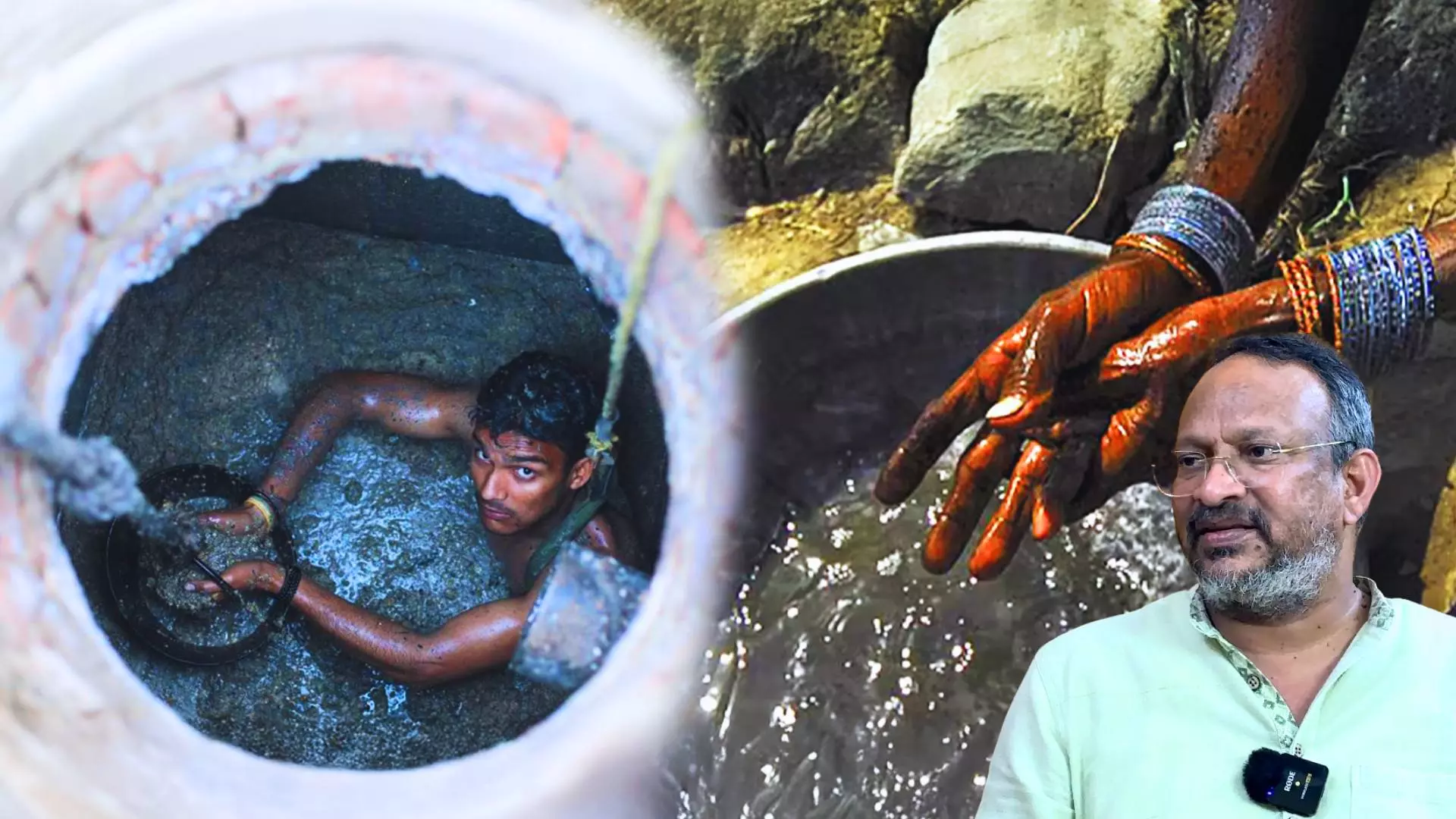
Manual scavenging deaths: Activist slams govt denial, demands accountability
Activist Bezwada Wilson alleges systematic underreporting of sewer deaths, calls for accountability, compensation, and an end to manual scavenging in India

Amid growing concerns over manual scavenging and sanitation worker deaths, The Federal spoke to Bezwada Wilson, national convenor of the Safai Karmachari Andolan, on the stark mismatch between official data and ground realities. Edited excerpts:
Why is there a discrepancy between government data and your figures on sewer deaths?
We are not looking at this as just figures. These are lives of people. When a minister gives an answer, there must be sensitivity. Whenever a death happens anywhere in the country, we immediately write to the minister of social justice, the Prime Minister, the governor, the chief minister, the district collector, and even the NHRC.
So the information is available in multiple places, including newspapers. There is not even a single death that is not reported in newspapers. If someone doesn’t trust our data, they can verify it.
The numbers given by the government are not reasonable. This is not the first time. Since the Supreme Court judgment on March 27, 2014, the government has been denying true data. That is not fair.
How do you collect your data?
Our team is fully rooted in the Safai Karmachari community. All our members come from the same community. So whenever a death happens in any locality, we know. We are not collecting data from outside—we are present where it happens.
Also read: Despite HC order, manual scavenging continues unabated in TN; 43 die in 4 yrs
Our data is authentic. We are not here to exaggerate numbers or do any business. Our intention is to prevent deaths.
Why do you think government figures are consistently lower?
The government has a habit of denying data. If we say six lakh, they will say two lakh. If we say 13 lakh, they will say eight lakh.
The problem is they don’t want to keep accurate data. Because if the data shows a high number of deaths, they will be answerable. So this is a strategy to underestimate and deny.
In a democracy, this should not happen. This is people’s government. You are not a dictator. If our data is wrong, verify it and take action. But they don’t do that.
What do you make of the claim that no manual scavengers exist in India?
They are playing a game. They know the reality. They say there is no dry latrine cleaning, but I challenge them—even today it exists. I told NITI Aayog three years ago.
The survey they talk about is only from 58 districts, not the whole country. Even in that, we found dry latrines.
Also read: SC to Centre and states: Ensure eradication of manual sewer cleaning in phases
If nothing is happening, why bring schemes like The National Action for Mechanized Sanitation Ecosystem (NAMASTE)? Clearly, deaths in sewage and septic tanks are still happening.
Is the definition of manual scavenging part of the confusion?
There is no confusion. The law clearly defines it as handling untreated human excreta in any manner. Whether permanent, contract, or informal—it is manual scavenging.
The government knows this but creates confusion deliberately. They are making a drama. Governments should not play games with citizens. Citizens elect them.
The government says sanitation work is occupation-based, not caste-based. Your view?
That is completely wrong. Even the law acknowledges historical injustice and untouchability. Occupation is linked with caste in India.
If it is not caste-based, why are only Scheduled Caste people doing this work?
No human being—regardless of caste—should do this work. But the government is not clear. They are manipulating facts.
Why has manual scavenging not been eradicated despite the 2013 law?
The 2013 Act came after 20 years of struggle. The Supreme Court also directed the government to act.
No law can solve everything, but with political will, change is possible. The problem is the government looks for loopholes instead of implementing the law.
Also read: Sanitation workers: Uncounted, neglected, untouched by tech advances
The law clearly says the district collector is responsible when a death happens. But no action is taken. Compensation has to be demanded—it should be automatic. This is our right, not something to beg for.
Is lack of political will the core issue?
Yes, lack of political will is the main issue. Also, those dying belong to Scheduled Castes. When it is Dalits or women, the system does not act urgently. They think it is acceptable.
Does the absence of an active Safai Karmachari Commission worsen the situation?
The commission alone cannot stop deaths. Even when it existed, it did not support the people. It often sided with the government.
Still, having monitoring bodies is good. More oversight is always welcome.
What are your key demands from the government?
The Prime Minister must apologise to the community for failing to stop deaths.
Second, the government must stop giving false data in Parliament. That is harmful to democracy.
Third, all families of the deceased must get compensation as per Supreme Court orders—Rs 30 lakh immediately.
The court also mandated jobs for family members, free education for children, housing, and rehabilitation support. None of this is being implemented.
This is a gross violation of Supreme Court orders. The government must act urgently.
The Prime Minister should declare that no human being will enter a sewer or septic tank again. Saying ‘no one enters’ is false—people are dying.
Also read: Kerala invokes Disaster Act after sanitation worker's death in canal; is it enough?
Even in the first three months of this year, deaths have occurred in places like Raipur and Kanpur. How can such numbers be ignored?
If such deaths happened elsewhere, the entire nation would react. But here, these citizens are treated differently. If that is the mindset, we will fight to change it.
(The content above has been transcribed from video using a fine-tuned AI model. To ensure accuracy, quality, and editorial integrity, we employ a Human-In-The-Loop (HITL) process. While AI assists in creating the initial draft, our experienced editorial team carefully reviews, edits, and refines the content before publication. At The Federal, we combine the efficiency of AI with the expertise of human editors to deliver reliable and insightful journalism.)