



You might see an aurora in India tonight: All you need to know
A powerful solar storm is hurtling towards Earth, and sky watchers in parts of northern India may witness nature's greatest light show, the aurora

If you are in the mountains of northern India, look up tonight. The night sky could put on a breathtaking display of shimmering greens — the same celestial phenomenon that people travel thousands of kilometres to witness in Norway and Iceland.
NASA and space weather agencies have issued an alert for a strong G3-class geomagnetic storm heading directly for Earth on Monday (June 8). The storm is expected to push auroras — also called the northern and southern lights — much further south than usual, potentially reaching parts of northern India, central Europe, the United States, and southern Australia.
It is a rare opportunity, and one that may not come around again for a while.
What is an aurora and why is it happening now?
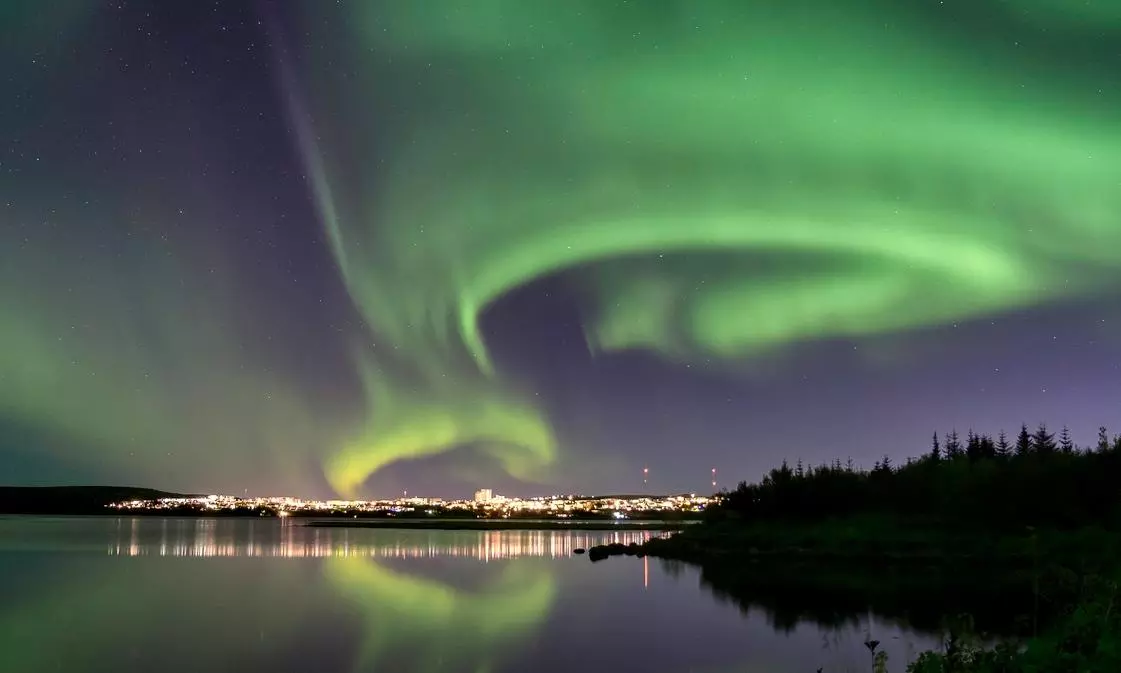
An aurora is a natural light display caused when charged particles from the Sun collide with gases in Earth's atmosphere, producing glowing ribbons of colour across the night sky. Ordinarily, these displays are confined to regions near the Arctic and Antarctic circles.
The ongoing celestial drama began on June 6, when an active patch on the Sun's surface known as Active Region 4461 erupted, shooting out an M1.8-class solar flare — a massive burst of X-ray radiation that immediately caused minor radio disruptions on Earth.
What followed was a Coronal Mass Ejection (CME), a massive burst of plasma and magnetic fields from the Sun, directed towards Earth, now expected to cause a geomagnetic storm between June 8 and 9. According to scientists, the Sun erupted a billion-tonne cloud of magnetised plasma into space at 1,400 kilometres per second.
Also Read: Is space a cosmic computer?
NOAA's Space Weather Prediction Center has issued a G3 geomagnetic storm watch for June 8, and a G2 watch for June 9. Geomagnetic storms are rated on a scale from G1 (minor) to G5 (extreme). The historic solar storm of May 2024 was a G5 event that famously lit up the night skies with vibrant pinks and greens in places like Ladakh. While tonight's storm may not reach those extreme levels, a G3 or G4 storm is powerful enough to push the aurora oval significantly away from the polar regions and towards lower latitudes.
The Sun is currently in a period of elevated activity following its solar maximum in 2024–25, and scientists say auroral displays generally remain strong for several years after solar maximum — meaning some of the most dazzling northern and southern lights may still be ahead.
Where will it be visible and when?
In India, the best chances lie in the high-altitude regions of the north, provided local atmospheric conditions remain clear. Ladakh, Spiti Valley in Himachal Pradesh, and parts of Uttarakhand and Arunachal Pradesh offer the best vantage points.
Also Read: From space, human arguments, fights seem really silly, says Sunita Williams
Beyond India, scientists predict the storm could also produce colourful auroras over Europe and Australia. In the United States, a G3 storm can push the aurora as far south as Pennsylvania, Iowa, and northern California.
The best time to spot auroras is usually between 10 pm and 2 am IST, when the sky is at its darkest. Aim for the window between 11 pm and 1 am IST for the highest likelihood of a sighting.
How to see it and what to keep in mind
You do not need any special equipment to witness an aurora, but a little preparation goes a long way.
Head to a dark area with a clear view of the northern horizon, allow time for your eyes to adjust to the dark as the northern lights may be faint, and use a tripod when taking pictures to help keep your camera steady. Move as far away from city lights as possible — even the glow of a small town can wash out a faint aurora.
If you want to photograph it, shoot in manual mode with the aperture wide open, set ISO between 1600 and 6400, use a shutter speed of 10 to 25 seconds, and focus manually. Modern phone cameras are far more sensitive to auroras than the naked eye.
It is worth keeping in mind that even though a G3–G2 geomagnetic storm has been forecast, things sometimes end up different from the predictions.