







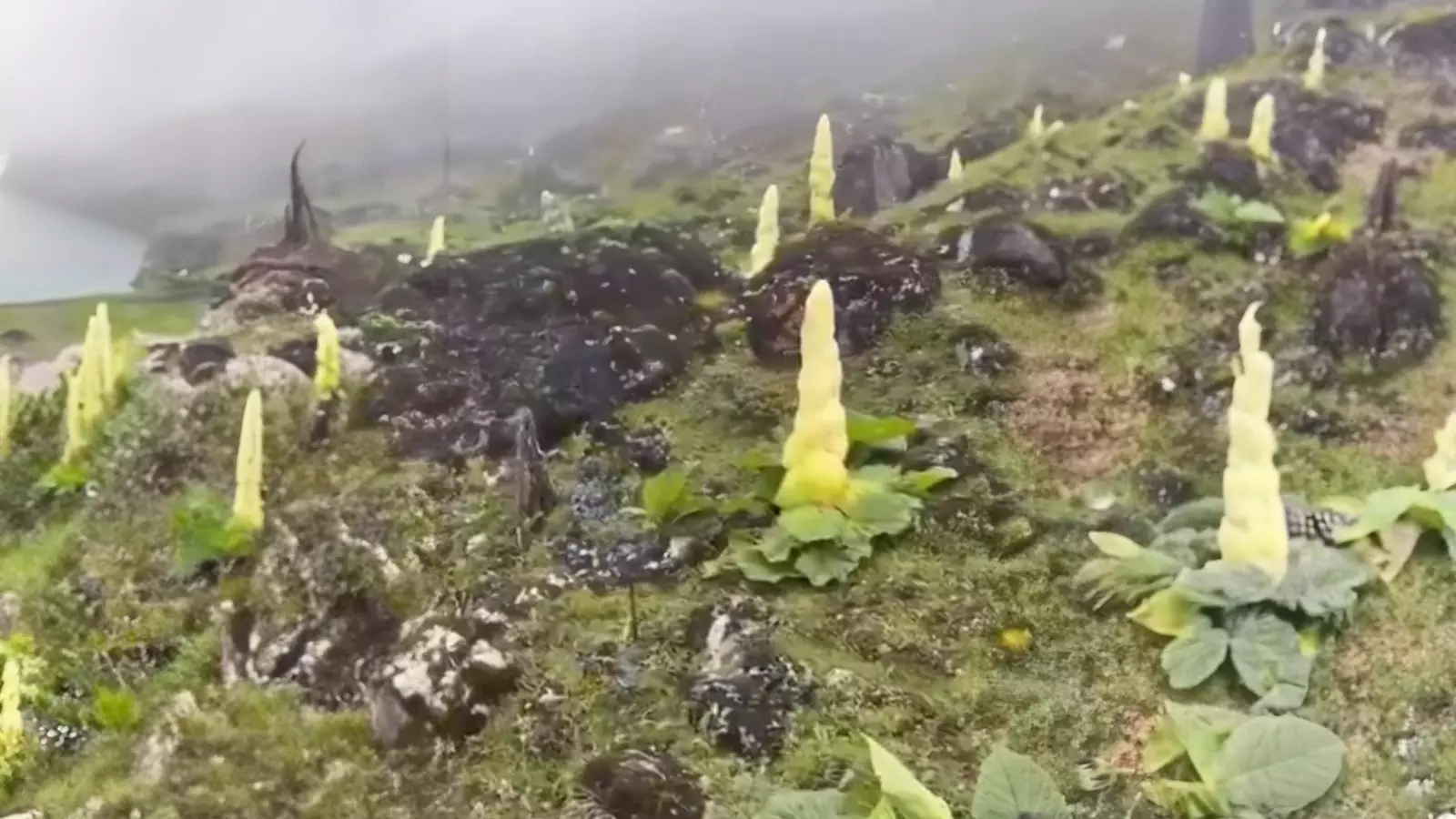
Sikkim Sundari or Rheum nobile, grows at extreme altitudes in the Eastern Himalayas and leads a life that Mahindra described as an exercise in extraordinary patience. Screengrab: X/@anandmahindra
Anand Mahindra draws attention to 'Sikkim Sundari', a rare Himalayan plant
Calling it a 'masterclass in patience', Mahindra explained that the Sikkim Sundari spends most of its life growing quietly beneath the ground

Mahindra Group chairman Anand Mahindra on Sunday (December 21) shared his admiration for a rare Himalayan plant, describing it as one of nature’s most extraordinary creations, and noting that it never featured in his school biology textbooks.
Calling it a “masterclass in patience”, Mahindra explained that the "Sikkim Sundari" spends most of its life growing quietly beneath the ground.
Rare Himalayan plant
The plant, locally known as Sikkim Sundari or Rheum nobile, grows at extreme altitudes in the Eastern Himalayas and leads a life that Mahindra described as an exercise in extraordinary patience.
In a post on X, Mahindra expressed surprise that such remarkable native species often go unnoticed, while school textbooks tend to focus on plants from faraway regions.
His post drew attention to the plant, which is found in Sikkim, eastern Nepal, and south-eastern Tibet, at elevations ranging between 4,000 and 4,800 metres above sea level.
Extreme endurance
For nearly 30 years, the plant survives as a small rosette of leaves, storing energy in harsh alpine conditions characterised by freezing temperatures and intense ultraviolet radiation.
Then, in what Mahindra described as a “single heroic act”, it shoots up to almost two metres in height, forming a striking, pagoda-like structure.
Also Read: Anand Mahindra welcomes Tesla, Elon Musk to India
The plant flowers once, releases its seeds, and then completes its life cycle. Mahindra said this slow, deliberate growth was deeply inspiring and symbolic of endurance in extreme environments.
'Glasshouse plant'
The Sikkim Sundari is also known as the “Glasshouse plant” because of its distinctive appearance. According to botanical sources such as Flowers of India, it has translucent, straw-coloured bracts edged with pink that overlap to form a cone-shaped tower.
Also Read: How Ameenpur, Hyderabad’s biodiversity lake, became a casualty of urban expansion
These bracts function like a natural greenhouse, allowing sunlight to pass through while shielding the delicate flowers from cold winds and strong UV rays.
This creates a warm microclimate within, enabling the plant to survive at high altitudes. Owing to its height and pale colouring, the plant is visible from across mountain valleys, standing out against the rugged terrain.
Call to rediscover biodiversity
Beyond its visual appeal, the Sikkim Sundari also holds cultural and practical significance. Locally known as Chuka, its acidic stems are edible and used in traditional cuisine. Its bright yellow roots, which can grow between three and seven feet long, are also used in traditional Tibetan medicine.
The plant typically flowers between June and July, making it a seasonal highlight in the high Himalayas. After its solitary bloom and seed dispersal, it dies, a final act following decades of quiet survival.
Also Read: How India’s Sacred Groves are protecting biodiversity in a time of ecological crisis
Mahindra concluded his post by encouraging people to explore regions such as Sikkim and reconnect with local biodiversity. He also posed a question about why such natural wonders are absent from the Indian school curriculum.
“I wonder if current Indian school curricula finally reference this local legend?” he concluded.