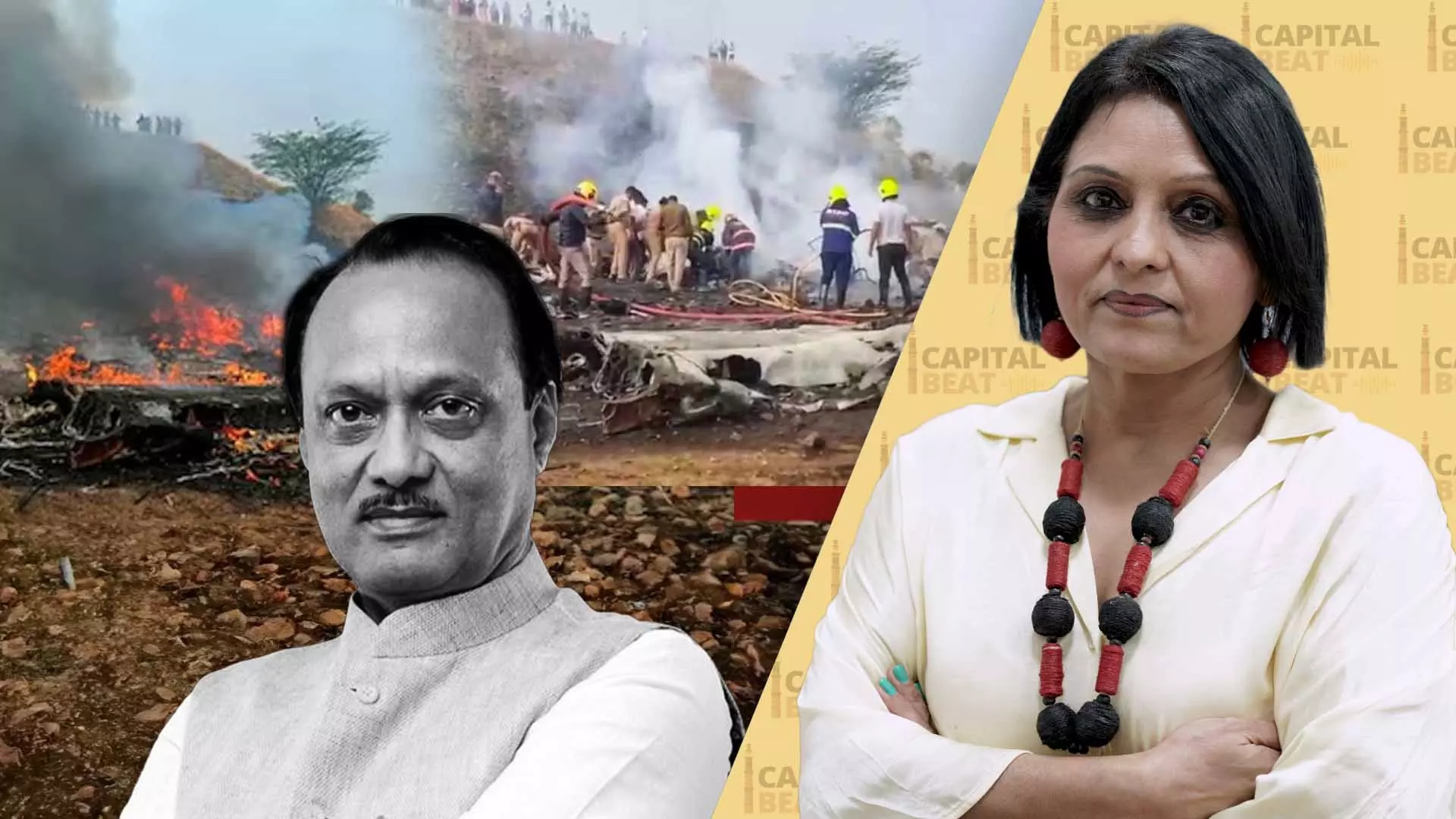
Ajit Pawar’s death in the Baramati plane crash
After Ajit Pawar’s death, can NCP factions reunite or will succession reshape party?
With Ajit Pawar’s untimely death, questions mount over NCP’s leadership, succession, and the party’s future in Maharashtra’s volatile political landscape

A Capital Beat episode examined the political consequences following the death of Maharashtra Deputy Chief Minister Ajit Pawar in a plane crash near Baramati. The discussion featured senior journalists Rohit Chandawarkar, Vivek Deshpande, and Pramod Chunchuwar, and Vanchit Bahujan Aghadi spokesperson Utkarsha Rupwate. The panel focused on the immediate political vacuum, the future of the Nationalist Congress Party (NCP), and unresolved questions around succession, party unity, and Maharashtra’s shifting power equations.
The programme opened with confirmation that the Bombardier Aerospace Learjet 45 carrying Ajit Pawar crashed while attempting a second landing at Baramati, with initial information pointing to poor visibility. A government statement outlining the sequence of events was released earlier in the day.
With the state government announcing three days of mourning, attention quickly shifted from the crash to its political impact, particularly on the NCP, which has been navigating internal divisions and attempted reunification efforts in recent months.
Mourning and immediate political disruption
Chandawarkar described the impact of Ajit Pawar’s death across Maharashtra, noting widespread shutdowns and public reaction. “This is a very shocking incident that has shaken not only those who follow politics but also the general public,” he said, pointing to school closures and halted commercial activity in Pune, Mumbai, and other regions influenced by the Pawar family.
He outlined how Ajit Pawar’s position in state politics made the loss particularly significant. “Ajit Pawar leaves a huge vacuum in Maharashtra politics,” Chandawarkar stated, noting that the NCP currently holds 41 seats in the Maharashtra Assembly and that Pawar served as both deputy chief minister and finance minister.
The upcoming Maharashtra budget session was also highlighted as an immediate concern. “We don’t know who will replace Ajit Pawar as finance minister of Maharashtra, which is a big responsibility,” Chandawarkar said, adding that many political questions remained unanswered.
NCP reunification efforts disrupted
The panel noted that Ajit Pawar’s death comes amid ongoing discussions about reunification between the two NCP factions led by Sharad Pawar and Ajit Pawar. Chandawarkar recalled meetings between the two leaders in December and subsequent coordination during municipal elections.
“There was huge speculation that the two factions of the NCP would unite,” he said, referring to seat-sharing arrangements that had already taken shape in recent local body polls. Plans were also announced for contesting upcoming Zilla Parishad elections together.
“Today’s incident has changed all that,” Chandawarkar said. “We don’t know what exactly the future of this reunification effort is going to be.”
Succession questions within the Pawar family
The discussion turned to leadership succession, with Chandawarkar stressing the central role of the Pawar family in party functioning. “Everybody knows that this is a family-run party,” he said. “It is run by Sharad Pawar. The other faction was run by Ajit Pawar.”
He outlined potential scenarios following Ajit Pawar’s death. “The senior most member is Sharad Pawar. He may continue for a while, perhaps taking a back seat but guiding the party,” Chandawarkar said. He added that Ajit Pawar’s organisational role could be taken over “to some extent” by Supriya Sule due to her electoral base and public presence.
However, he ruled out senior leaders outside the family taking control. “I don’t see a situation where Praful Patel or Sunil Tatkare or any other leader would come forward and say they want to control the party,” he said.
Organisational challenges ahead
Chunchuwar focused on the organisational difficulties facing the NCP without Ajit Pawar. “It is a very difficult task in the absence of Ajit Pawar,” he said, pointing to the party’s weak performance in recent municipal elections despite Pawar’s leadership.
He highlighted structural constraints within the party. “It is a family party. It is also a Maratha-dominated party,” Chunchuwar said, adding that leadership traditionally aligned with cooperative networks in western Maharashtra.
Referring to Ajit Pawar’s influence, he said, “To fill the vacuum of Ajit Pawar is almost impossible.” He expressed doubt over whether any current leader could command similar authority within the party structure.
Electoral implications and regional dynamics
The panel discussed the upcoming Zilla Parishad elections scheduled for February, which were repeatedly identified as a critical test for the NCP. Chandawarkar noted that the party could see an emotional consolidation in its traditional strongholds. “You will see the party uniting. You will see the Pawar family sticking together,” he said.
However, Chunchuwar cautioned that electoral revival would not be automatic, particularly given the BJP’s growing presence in western Maharashtra. He pointed out that even traditional NCP bastions had seen significant BJP gains in recent years.
BJP factor and shifting alliances
Deshpande addressed the broader political implications, particularly the BJP’s role in shaping outcomes after Ajit Pawar’s death. He noted that reunification talks between the two NCP factions were already underway before the incident. “The next question would be whether after reunion the entire NCP goes with the BJP,” Deshpande said, adding that internal disagreements on this issue were likely.
He raised the possibility of defections. “The best case scenario for BJP would be to break the Ajit Pawar faction,” he said, suggesting that several MLAs might reassess their political futures in the absence of a strong central leader.
Deshpande also pointed to the BJP’s strategic interests. “BJP would like a large section of Ajit Pawar’s MLAs to join them so that they can reduce dependence on Eknath Shinde,” he said.
Calls for investigation into the crash
Rupwate focused on questions surrounding the aircraft crash and demands for an independent inquiry. He referenced earlier incidents involving similar aircraft and urged caution in drawing conclusions.
“It will be very immature for me to comment at this point of time,” Rupwate said, while stressing that “a proper investigation into the incident must take place.”
He also referred to historical precedents in Maharashtra. “We have a history where nothing came out later, and that is why this needs a proper investigation,” he said, citing past incidents involving political leaders.
Political uncertainty ahead
As the discussion progressed, panelists agreed that Ajit Pawar’s death had introduced significant uncertainty into Maharashtra politics. Deshpande summarised the situation by noting that MLAs and MPs would now prioritise their political futures.
“For them, their political future is very important,” he said, adding that alignments could shift rapidly once the immediate mourning period ends.
The panel concluded without definitive answers on succession or alliances, reflecting the fluid nature of Maharashtra’s political landscape following the sudden loss of one of its most influential leaders.
The content above has been transcribed from video using a fine-tuned AI model. To ensure accuracy, quality, and editorial integrity, we employ a Human-In-The-Loop (HITL) process. While AI assists in creating the initial draft, our experienced editorial team carefully reviews, edits, and refines the content before publication. At The Federal, we combine the efficiency of AI with the expertise of human editors to deliver reliable and insightful journalism.