AR Rahman’s ‘communal’ remark: Discrimination or a creative churn in Bollywood?
AR Rahman’s remark hinting that Bollywood may be communal triggers a panel clash on power shifts, music labels, and cancel culture - what’s really going on?

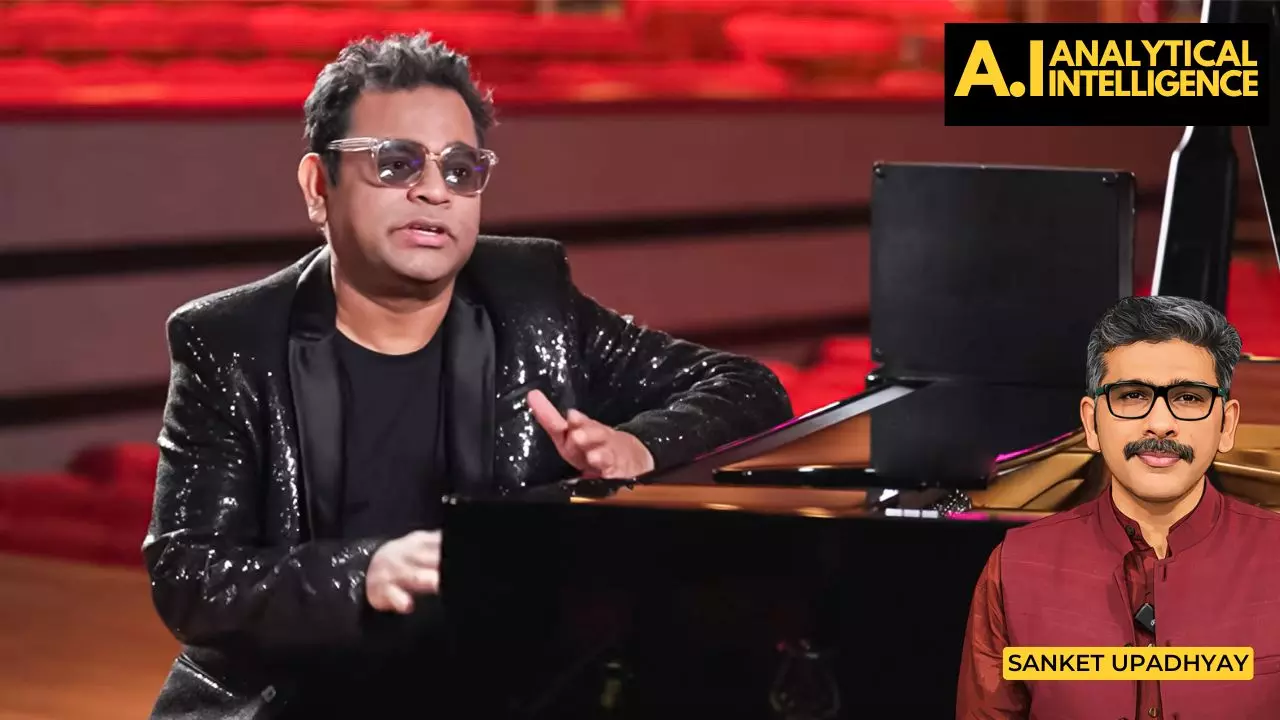
On AI with Sanket, host Sanket Upadhyay moderates a panel discussion featuring Girish Wankhede, Abhishek Tripaati, T Ramakrishnan, and Saira Shah Halim, to examine why music maestro AR Rahman described Bollywood as “communal” in a recent BBC interview, and whether his remarks point to discrimination, shifting industry dynamics, or a deeper creative and commercial churn within Hindi cinema.
The conversation explores Rahman’s comments in detail, weighing claims of changing power centres, corporate control over music, nationalism in cinema, and evolving audience preferences.
Rahman’s remarks surprised many, given his long-standing reluctance to speak publicly about politics or discrimination. Responding to a question on whether he faced bias as a Tamil outsider in Bollywood, Rahman said he did not experience overt discrimination but suggested that over the last eight years, the industry’s power structures had changed, creativity had diminished, and decisions were increasingly driven by non-creative forces.
Also read: Lights, camera, scare: Why Bollywood’s horror films feel different now
His use of the word “communal” triggered sharp reactions, prompting the AI with Sanket panel to debate whether Bollywood has become exclusionary or whether Rahman was articulating frustration with an industry that no longer functions the way it once did.
Serious allegation
Film trade analyst Girish Wankhede told AI with Sanket that Rahman’s statement was a serious allegation that needed careful interpretation. He argued that Bollywood has historically been inclusive, citing decades of contributions by Muslim lyricists, singers, and composers.
Wankhede suggested Rahman’s concerns may stem more from a transformed music ecosystem than communal bias. He pointed to the rise of multiple composers per film, intense competition from younger musicians, and producer-led decision-making driven by music labels.
“Rahman is a genius, but there is massive competition today,” Wankhede said, adding that new sounds and faster production cycles now dominate the industry.
BJP response
Filmmaker and BJP spokesperson Abhishek Tripaati, speaking on AI with Sanket, rejected Rahman’s claim, calling it irresponsible. He stressed that Rahman continues to receive acclaim and commercial success in Hindi cinema.
Also read: Raanjhanaa re-release row: 'Producers, not creators, should have a bigger say' I Interview
Tripaati argued that today’s cinema is market-driven rather than ideological. “Cinema reflects audience demand, not political agendas,” he said, adding that nationalism in films should not be equated with communalism. He also pointed to budget pressures and tight timelines, suggesting Rahman’s elaborate working style may not align with the industry’s current pace.
Industry shift
Senior journalist T Ramakrishnan urged viewers of AI with Sanket to approach Rahman’s comments analytically. While acknowledging Rahman’s stature, he questioned why the composer raised these concerns at this point in his career.
Ramakrishnan suggested that Rahman may be confronting creative stagnation rather than discrimination. “Every artist has a peak,” he said, noting that Rahman himself has spoken earlier about creative cycles. He warned against framing professional challenges in communal terms, calling it a risky narrative that could deepen social divides.
Power centres
Author and activist Saira Shah Halim, however, offered a contrasting view on AI with Sanket, situating Rahman’s remarks within a broader socio-political context. She argued that Rahman was referring to subtle exclusion rather than overt discrimination, pointing to how power has shifted away from artists to corporate labels and ideological gatekeepers.
“The creative process itself has been compromised,” Halim said, arguing that cinema increasingly mirrors dominant political narratives and rewards conformity over experimentation.
Changing taste
The panel also debated whether changing audience tastes have altered Bollywood’s musical landscape. Wankhede and Tripaati highlighted the rise of social-media-driven composers and fusion genres. They argued that orchestral and classical compositions associated with Rahman no longer dominate mainstream cinema.
Also read: How Bollywood hides its representation crisis, bigotry behind superstardom of Khans
However, Halim countered that market trends are inseparable from political and cultural moods.
Communal question
At the core of the AI with Sanket discussion was whether Rahman’s religious identity played any role in his professional experience. Tripaati dismissed the idea, citing successful Muslim artists across cinema.
Halim responded that success does not negate vulnerability, pointing to boycott campaigns and informal censorship that can shape artistic choices.
Creative loss
Later in the discussion, veteran entertainment journalist Denzil O’Connell highlighted how concentrated corporate control has reshaped Bollywood’s music industry. He argued that Rahman thrived when paired with directors who understood his musical language, such as Mani Ratnam, and that such collaborations are increasingly rare in a risk-averse industry.
The AI with Sanket panel concluded that Rahman’s comments deserve serious debate rather than outright rejection. While participants disagreed on whether Bollywood is becoming communal, all agreed that the industry is undergoing a profound transformation.
The discussion underscored tensions between creativity and commerce, artistic legacy and contemporary taste, and freedom and conformity. Whether Rahman’s remarks reflect personal frustration or a deeper cultural shift remains unresolved.
But as the panel noted, when a figure as reserved as AR Rahman speaks out, the industry is compelled to listen.
The content above has been transcribed from video using a fine-tuned AI model. To ensure accuracy, quality, and editorial integrity, we employ a Human-In-The-Loop (HITL) process. While AI assists in creating the initial draft, our experienced editorial team carefully reviews, edits, and refines the content before publication. At The Federal, we combine the efficiency of AI with the expertise of human editors to deliver reliable and insightful journalism.