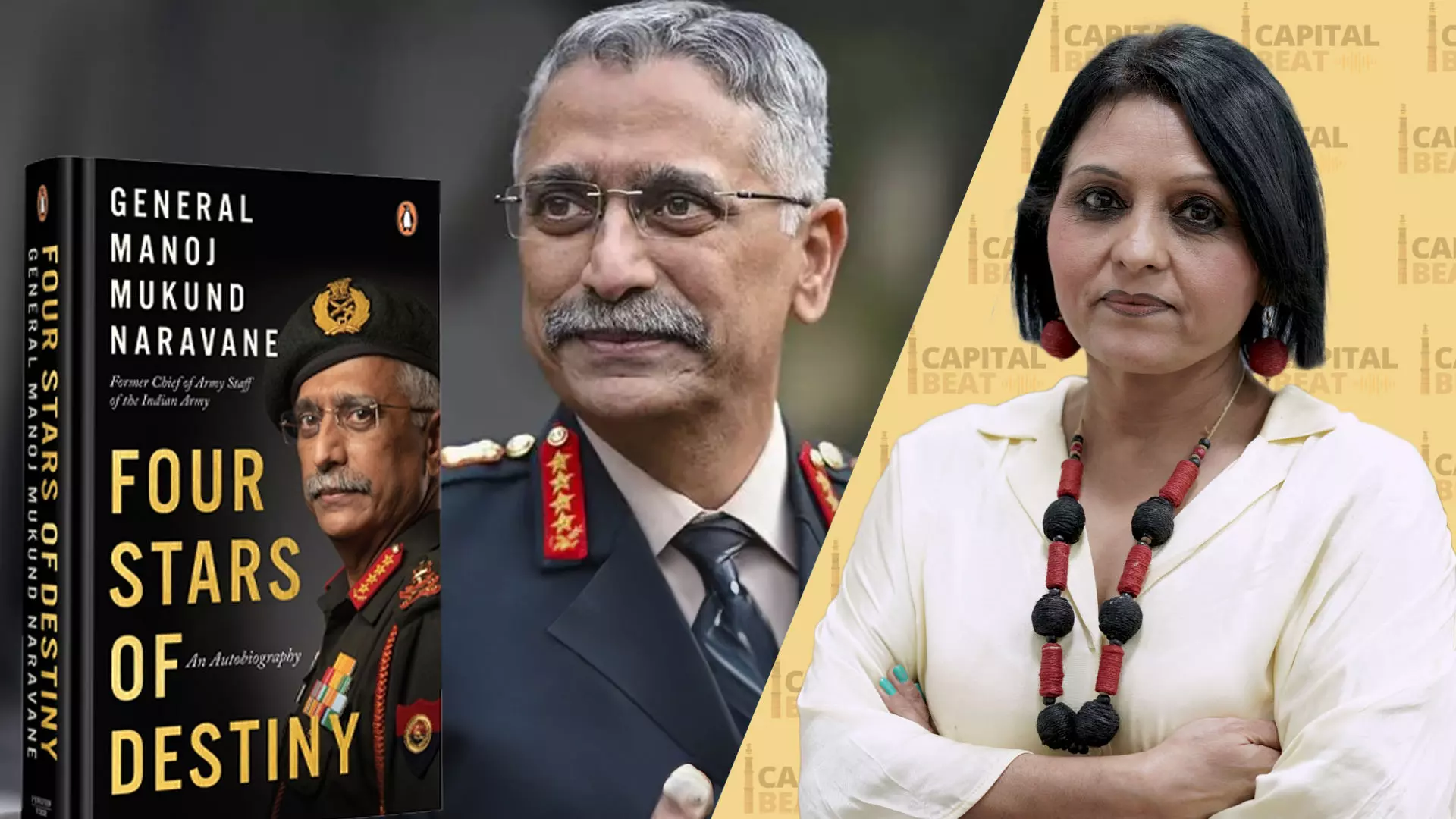
Naravane memoir controversy
Is 20-year cooling-off period for retired officials’ books justified? | Capital Beat
As the govt mulls a 20-year cooling-off period for retired officials’ books on sensitive topics, experts debate its impact on national security, transparency, and freedom of expression

In this episode of Capital Beat, Brigadier Ajit Apte, Pushparaj Deshpande, author and policy expert, and TK Rajalakshmi, senior journalist, discussed the Centre’s reported proposal to impose a 20-year cooling-off period for serving and retired armed forces personnel and other government officials before they can publish books on sensitive subjects. The conversation centered on the controversy surrounding former Army Chief General Manoj Naravane’s unpublished memoir Four Stars of Destiny and explored the wider implications of the proposed guideline.
The programme noted that the issue was reportedly discussed at a recent Cabinet meeting, though it was not part of the official 27-point agenda. Several ministers were said to have favoured a mandatory cooling-off period for those who held positions of power, including senior military officers, before authoring books on sensitive subjects.
The proposal has emerged amid controversy over the unpublished memoir of General Manoj Naravane, with questions raised about whether such a cooling-off period would be logical, rational, or a violation of fundamental rights.
Existing legal framework and national security
Brigadier Ajit Apte underlined that no formal order has yet been issued and that the matter remains under consideration. He clarified that any such proposal would apply to all government officials, including those from the foreign service, administrative services, and the armed forces.
“As of now, as long as a veteran writes a book or a journal or a publication which does not pertain to national security or any such topic which is sensitive in nature, we are all governed while we were in service and even now throughout under the Indian Official Secrets Act of 1923,” Brigadier Apte stated. He added that the Act prohibits writing anything sensitive from a national security perspective or containing operationally sensitive information.
He stressed that the contents of General Naravane’s unpublished book are not publicly known. “The very fact that the book has not yet been sanctioned or approved, so obviously there would be something which the government of India is mulling over,” he said, adding that it would be premature to comment without knowing the contents.
Debating the 20-year timeline
Brigadier Apte referred to historical precedent, citing a senior general who wrote about the 1962 Sino-Indian conflict after more than 20 years. “He didn’t want to write it in a haste. He wanted to absorb what others have mentioned about that particular conflict,” he noted, adding that the officer may have wanted to avoid hurting sentiments.
However, he questioned the rationale for a specific 20-year limit. “Why 20 years, why not 10 years? Why not 25 years?” he asked. He added that if the government proceeds with such a policy, “there must be some very valid reason which would have been discussed.”
Brigadier Apte also observed that many officers who write on non-sensitive subjects face no obstacles. “If a person wants to write fiction or wants to write on environment or wants to write his own story which has no consequential impact of any sensitive nature information, I don’t think there would be a ban on that,” he said.
Transparency and accountability concerns
Pushparaj Deshpande described the proposal as potentially undermining transparency. “If the BJP government were to enforce this rule… it would effectively consign transparency and accountability to the dustbin of history,” he stated.
He argued that a 20-year waiting period would delay publication until individuals are in their mid-80s, “way after any sense of commission and omission by any government are beyond rectifying.”
Deshpande questioned the consistency of such a rule, referring to past publications critical of previous governments. He also cited several former officials who took up political assignments after retirement, asking why a similar cooling-off period was not being considered for post-retirement political roles.
Due diligence and publication process
On the Naravane memoir, Deshpande stated that the book could not have been cleared by the publisher without legal vetting. “Before it was sent out, General Naravane would have done his due diligence,” he said, referring to the Official Secrets Act and defence publication guidelines.
He said, “Penguin and General Naravane clearly did not disclose any classified military information or operational intelligence plans.” He described the proposed cooling-off measure as “an insidious attempt… to send a chilling effect on any sitting official or just about to retire official.” He added, “You can’t have it two ways. Either you uniformly ban all books and films talking about contemporary events… or you don’t.”
Freedom of expression and interpretation of laws
Rajalakshmi stated that the move appeared to be linked to the Naravane book. “It seems to have been motivated by this particular book and this particular instance,” she said, adding that material in the public domain suggested the contents were “not exactly flattering… as far as the executive is concerned.”
She emphasised that if a cooling-off rule were introduced, it should apply uniformly. “This whole 20-year cooling-off period, it should apply to all services then,” she said, including judges and police officers.
Rajalakshmi highlighted concerns over the interpretation of national security. “The whole definition of national security itself has got a wide definition. It all depends on how it’s interpreted by a particular government,” she observed. She added that such measures are “prone to misuse.”
Historical examples and publication trends
Brigadier Apte referred to past military publications, including Brigadier John Dalvi’s Himalayan Blunder, written about the 1962 conflict. He noted that contentious books have been published in the past and are still referred to as military history texts.
“If there is anything which is objectionable, that particular paragraph or sentence may need to be amended,” he suggested, while reiterating that the 20-year proposal has not yet been finalised.
He also pointed out that relatively few officers write memoirs. “The percentage of officers who really wish to write is quite low,” he said. He cited Field Marshal Sam Manekshaw, noting that he never authored a book himself, though books were written about him by others.
Democracy and legal recourse
Rajalakshmi maintained that freedom of expression applies equally to retired officials. “Since we are in a democracy, that freedom also applies to all sections of society,” she said, adding that General Naravane did not write his book while in service and therefore did not break service rules.
She stated that if the government disputes facts in a book, there are legal avenues available. “The government can take General Naravane to court saying that those facts are wrong or that they have been misrepresented,” she said.
Rajalakshmi described the proposed 20-year cooling-off limit as “a sign of a very insecure political dispensation,” and said that banning or prescribing such a long delay raises questions about the handling of dissenting narratives.
The content above has been transcribed from video using a fine-tuned AI model. To ensure accuracy, quality, and editorial integrity, we employ a Human-In-The-Loop (HITL) process. While AI assists in creating the initial draft, our experienced editorial team carefully reviews, edits, and refines the content before publication. At The Federal, we combine the efficiency of AI with the expertise of human editors to deliver reliable and insightful journalism.