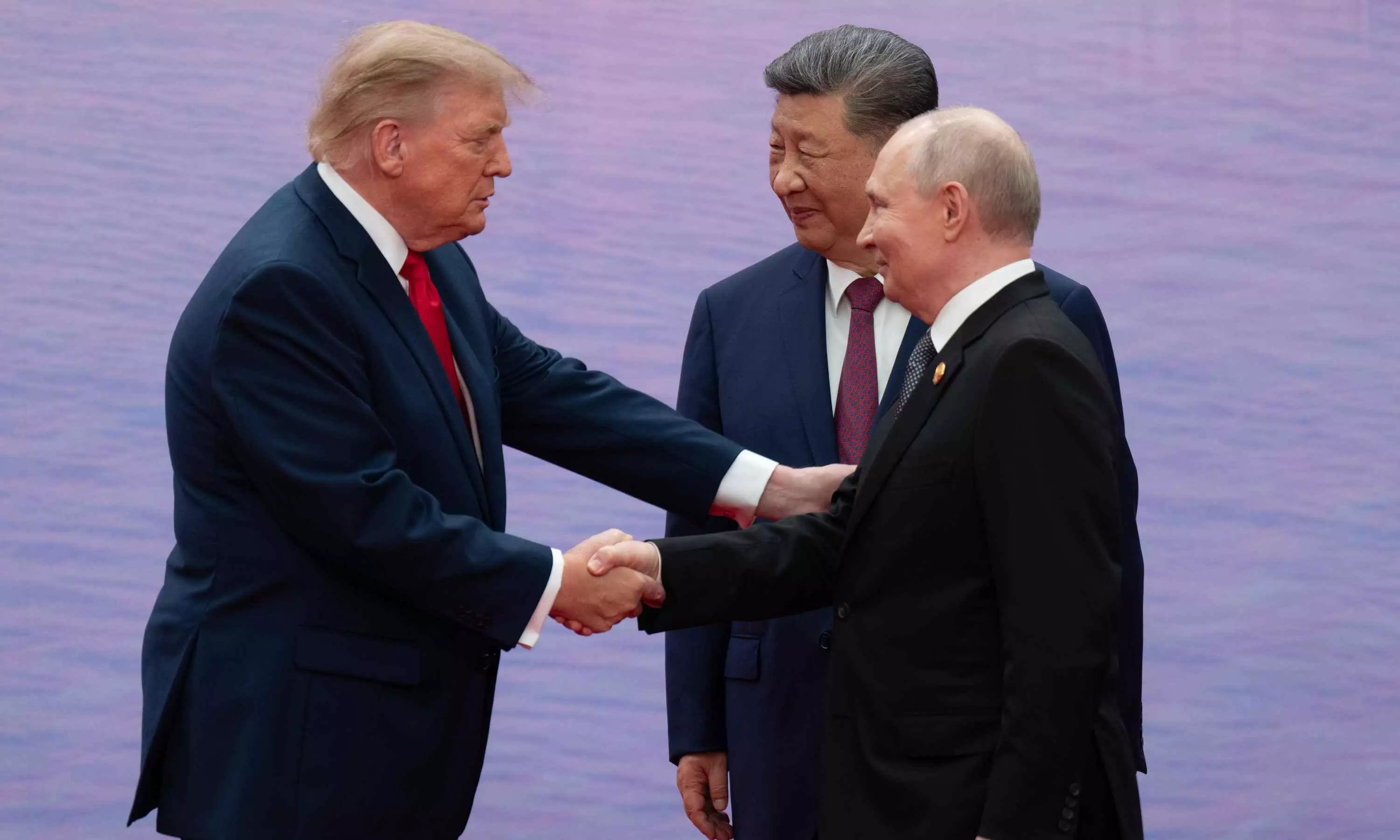
After a major drubbing in the recent US midterm elections, President Donald Trump (left) is looking for some foreign policy success and to try to get some concessions from both Chinese President Xi Jinping (centre) and his Russian counterpart Vladimir Putin (right) and show it off as a diplomatic victory. Photo: AP/PTI
What Xi-Trump-Putin trilateral meeting means for India and global power order
The meeting is taking place at a time of global flux, when the old order that has been in place since the end of the Second World War is crumbling, while its replacement is yet to emerge

The first-ever trilateral meeting between three great powers, China's Xi Jinping, US President Donald Trump and Russian President Vladimir Putin, in the Chinese city of Shenzhen on the sidelines of the Asia-Pacific Economic Cooperation (APEC) summit is grabbing the world's attention.
No one is quite sure of the agenda or the meeting's eventual outcome. But the very fact that these three leaders are coming together, even for a preliminary meeting, has surprised many and ruffled quite a few feathers in both the American establishment and Europe.
Also read: Trump arrives in China as Xi rolls out red carpet ahead of high-stakes trilateral summit
Moreover, it is taking place at a time of global flux, when the old order that has been in place since the end of the Second World War is crumbling, while its replacement is yet to emerge. At the same time, two wars – in Ukraine, initiated by Russia, and in Iran, launched by the US and Israel – have severely disrupted the global economy and show no signs of ending.
Global dominance
This is a critical moment in world history. The US, despite remaining the world's only superpower, faces challenges to its global dominance. The challenge comes not so much from Russia, which is no longer the power it was before the breakup of the Soviet Union, but from a rising China, which hopes to one day become the world's number one power. Yet under Russian President Vladimir Putin, the country continues to punch well above its weight.
As pointed out earlier, no agenda has been spelt out for the three-way conversation. All three leaders are looking to gain something from the meeting. After a major drubbing in the recent US midterm elections, Donald Trump is looking for some foreign policy success and to try to get some concessions from both Xi and Putin and show it off as a diplomatic victory. The White House has said that arms control and nuclear non-proliferation will be high on the agenda. But certainly Iran and perhaps Ukraine may also figure.
China’s agenda
Xi’s agenda, according to Mao Ning, Chinese foreign ministry spokesperson, is “safeguarding world peace and promoting strategic stability in major-power relations”, describing the meeting as having “ground-breaking significance”. This is in keeping with China’s belief that the time has come to assert its place in the world. Xi would like Trump to acknowledge China as a responsible world power and an equal.
Also read: Putin and Xi call for fairer multipolar world order, slam economic coercion at APEC
This desire stems from China’s perception of a Century of Humiliation, roughly from 1839 to the Communist revolution of 1949, and covers a time in history when China believed that Britain, France, Germany, Russia and Japan had imposed “unequal treaties” on a weak China.
Soon after Putin ordered the military strike on Ukraine, he became the pet hate of Western leaders, with former US President Joe Biden leading from the front. Sanctions on Russia and a bid to isolate Putin were on top of the West’s agenda. It did not succeed, with Trump fully embracing the Russian leader and inviting him to Alaska. Moscow is sending a message that attempts to isolate Russia cannot succeed, despite its ongoing war in Ukraine.
What trilateral meeting means for India
How should India view this meeting between Trump, Xi and Putin?
“No need to get concerned. Trump is unreliable and can’t be counted on to deliver on any commitment he makes. There is no shared agenda between the three countries except high-sounding cooperative principles. After unilateralism, bipolarity and now tripolarity? No multilateralism? No G 20, BRICS?” says Kanwal Sibal, former foreign secretary.