







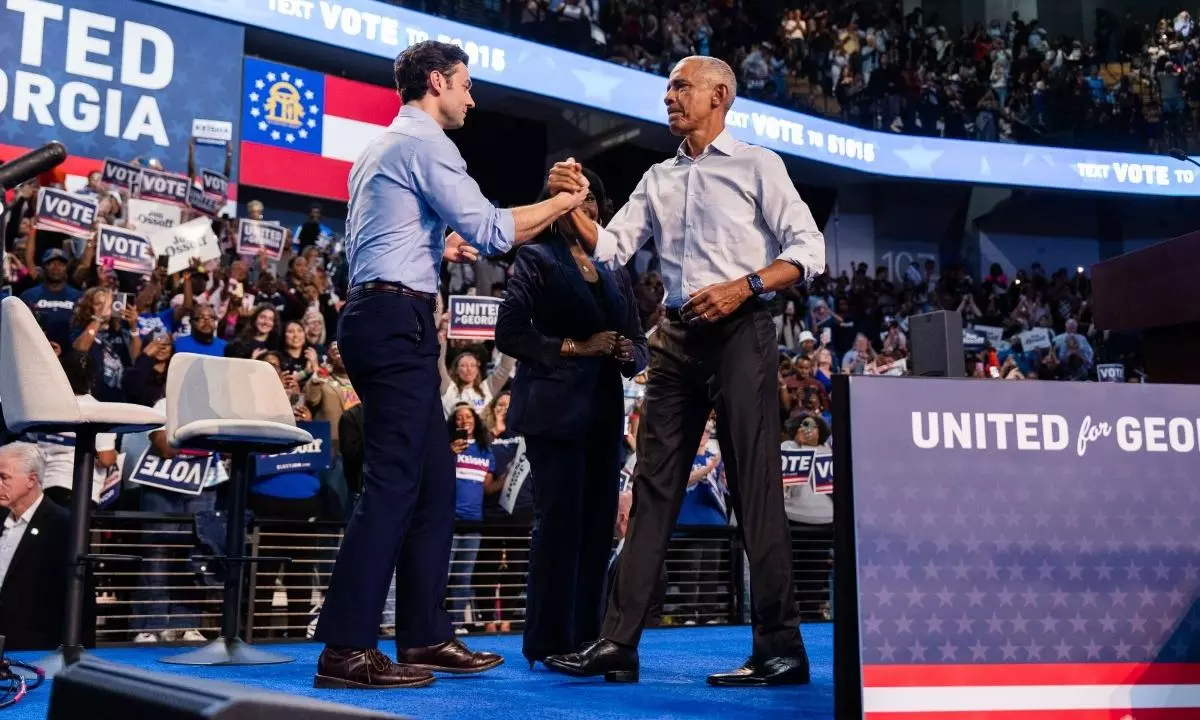
US Senator Jon Ossoff (left) with former American President Barack Obama (right). File photo: electjon.com
Who is Jon Ossoff, being touted as 'next Obama' and future US president?
At 39, the Georgia senator has become one of the Democratic Party's most talked-about younger leaders following his re-election victory. His communication style, political journey and association with Barack Obama have fuelled speculation about a possible presidential future.

Young Senator Jon Ossoff is increasingly attracting attention in the US as a potential new face of the Democratic Party, with some commentators drawing comparisons between the 39-year-old Georgia Democrat and former President Barack Obama.
Ossoff's re-election victory in Georgia on Wednesday (November 4), has further amplified the discussion about his political future. His growing visibility, fundraising capabilities and ability to generate attention through campaign speeches and social media have placed him among the prominent younger figures in American politics.
Also read: Midterms make Trump admin ‘lame duck’: How it impacts India-US trade, immigration
He is seen as a potential presidential candidate in the 2028 elections though he has said he has “zero interest”.
“I have zero interest in running for president. I’m not running for president. I’m running for re-election to the Senate,” Ossoff said during an election debate on October 13.
Who is Ossoff?
Born on February 16, 1987, in Atlanta, Georgia in a Jewish family, Ossoff represents a generation of Democratic politicians seeking to reshape the party's leadership and political messaging. He studied at Georgetown University's School of Foreign Service and later earned a master's degree from the London School of Economics.
Ossoff's paternal family traces its ancestry to Jewish communities in Lithuania and Russia. His great-grandparents, Israel and Annie Ossoff, emigrated from Eastern Europe to the United States in the early 20th century, escaping the persecution faced by Jewish communities.
They settled in Peabody, Massachusetts, where they operated a petrol station and a small trucking business. The family subsequently established itself in business and community life. His family history also includes relatives who experienced the Holocaust. His father's extended family helped relatives who had survived Nazi persecution and escaped concentration camps.
Ossoff is married to Dr. Alisha Kramer, an Atlanta-based physician, and they have two daughters.
Investigative journalist to politician
Before entering politics, Ossoff worked in investigative journalism and documentary filmmaking. His production company investigated subjects including organised crime, corruption, human trafficking and war crimes.
His first major political breakthrough came in 2017, when he contested a special election for Georgia's 6th Congressional District. Although he lost to Republican Karen Handel, the campaign attracted national attention and established him as a prominent Democratic voice.
Also read: Trump admits Iran war cost Republicans midterm votes, says he would do it again
Ossoff entered the US Senate in January 2021 after defeating Republican incumbent David Perdue in a closely watched Georgia runoff. At 33, he became the youngest sitting US senator. His victory, alongside fellow Democrat Raphael Warnock's win, helped Democrats secure control of the Senate.
His political profile has since been shaped by legislative work, investigations into institutional misconduct and criticism of corporate influence in government. His initiatives have addressed healthcare affordability, public safety, voting rights and protections for vulnerable communities.
Why the Obama comparison?
The comparison with Obama goes beyond their relatively young age when entering national politics. Observers have pointed to similarities in their measured speaking styles, public presentation, carefully crafted speeches and ability to connect with audiences.
“Ossoff has a visual grammar that looks like Obama in the way that he speaks and positions himself,” US commentator and journalist Ezra Klein wrote in The New York Times.
"When he speaks, I think of Barack Obama," Mary, a canvasser in her 60s, told news agency AFP.
“Ossoff would be a very interesting candidate. Because he’s in the centre, he represents a southern state, his rhetoric fits the moment, and he looks the part. He could be a real player,” Hank Sheinkopf, a veteran Democratic strategist and former adviser to Bill Clinton, told The Observer.
Ossoff's relationship with the late civil rights leader John Lewis is another important element of this narrative. As a teenager, he approached Lewis seeking an internship and subsequently developed a lasting political association with the Georgia congressman.
Obama, too, shared a close political relationship with Lewis, one of the most prominent figures of the American Civil Rights Movement.
Obama has also publicly campaigned alongside Ossoff, adding another dimension to the comparison. However, the former president's support should not be interpreted as an endorsement of a future presidential campaign.
There are also differences between the two politicians. Obama's national rise was built around a message of hope and political change, while Ossoff's recent public identity has been more closely associated with accountability, anti-corruption initiatives and opposition to the policies of President Donald Trump.
Re-election strengthens national profile
Ossoff's November victory is particularly significant because Georgia has become an important battleground in American politics. The state voted for Trump in the 2024 presidential election, making the Democratic senator's seat a major Republican target.
His campaign reportedly raised more than USD 100 million, while his speeches and criticism of the Trump administration generated considerable attention online.
His political positions include support for reducing prescription drug costs, strengthening voting rights, protecting manufacturing jobs and restricting corporate influence in politics. On foreign policy, he has expressed support for Israel's security while also criticising Israeli military conduct in Gaza and raising concerns about civilian casualties.