







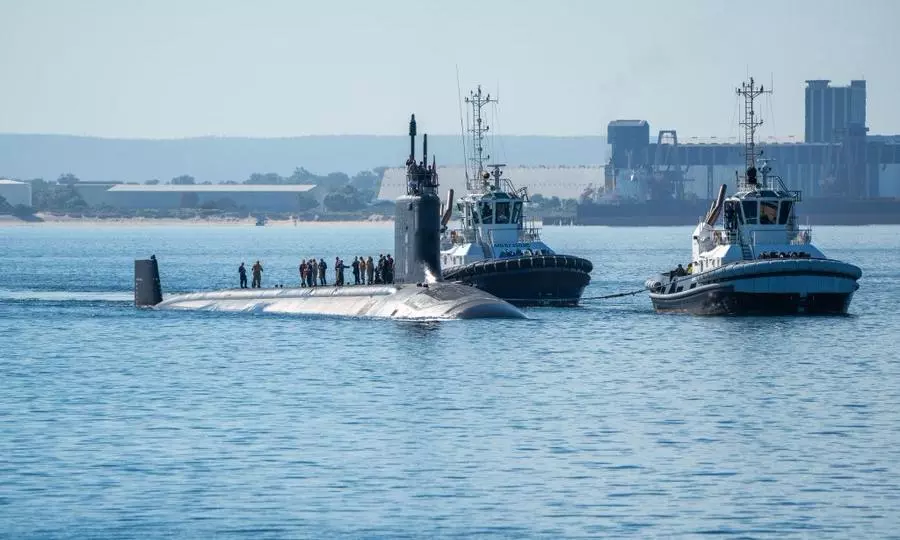
The term “Indo-Pacific” gained prominence over the past decade as a geopolitical framework linking the Indian and Pacific Oceans into a single strategic theatre. Representative photo: X/@INDOPACOM
US drops ‘Indo’ from Pacific Command name, raises questions on regional strategy
US govt says new name reflects its long military heritage, assures command’s area of responsibility remains unchanged, stretching from the west coast of the US to India’s western boundary

The United States has restored the name of the US Indo-Pacific Command (USINDOPACOM), its biggest unified command, back to the US Pacific Command (USPACOM), reversing a strategic rebranding introduced during US President Donald Trump’s first term in 2018.
Also read: India a 'critical Indo-Pacific anchor', says US War Secretary, backs deeper defence cooperation
The move has sparked a debate in India, with Congress MP Shashi Tharoor questioning whether it signals a dilution of Washington’s commitment to the Indo-Pacific concept and a weakening of the strategic importance accorded to India.
Nail in Quad coffin?
Reacting to the development, Tharoor described the decision as “another nail in the Quad coffin”, arguing that removing the word “Indo” strips away the symbolic recognition of the growing strategic linkage between the Indian and Pacific Oceans.
The US command announced that the change was intended to honour its historical legacy. Established in 1947 by then US president Harry S Truman, the command operated as USPACOM for more than seven decades before being renamed in 2018.
US defends decision
Explaining the decision, the US Department of War said the USPACOM name reflects its long military heritage, including its role in shaping the post-World War II security architecture in Asia, coordinating operations during the Korean and Vietnam wars, and leading numerous humanitarian and disaster relief missions.
Also read: Quad expands Indo-Pacific cooperation with maritime surveillance and port initiatives
US officials have stressed that only the name is changing. The command’s area of responsibility remains unchanged, stretching from the west coast of the United States to India’s western boundary. Headquartered in Hawaii, it continues to oversee one of the world's most strategically important regions, spanning the Pacific and much of the Indian Ocean, East and Southeast Asia, Australia, and parts of South Asia.
Why the ‘Indo’ mattered
The term “Indo-Pacific” gained prominence over the past decade as a geopolitical framework linking the Indian and Pacific Oceans into a single strategic theatre. In 2018, then US defence secretary James Mattis said the renaming recognised the increasing connectivity between the two oceans and highlighted India’s growing role in maintaining regional stability.
Also read: Is Quad gradually slipping into irrelevance? | Worldly-Wise
For India, the command became an important institutional mechanism for expanding defence ties with Washington. Under the broader Indo-Pacific strategy, India and the US deepened cooperation through joint military exercises, maritime surveillance, intelligence-sharing arrangements and wider strategic coordination.
Concerns over strategic messaging
While Washington insists that operational responsibilities remain unchanged, some diplomatic and security analysts argue that the removal of “Indo” carries symbolic significance. Critics argued that the change could be interpreted as a reduced emphasis on the Indian Ocean region and India’s role within the broader regional security architecture.
The move has also reignited debate over the future direction of the Quad grouping comprising India, the United States, Japan, and Australia.