



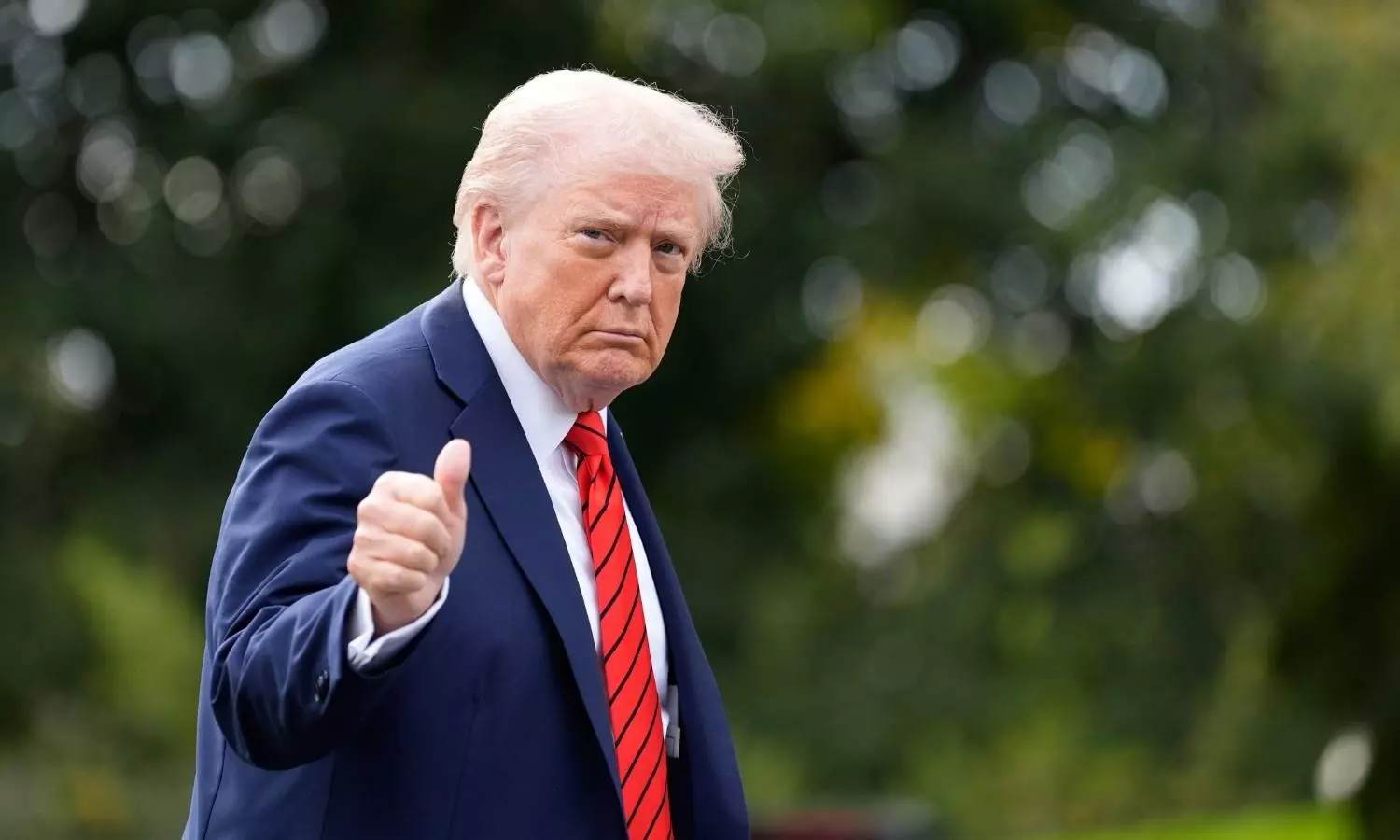
Trump photo among 16 Epstein files that disappear from US Justice Dept website
Lawmakers and survivors questioned why the Epstein records were taken offline so soon after their release under a transparency law

At least 16 files disappeared from the Justice Department's public webpage for documents related to Jeffrey Epstein — including a photograph showing President Donald Trump — less than a day after they were posted, with no explanation from the government and no notice to the public.
Also read | US Justice Department releases partial Epstein files
The missing files, which were available Friday and no longer accessible by Saturday, included images of paintings depicting nude women, and one showing a series of photographs along a credenza and in drawers. In that image, inside a drawer among other photos, was a photograph of Trump, alongside Epstein, Melania Trump and Epstein's longtime associate Ghislaine Maxwell.
The Justice Department did not say why the files were removed or whether their disappearance was intentional. A spokesperson for the department did not immediately respond to a request for comment.
Online, the unexplained missing files fuelled speculation about what was taken down and why the public was not notified, compounding long-standing intrigue about Epstein and the powerful figures who surrounded him.
Democrats on the House Oversight Committee pointed to the missing image featuring a Trump photo in a post on X, writing: “What else is being covered up? We need transparency for the American public.” The episode deepened concerns that had already emerged from the Justice Department's much-anticipated document release.
Scant new insight in initial disclosures
The tens of thousands of pages made public offered little new insight into Epstein's crimes or the prosecutorial decisions that allowed him to avoid serious federal charges for years, while omitting some of the most closely watched materials, including FBI interviews with victims and internal Justice Department memos on charging decisions.
Some of the most consequential records expected about Epstein are nowhere to be found in the Justice Department's initial disclosures, which span tens of thousands of pages.
Missing are FBI interviews with survivors and internal Justice Department memos examining charging decisions — records that could have helped explain how investigators viewed the case and why Epstein was allowed in 2008 to plead guilty to a relatively minor state-level prostitution charge.
The gaps go further. The records, required to be released under a recent law passed by Congress, hardly reference several powerful figures long associated with Epstein, including Britain's former Prince Andrew, renewing questions about who was scrutinised, who was not, and how much the disclosures truly advance public accountability Among the fresh nuggets: insight into the Justice Department's decision to abandon an investigation into Epstein in the 2000s, which enabled him to plead guilty to that state-level charge, and a previously unseen 1996 complaint accusing Epstein of stealing photographs of children.
The releases so far have been heavy on images of Epstein's homes in New York City and the US Virgin Islands, with some photos of celebrities and politicians.
Records being released in phases
There was a series of never-before-seen photos of former President Bill Clinton but fleetingly few of Trump. Both have been associated with Epstein, but both have since disowned those friendships. Neither has been accused of any wrongdoing in connection with Epstein and there was no indication the photos played a role in the criminal cases brought against him.
Also read | Trump signs bill to release Jeffrey Epstein case files after fighting it for months
Despite a Friday deadline set by Congress to make everything public, the Justice Department said it plans to release records on a rolling basis. It blamed the delay on the time-consuming process of obscuring survivors' names and other identifying information. The department has not given any notice when more records might arrive.
That approach angered some Epstein accusers and members of Congress who fought to pass the law forced the department to act. Instead of marking the end of a yearslong battle for transparency, the document release Friday was merely the beginning of an indefinite wait for a complete picture of Epstein's crimes and the steps taken to investigate them.
“I feel like again the DOJ, the justice system is failing us,” said Marina Lacerda, who alleges Epstein started sexually abusing her at his New York City mansion when she was 14.
(With agency inputs)