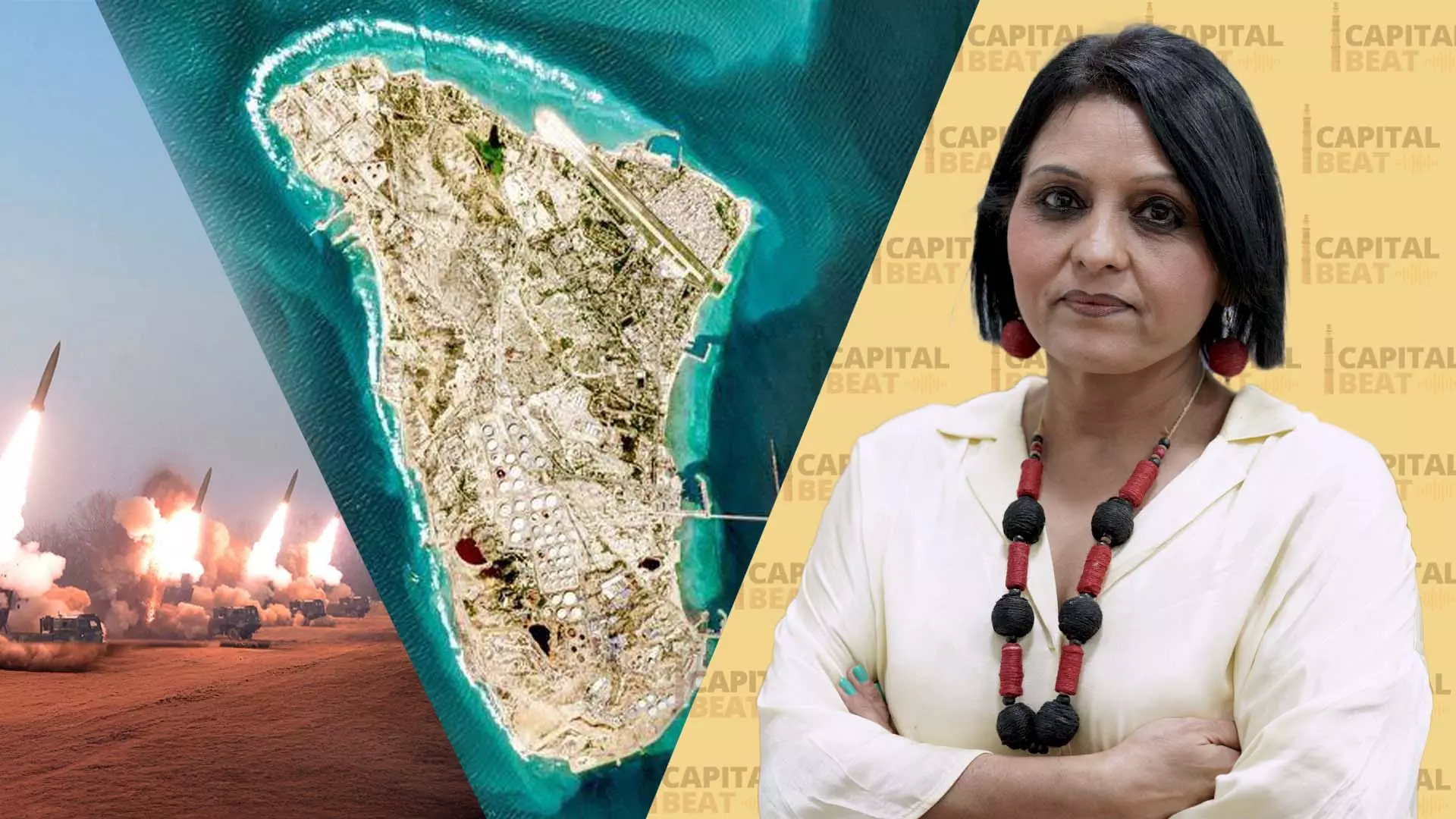
Will the Kharg Island strike impact global energy security? | Capital Beat
Experts analyse the significance of Kharg Island, the warning from Trump, and the potential impact on global oil prices, shipping routes, and regional stability

Former diplomat KP Fabian and Middle East expert Prof Aftab Kamal Pasha discussed the implications of the US strike on Iran’s Kharg Island and its potential economic and geopolitical consequences in this episode of Capital Beat. The discussion focused on the strategic significance of the island, the warning issued by US President Donald Trump, and the possible impact on global oil supply and the world economy.
The episode examined reports that American forces targeted military sites on Kharg Island, which hosts Iran’s main oil export terminal. The island handles about 90 per cent of Iran’s crude shipments and serves as a critical hub in the country’s petroleum network.
The discussion also examined the warning issued by Trump regarding the oil infrastructure on the island and its link to the security of shipping routes through the Strait of Hormuz, a major global energy transit corridor.
Kharg Island and its strategic significance
Kharg Island lies around 16 miles or roughly 26 km off Iran’s coast and about 300 miles northwest of the Strait of Hormuz. The island functions as the export terminal for nearly 90 per cent of Iran’s oil shipments and is connected to several offshore oil fields.
Crude oil reaches the island’s facilities from the offshore fields of Abuzar oil field, Foroozan oil field, and Doroud oil field. The oil is transported through underwater pipelines to processing facilities before being stored or shipped to international markets.
Satellite imagery cited during the discussion indicated that several large crude oil tankers had recently been loading cargo at the island. Reports cited in the programme indicated that Iran exported between 1.1 million and 1.5 million barrels of oil per day since the war began.
Trump’s warning on oil infrastructure
The panel examined a statement by Trump posted on the social media platform Truth Social. In the post, the US president described the operation as a major bombing raid targeting military installations on Kharg Island.
Trump stated: “Moments ago at my direction United States Central Command executed one of the most powerful bombing raids in the history of the Middle East and totally obliterated every military target in Iran’s crown jewel Kharg Island.”
The statement also referred to the possibility of further strikes on energy infrastructure. Trump wrote: “But for reasons of decency, I have chosen not to wipe out the oil infrastructure on the island.”
He added a warning tied to maritime security in the Strait of Hormuz: “However, should Iran or anyone else do anything to interfere with a free and safe passage of ships through the Strait of Hormuz, I will immediately reconsider this decision.”
Debate over the scale of the strike
Fabian addressed the strategic rationale behind the attack and the broader context of the conflict. He stated: “President Trump claims that he has destroyed only the military facilities. He has not touched the oil facilities. Now I do not know, given the situation, whether he could have avoided touching the oil facilities.”
He also questioned earlier proposals regarding maritime security in the region. “Sometime back he had said that he was going to arrange for naval escort for ships passing through the Strait of Hormuz. Has he done that? No. Can he do that? Well, I doubt it,” he said.
Fabian further described the escalation in the conflict and its origins. “It is Iran that has been attacked. There is no question of equivalence. Iran was attacked when a diplomatic negotiating process was yielding results,” he said.
Kharg Island’s infrastructure and role in exports
Pasha described the island as a facility primarily used for oil storage and export rather than a major military base. He said: “It is a relatively small island and most of the space is occupied by the pipelines, the storage tanks and other necessary infrastructure.”
He added that the island does not host large-scale military installations. “They have not stationed any planes or ships or airfields or any of the military infrastructure,” he said.
Pasha also described the island’s logistical advantage for tanker traffic. “Because of the depth of the sea there around, huge tankers can come and load and find their way through the Strait of Hormuz,” he said.
Oil prices and global economic implications
Both panellists addressed the possible impact of further attacks on energy facilities and oil exports.
Fabian said that any disruption to shipments could influence global energy markets. “As Pasha said, the oil prices will go up. You know then what the impact will be,” he stated.
He also clarified that shipping activity had not completely stopped in the Strait of Hormuz. “It is not correct to say that the Strait of Hormuz is entirely closed. Some movement is taking place, of course much less,” Fabian said.
Pasha described the broader economic implications if the island’s facilities were destroyed or severely damaged. “It will only increase oil prices in the global market, and the current situation—the lack of gas from Qatar—has already accelerated energy bills worldwide,” he said.
He added that the impact would extend across global markets. “It will have a cascading effect on the inflation, transport sector, and overall economy,” Pasha said.
Strategic calculations and regional consequences
The discussion also examined the potential consequences if Iran’s oil export infrastructure were heavily damaged.
Pasha said the destruction of the facilities could trigger wider regional reactions. “If we can’t export, we will not allow you also to export,” he said while describing the possible response if Iran’s primary oil terminal were destroyed.
He also noted the potential impact on Gulf energy producers and international markets. “It will hurt not only the Gulf countries but also the global economy,” he said.
The conversation also referenced Iran’s experience during the Iran–Iraq War, when Kharg Island facilities were targeted but later repaired and exports resumed.
Political debate within the US
Pasha also referred to political debate within the United States regarding the conflict. “There is growing opposition not only among the public and the Democrats but also within the Republican Party,” he said.
He added that questions were being raised about the objectives of the war. “Sometimes it is nuclear issue, sometimes it is regime change, sometimes it is missile thing, and all this has led to confusion,” he said.
Fabian responded to remarks about possible leadership change in Washington, stating: “I agree with Pasha almost entirely, but I doubt whether Trump will ever walk out of the White House.”
The content above has been transcribed from video using a fine-tuned AI model. To ensure accuracy, quality, and editorial integrity, we employ a Human-In-The-Loop (HITL) process. While AI assists in creating the initial draft, our experienced editorial team carefully reviews, edits, and refines the content before publication. At The Federal, we combine the efficiency of AI with the expertise of human editors to deliver reliable and insightful journalism.