







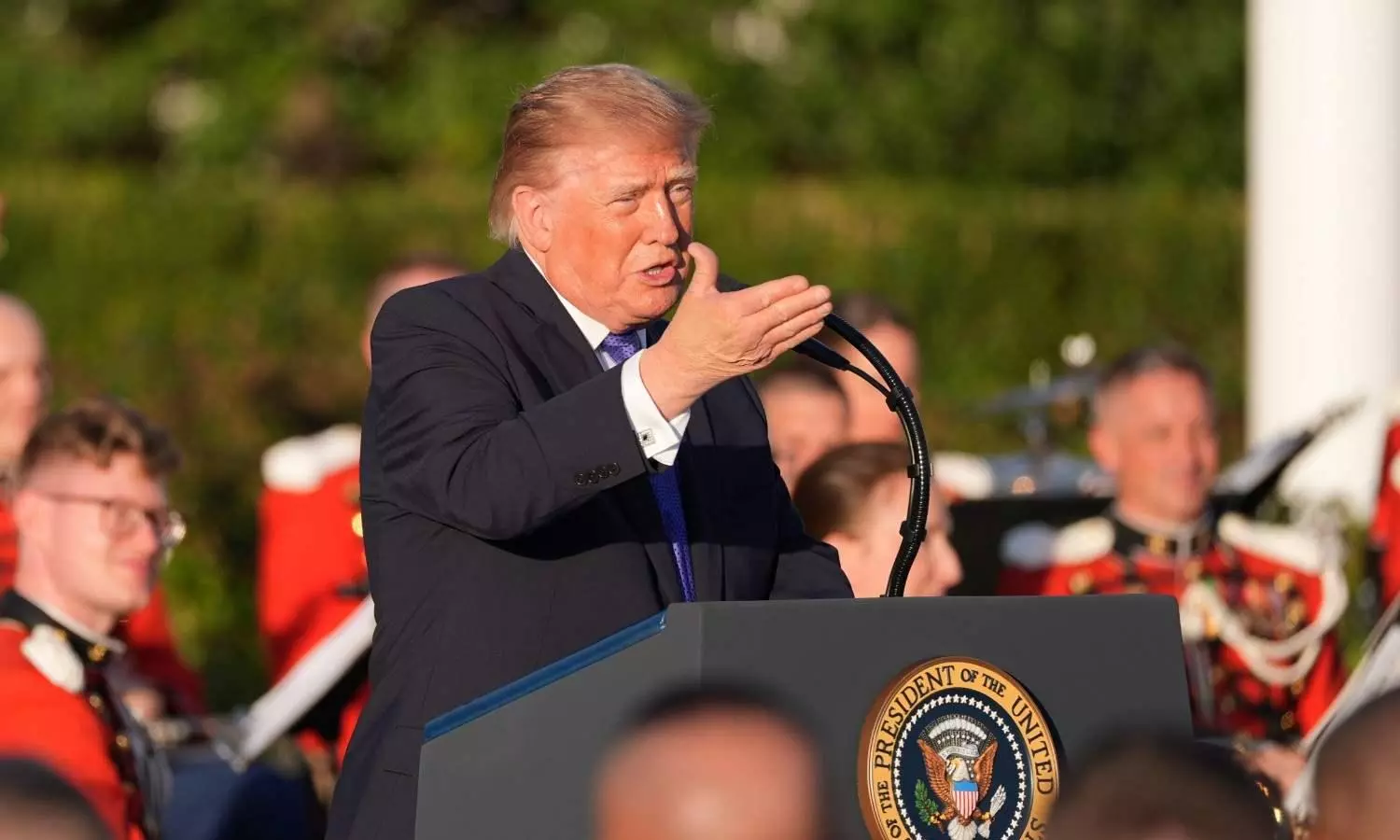
Speaking to reporters at the White House on Friday (Nov 20), Trump accused the US central bank of following a 'very political' approach to monetary policy, claiming that it raised interest rates even when economic indicators were strong. Photo: AP/PTI
Trump cites India’s 7 pc growth to argue US could hit 15-20 pc with lower interest rates
The US President accuses US Federal Reserve of undermining economic growth by keeping borrowing costs high, and cites India’s relatively low interest rates and strong economic performance

US President Donald Trump has invoked India's economic performance to renew his criticism of the Federal Reserve, arguing that lower interest rates could help the American economy achieve growth of 15-20 per cent.
Speaking to reporters at the White House on Friday (November 20), Trump accused the US central bank of following a “very political” approach to monetary policy, claiming that it raised interest rates even when economic indicators were strong.
"Interest rates are too high because we have a very political Fed. And I'm not blaming the chairman, by the way; I'm blaming the fact that we have a very political Fed," Trump said.
“Whenever we announce good numbers, they raise the interest rates. They do that for a reason. It should be the opposite,” he said.
Trump argued that strong economic performance should give the US greater financial credibility and allow the Federal Reserve to reduce borrowing costs. Instead, he alleged, the central bank was doing the opposite and “destroying the country”.
“We'd have a GDP of 15 or 20 per cent, not 4 per cent. We'd pay off the debt very rapidly,” he claimed, advocating a more accommodative monetary policy.
India becomes Trump's economic example
Pointing to India, Trump praised its relatively low interest rates and economic growth of around 7 per cent, suggesting that the US could achieve double-digit expansion under a similar interest-rate environment.
“If you look at India, they have low interest rates and they have a 7 per cent GDP. We would have a 14, 15, or maybe even a 20 per cent GDP,” he said.
He also argued that the US deserved to have the world's lowest interest rates because of its role in supporting other economies.
Also Read: US Fed Reserve keeps rates unchanged despite elevated inflation, gives little signal of next move
However, the comparison overlooks differences in the economic conditions and monetary policy priorities of the two countries. India's Reserve Bank sets rates based on domestic inflation and growth considerations, while the Federal Reserve balances price stability with maximum employment.
India remains the world's fastest-growing major economy, recording GDP growth of 7.8 per cent in the April-June quarter of 2026. Its repo rate, meanwhile, stood at 5.5 per cent following a 25-basis-point increase in September 2025.
Trump's long-running feud with the Fed
Trump's latest remarks are part of his prolonged confrontation with the Federal Reserve over interest-rate decisions. His disagreements with former chairman Jerome Powell began during his first presidency and intensified during his second term, as he repeatedly demanded deeper rate cuts.
Also Read: Defying Trump, Federal Reserve hikes key rate for first time in 3 years
The dispute escalated in 2026 over the rising cost of renovations at the Federal Reserve's headquarters, with Trump questioning the expenditure and his administration pursuing legal action against Powell. A federal judge subsequently blocked subpoenas linked to the investigation, finding that they had been issued for an improper purpose.
Powell's term as chairman ended in May 2026, with Kevin Warsh taking over the position. Powell, however, remained on the Fed's Board of Governors.
Fed maintains cautious approach
Despite Trump's demands, the Federal Reserve has maintained a cautious approach. It raised its benchmark interest rate by 25 basis points in September 2026, taking the target range to 3.75-4 per cent, before holding rates steady at its October 28 meeting.
The decision reflected continuing concerns over elevated inflation, despite resilient consumer spending and strong economic activity. Fed officials have reiterated their commitment to bringing inflation back to the central bank's 2 per cent target.
Also Read: Trump says he has 'no intention' of firing Federal Reserve chair Powell
The debate over further tightening remains alive, with Governor Michael Barr indicating on November 18 that additional rate increases could be necessary depending on how economic conditions evolve.