







During its return, Starship passed over sparsely populated desert areas and flew above towns. Screengrab: @SpaceX
SpaceX catches Starship for first time in milestone for reusable rocket programme
The spacecraft was caught by mechanical arms nicknamed ‘chopsticks’ after a test flight that included 14 orbits of Earth and the deployment of 26 Starlink satellites

SpaceX for the first time successfully performed the “catch” of its Starship spacecraft, completing a feat Elon Musk's company has pursued as part of its plan to make rockets fully reusable.
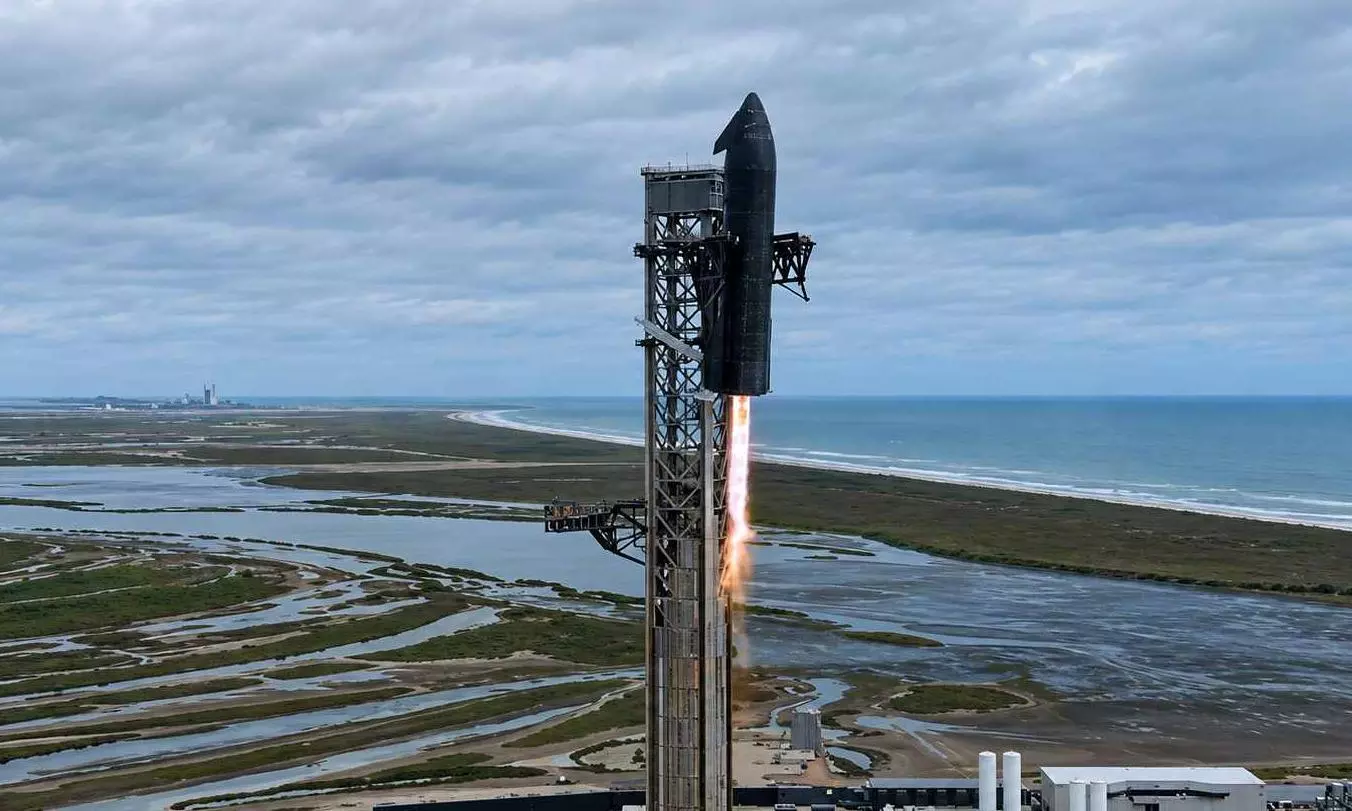
The spacecraft emerged from a cloudy sky after surviving the heat of atmospheric re-entry. It then descended over Starbase in Texas before passing between the mechanical arms above Launch Pad 2.
The arms, nicknamed "chopsticks", caught the spacecraft.
‘Holy Grail of spaceflight’
"That was the Holy Grail of spaceflight, plummeting through fire to be snatched out of the air by steel. We caught a Starship and now, everything changes," SpaceX spokesman Dan Huot said, as quoted by NDTV.
Also Read: SpaceX launches Starship on another test flight with most advanced Starlinks
People gathered on a Gulf of Mexico beach near Starbase cheered as Starship came into view. The final descent played out on SpaceX's official livestream, with the 1977 soft rock song "Baby Come Back" providing the soundtrack.
Starship completes 15th test flight
The recovery took place during the 15th test flight of the world's biggest and most powerful rocket system.
Starship spent 22 hours in flight, orbiting Earth 14 times and deploying 26 satellites for Musk's Starlink internet network.
SpaceX had previously caught its returning booster rockets three times. Catching Starship posed a different challenge. The spacecraft returned from a much higher altitude and descended at a far greater speed than the boosters.
Musk congratulated the team and shared videos of the spacecraft suspended between the arms. He wrote that the vessel "looks great!"
During its return, Starship passed over sparsely populated desert areas and flew above towns. It then performed a "giant swoosh manoeuvre", looping around cities in Texas' Rio Grande Valley before approaching the landing site from the east.
Musk's plans for Starship
Some versions of the spacecraft are intended to carry internet satellites and data centres into orbit. Others are being developed to take people to the Moon and Mars.
Also Read: SpaceX Starship launch aborted on pad at last moment
NASA expects Starship to serve as a lunar lander for its Artemis mission. Administrator Jared Isaacman called Saturday's recovery "almost magic."
"Making more believers by the day... one step closer to (the Moon)," he said on X.
Musk wants Starship to become the workhorse of "rapidly reusable" rockets, with launches as frequent as once an hour.