



South Korean, US militaries shorten drills after Trump ordered reduction
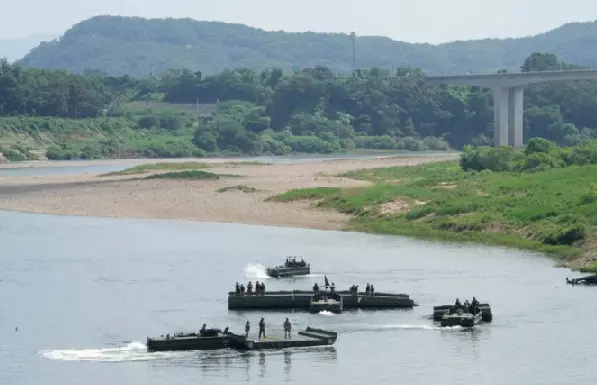
South Korea's military says ongoing drills with the US would end on Aug 21, not Aug. 27 as initially planned. It said the allies also agreed to downsize some joint field training exercises

Seoul, Aug 19 (AP) The South Korean and US militaries have agreed to shorten their drills at the US's request, South Korean officials said Wednesday, days after President Donald Trump ordered cuts to the exercises.
The allies' summertime Ulchi Freedom Shield exercises began Monday morning for an 11-day run, just after Trump ordered his Pentagon chief to “substantially reduce” them. Trump cited what he said was a good relationship with North Korean leader Kim Jong Un and South Korea's refusal to join the US war against Iran.
South Korea's military said in a statement the ongoing drills with the US would end Friday, not Aug. 27 as initially planned. It said the allies also agreed to downsize some joint field training exercises.
Many experts say Trump's move threatens to hurt combined US-South Korean readiness and eventually weaken their decades-long alliance.
Ulchi Freedom Shield is largely a computer-simulated command post exercise meant to hone the allies' ability to deal with potential regional security threats like North Korean aggression. The two countries usually hold field training exercises during the command post exercise period.
The drills and a similar springtime exercise are a central pillar of the US -South Korea alliance, which dates to the 1950-53 Korean War. But it's also a long-running source of tensions with North Korea, which has denounced the exercises as a rehearsal for war and responded with provocative missile tests.
North Korea hasn't responded to Trump's overture. But earlier Wednesday, its state news agency, KCNA, published commentary slamming the US-South Korean military drills as “frantic” and “extremely dangerous” and vowing to completely frustrate its rivals' hostilities.
Experts said North Korean leader Kim Jong Un, now emboldened by his advancing nuclear program and expanding military cooperation, won't likely embrace Trump's overture anytime soon unless he's promised bigger concessions. In response to Trump's previous outreach, Kim suggested last year that he can return to talks only after the US drops its demand of a North Korean denuclearization as a precondition for diplomacy.
Trump and Kim met three times from 2018-2019 but their high-stakes diplomacy eventually fell apart over wrangling over a North Korean demand for extensive sanctions relief in return for limited denuclearization steps. AP