



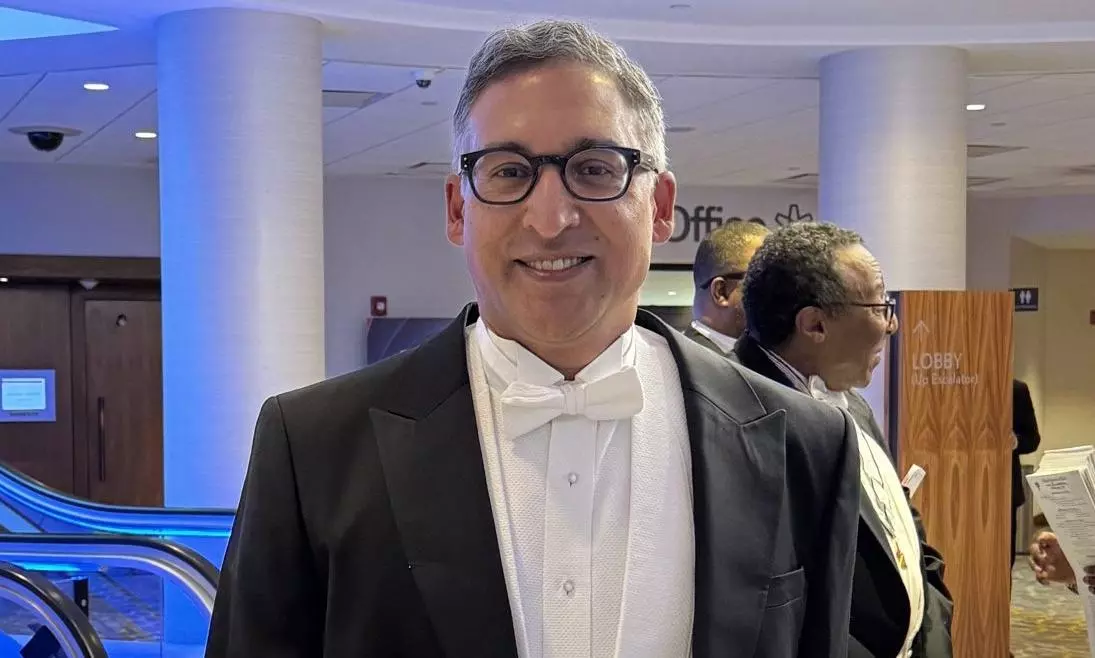
Neal Katyal was one of the youngest professors to have received tenure and a chaired professorship in Georgetown University's history. | Photo: X/@neal_katyal
Who is Neal Katyal, the Indian-origin lawyer who challenged Trump’s tariffs?
Former US Acting Solicitor General argued for small businesses, calling the ruling a major constitutional victory reaffirming Congress’s power over taxation

An Indian-origin lawyer has emerged at the centre of the landmark US Supreme Court verdict striking down President Donald Trump’s sweeping global tariffs. He had argued the case on behalf of small businesses and won.
Neal Katyal, the son of Indian immigrants and the former Acting Solicitor General of the United States under President Barack Obama, argued before America’s highest court about the illegality of the levies.
“Victory,” Katyal posted on X shortly after the Supreme Court verdict came in on Friday (February 20).
Also read: Explainer: India-US tariffs after Supreme Court verdict
“That is something so extraordinary about this country. The idea that we have a system that self-corrects, that allows us to say, ‘You might be the most powerful man in the world, but you still can’t break the Constitution.’ That to me is what today is about,” he said after the judgement.
Who is Neal Katyal?
Katyal was born in Chicago in 1970 to a paediatrician mother and engineer father, both of whom immigrated from India.
Currently working as a partner in the Washington DC office of Milbank LLP and a member of the firm’s Litigation & Arbitration Group, Katyal focuses on appellate and complex litigation. He has argued 54 cases before the Supreme Court of the United States, breaking records for minority advocates.
Legal career
He has also served as a law professor for over two decades at Georgetown University Law Center, “where he was one of the youngest professors to have received tenure and a chaired professorship in the university's history,” and has served as a visiting professor at Harvard and Yale law schools.
A graduate of Yale Law School, Katyal clerked for Guido Calabresi of the US Court of Appeals for the Second Circuit as well as for Justice Stephen G Breyer of the US Supreme Court.
Also read: Who is Mathura Sridharan, and why is her bindi being trolled?
He also served in the Deputy Attorney General's Office at the Justice Department as National Security Advisor and as Special Assistant to the Deputy Attorney General during 1998-1999.
He has defended the constitutionality of the Voting Rights Act of 1965, contested Trump’s 2017 travel ban, and won unanimous decisions in major environmental and national security cases.
He previously served as Special Prosecutor for the State of Minnesota in the murder case of George Floyd and authored Impeach: The Case Against Donald Trump.
Accolades
Katyal is the recipient of the “highest award given to a civilian” by the US Department of Justice, the Edmund Randolph Award, which was presented to him by the Attorney General in 2011.
He has been named Litigator of the Year by The American Lawyer in 2017 and 2023. Forbes listed him among the top 200 lawyers in the United States in 2024 and 2025.
Also read: Meet Manpreet Monica Singh, first female Sikh judge in US
The Chief Justice of the United States appointed him in 2011 and 2014 to the Advisory Committee on Federal Appellate Rules.
The tariff case
The case was brought by small businesses and supported by the Liberty Justice Center. Trump had defended the tariffs as vital to national security and economic leverage, citing trade deficits and fentanyl overdoses as national emergencies.
Also read: India’s tariff cut to 10 pc as Trump issues proclamation on new levy
Calling the ruling a constitutional milestone, Katyal said, “Its message was simple: Presidents are powerful, but our Constitution is more powerful still. In America, only Congress can impose taxes on the American people. The US Supreme Court gave us everything we asked for in our legal case. Everything.” Katyal expressed gratitude for the leadership of the Liberty Justice Centre, who “led the fight when others wouldn’t”.
"This case has always been about the presidency, not any one president. It has always been about separation of powers, and not the politics of the moment. I'm gratified to see our Supreme Court, which has been the bedrock of our government for 250 years, protect our most fundamental values,” he said.
(With agency inputs)