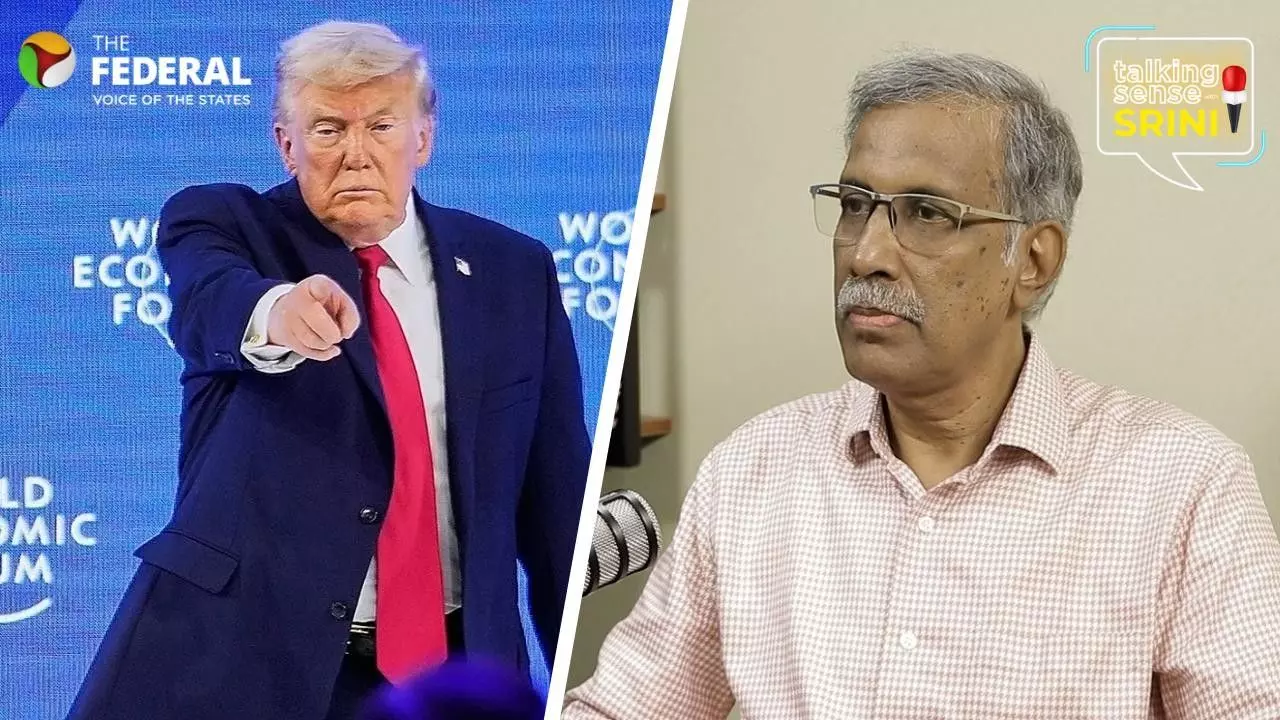
From threats to tariffs, how Trump has altered US foreign policy| Talking Sense With Srini
What sets this new phase apart is the personalisation of power, with decision-making increasingly centred on “I” and “me”

As Donald Trump completes a year back in the Oval Office, the global order appears increasingly unsettled, with U.S. allies and adversaries alike struggling to interpret Washington’s intentions. That unease was on full display at the World Economic Forum in Davos, where Trump openly berated traditional partners while doubling down on an aggressively transactional worldview.
Trump’s approach, The Federal’s Editor-in-Chief S Srinivasan said, is not the absence of a U.S. foreign policy but a radical shift in how it is executed. “America has behaved unilaterally in the past as well,” Srinivasan said, pointing to the Iraq war. “What is different now is the personalization of power — everything is about I, me.”
'More of real estate language'?
Nowhere has that been clearer than in Trump’s remarks on Greenland. The U.S. president has repeatedly floated the idea of acquiring the Danish territory, a language Srinivasan described as resembling a real-estate transaction rather than statecraft. “He is not talking about influence or security cooperation,” Srinivasan said. “He wants ownership and title.”
India is not a pushover because of its market size and geopolitical weight
The comments rattled European leaders, even as official responses from Brussels and major capitals remained measured. France and Germany warned of potential retaliation, while Denmark rejected any notion of sovereignty negotiations. According to Srinivasan, Europe initially underestimated Trump, hoping accommodation would defuse tensions. “That changed when Greenland entered the picture,” he said, adding that Trump appeared to tactically retreat after markets reacted negatively and political pushback mounted.
'Part of Broader Trump Doctrine'
The Greenland episode fits into what Srinivasan described as a broader “Trump Doctrine” — one that departs even from the Monroe Doctrine’s traditional spheres of influence. “Instead of defined regions, the entire world becomes his theatre,” he said.
Also Read: Why Donald Trump is fuming at UK over ceding Diego Garcia to Mauritius
Trump’s use of uncertainty as leverage has also defined his trade policy. While he imposed sweeping tariffs on China, Europe and India, he ultimately backed down after Beijing pushed back. “There’s a phrase now doing the rounds — TACO: Trump Always Chickens Out,” Srinivasan said, noting that market volatility remains one of the few constraints on Trump’s behavior.
Yet Trump has also taken steps previous administrations avoided, including authorizing strikes on Iranian nuclear facilities and backing covert operations in Venezuela. “These are unthinkable moves,” Srinivasan said. “They show a global power trying not to lose relevance.”
India's challenges
For India, the challenge is particularly complex. New Delhi faces some of the highest U.S. tariff rates while balancing strategic cooperation with economic self-interest. Srinivasan said Prime Minister Narendra Modi’s government has chosen restraint over confrontation. “India hasn’t stared Trump down, but it hasn’t buckled either,” he said.
Instead, India has quietly diversified — accelerating trade talks with Europe, reducing Russian oil imports, and expanding defense and commercial ties with the U.S. “India is not a pushover,” Srinivasan said, citing its market size and geopolitical weight. “Trump knows that.”
Ultimately, Srinivasan argued, India’s leverage will depend on domestic strength. “The real answer lies in building our own economic and technological capacity,” he said. “Without that, diplomacy alone has limits.”