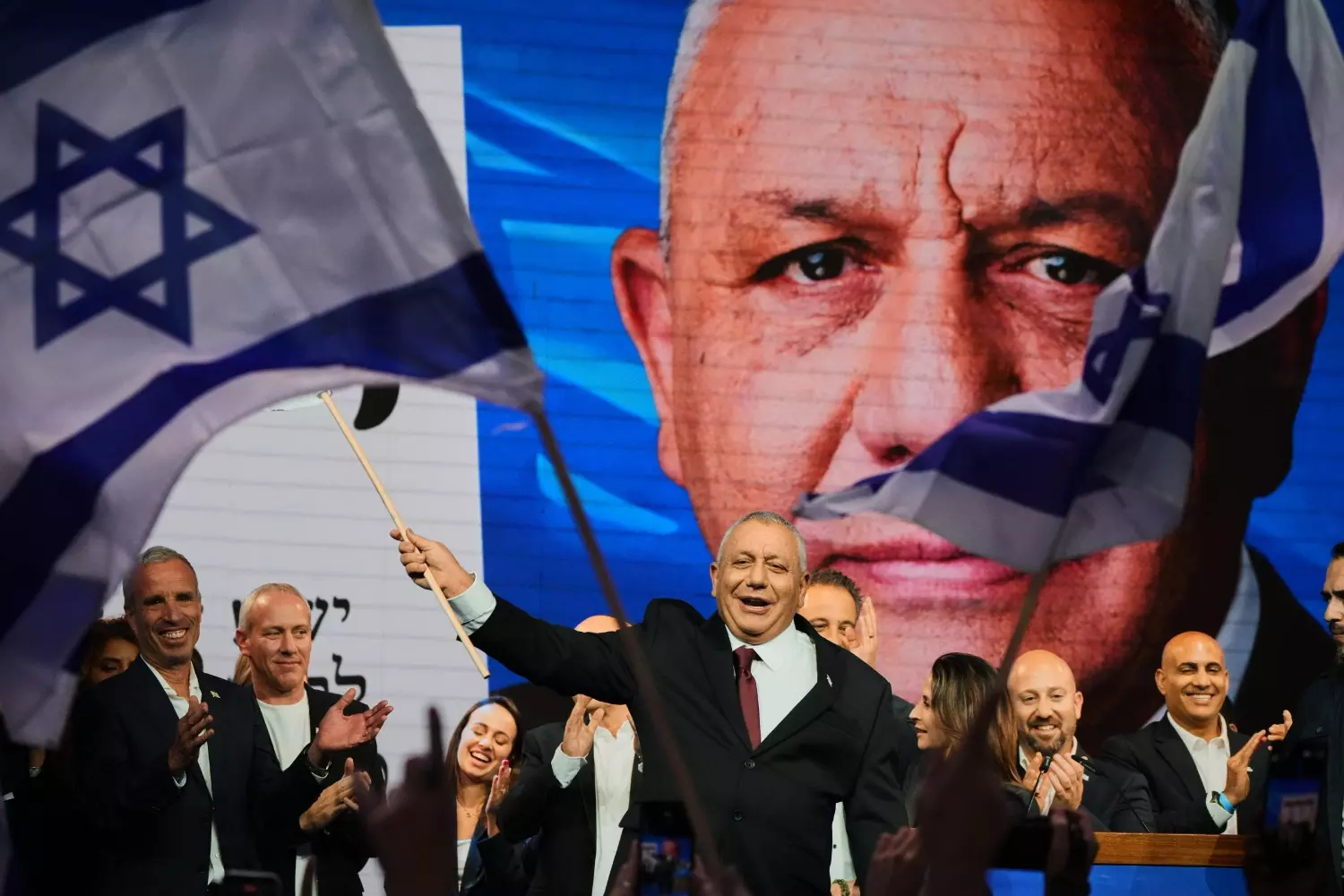
Gadi Eisenkot, leader of the Yashar ("Straight") party, waves an Israeli flag onstage following the release of the first exit poll results in Israel's general election in Tel Aviv, Israel, Wednesday, October 28. AP/PTI
Choice for Israel’s Opposition: Work with Arab parties or let Netanyahu return
Final count is still underway, but emerging picture is clear. Netanyahu’s Likud is single largest party, with 26 seats, followed by Eisenkot’s Yashar with 21

Will Israel’s Opposition leader Gadi Eisenkot forfeit his chance of defeating Benjamin Netanyahu simply because he will not align with the Arab parties, whose members are as much citizens of Israel as the Jews? Will he hand power back to Netanyahu and expose the country to another period of endless wars, while allowing the government to complete the deeply controversial judicial reforms that have so angered large sections of Israeli society?
The Israeli elections have thrown up a mixed bag, as was to be expected in a country where no single party has ever won an outright majority. This is partly because of its system of proportional representation, under which voters choose a party rather than a candidate in an individual constituency.
Netanyahu’s Likud is single largest party
The final count is still underway, but the emerging picture is clear. Netanyahu’s Likud is the single largest party, with 26 seats, followed by Eisenkot’s Yashar with 21. The Arab parties together have won 19 seats, their strongest showing yet. The 120-member Knesset requires 61 seats for a majority. The Opposition bloc has 48, which means Arab support could take it to 67. Netanyahu had 53.
Also read: Israelis await final poll results as Netanyahu rivals weigh joining forces with Arab parties
Haaretz, Israel’s well-respected English-language daily, has posed the question in a front-page story: “Israel’s Opposition Says It’s Different From Netanyahu. Now It Must Prove It.” The Opposition’s best chance of defeating Netanyahu, Israel’s longest-serving prime minister, is to form a government with the support of the Arab parties. Yet the reluctance to work with Arab citizens of Israel remains so strong that few Opposition leaders are willing to take an independent line.
The question is how far Eisenkot is prepared to break with Netanyahu’s approach. Although he is challenging Netanyahu politically, his views on security and Palestinian rights do not necessarily mark a clear departure from those of the prime minister. As a former chief of staff of the Israel Defense Forces (IDF), Eisenkot was associated with the controversial “Dahiya doctrine”, which advocates the use of overwhelming force and the destruction of civilian infrastructure in areas used by militant groups.
The doctrine takes its name from the Dahiya neighbourhood of Beirut, which was heavily bombarded during Israel’s 2006 war with Hezbollah. Critics have drawn parallels between this approach and the extensive destruction inflicted by the IDF in Gaza and Lebanon in more recent conflicts.
Islamist party leader offers support to Opposition
It is therefore not surprising that Eisenkot and several others in the Opposition’s “change bloc” had declared before the elections that they would not form a government with the Arab parties. Yair Golan, leader of the Democrats, was a notable exception. He refused to rule out such an arrangement.
Also read: US asks Middle East allies to prepare for renewed strikes on Iran: Report
“We must no longer accept Netanyahu’s racist division between Jewish votes and Arab votes,” Golan said. “We have a majority. We have a responsibility. And we have an opportunity to form a change government in partnership with Arab citizens of Israel,” he said after election results poured in.
Mansour Abbas, leader of Ra’am, an Islamist party, has offered to support the Opposition. Abbas broke a longstanding taboo when he joined a governing coalition in 2021-22. But public opinion in Israel has hardened considerably since the Hamas attack of October 7, 2023, including among liberal and left-leaning sections of the Jewish population.
“Clearly this is emerging as an option mathematically and politically,” Yohanan Plesner, president of the Israel Democracy Institute, told the Jewish Telegraphic Agency, according to The Times of Israel. “It’s obviously not only a violation of campaign promises, but I think the Israeli public opinion is deeply unprepared for such an option,” he added.
Arab parties not a united bloc
The willingness of Jewish voters to accept a government dependent on an Islamist party has diminished since the Hamas onslaught. The Arab parties, too, are not a united bloc, and their willingness to support an alternative government does not automatically guarantee agreement on the terms.
Several well-wishers of Israel in the US have urged Eisenkot’s bloc to work with the Arab parties. Dan Shapiro, a former US ambassador to Israel during the Obama administration, commended voters on X (Formerly Twitter) for creating an “important opportunity for change”. That change, he said, could come if Eisenkot’s bloc worked with the Arab parties. In a follow-up post, Shapiro argued that “in almost no scenario” would far-right ministers Itamar Ben-Gvir and Bezalel Smotrich continue to wield the influence they currently enjoy.
“Greater integration of the Arab community into Israeli society is also key for political and democratic legitimacy,” Gabriel Epstein, a senior policy associate at the Israel Policy Forum, wrote on X.
What Netanyahu will do
Netanyahu, meanwhile, will try to present the election results as a vindication of his policies. For the prime minister, the stakes are also personal. Facing trial on charges of fraud and bribery, he would also face renewed scrutiny over the failure to prevent the Hamas attack three years ago if he leaves office.
Israeli Prime Minister Benjamin Netanyahu, accompanied by his wife, Sara, waves to supporters at Likud party headquarters in Jerusalem after the release of the first exit poll results in Israel's general election, Wednesday, October 28. AP/PTI
Despite these liabilities, Likud has emerged as the largest party. Netanyahu will do his best to prevent the Opposition from forming a government with Arab support. During the campaign, he portrayed the change bloc as willing to come to power on the backs of Arab lawmakers. On election day, as thousands of Arab citizens turned out to vote, Netanyahu raised the alarm over their participation. His party also alleged vote tampering by Arab voters, a claim that police quickly dismissed as unsupported.
When will new govt be formed?
Netanyahu may also present the election as only a partial victory in his larger mission to secure Israel. He has made regime change in Iran a stated goal, raising concerns that Israel could once again seek a full-scale military confrontation with Tehran. US President Donald Trump has also spoken of the possibility of renewed bombing, while the US has reinforced its military presence in the region. Any escalation would have consequences far beyond Israel’s borders.
How long will it take to form a new government? The choices before the Opposition’s change bloc are clear. It can work with the Arab parties and attempt to form a government, seek a national unity arrangement with Likud, or allow Netanyahu to remain caretaker prime minister while the country heads towards another election.
Reports suggest that Washington favours a stable Israeli government as part of its wider efforts to secure peace in a region already wracked by war. But stability alone will not resolve the deep political divisions within Israel, or the question of how far a new government would depart from Netanyahu’s policies.
The Opposition’s refusal to work with the Arab parties could once again give Netanyahu a way back to power, despite the possibility of forming an alternative government. For Eisenkot and others in the change bloc, the question is whether defeating Netanyahu matters more than the political cost of breaking their campaign promises. With Trump keen to see a stable Israeli government as part of his wider regional peace efforts, the coming weeks could prove decisive. But unless the opposition is willing to rethink its red lines, the promise of change may remain just that.