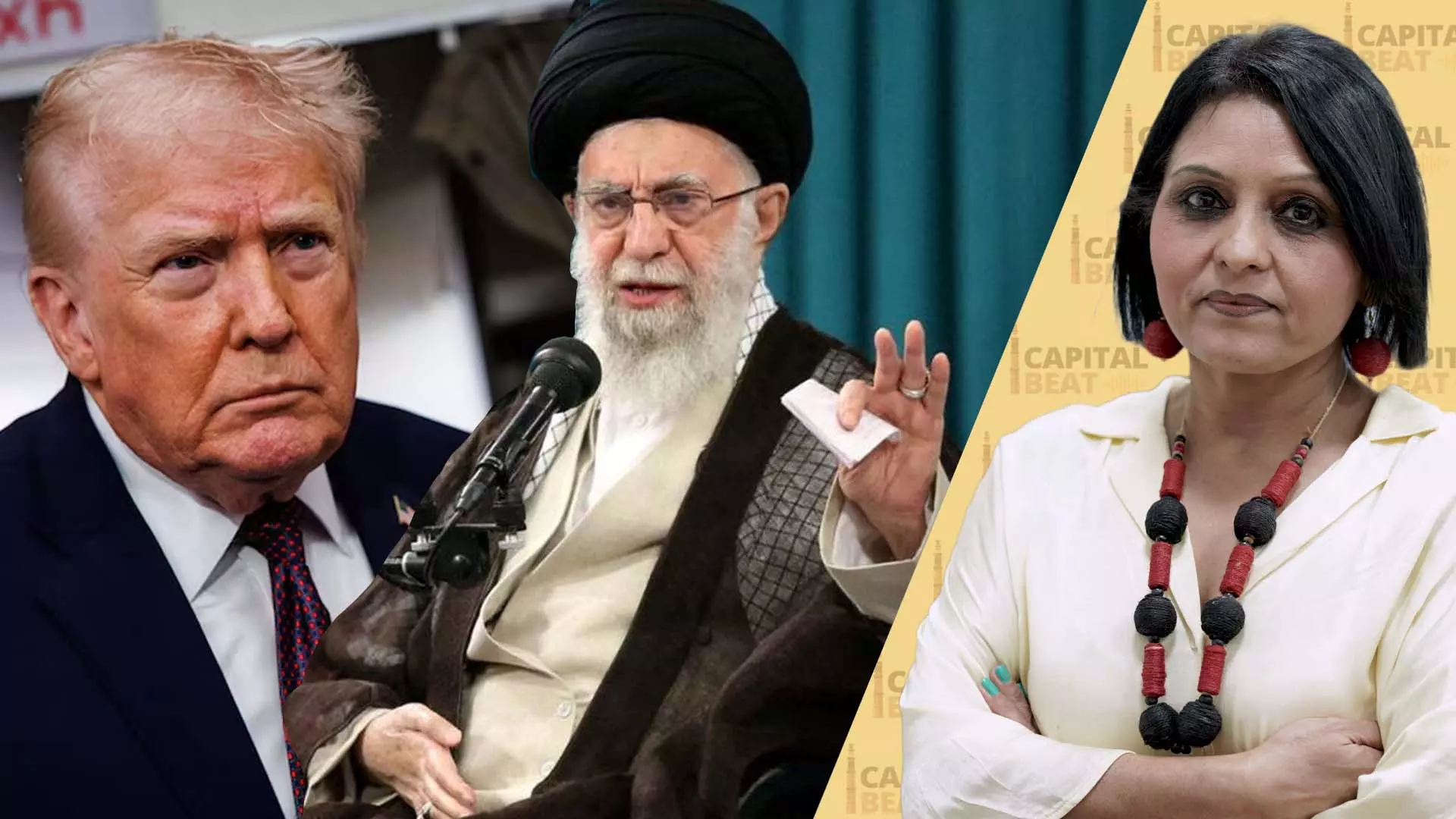
Can Trump unleash a war on Iran amid changing global dynamics?
The Federal speaks with former diplomat Ambassador Anil Trigunayat and senior foreign affairs journalist Kallol Bhattacherjee on escalating US-Iran tensions

The Federal spoke to former diplomat Ambassador Anil Trigunayat and senior foreign affairs journalist Kallol Bhattacherjee in the latest Capital Beat episode on the escalating tensions between the United States and Iran. As US President Donald Trump issues stark threats and Tehran responds in kind, the discussion explores whether war is imminent, how Iran may respond, and why India’s strategic interests are deeply at stake.
Can Trump unleash a war on Iran amid changing global dynamics? How serious is his threat?
Kallol Bhattacherjee said Trump’s threat to “wipe Iran off the face of the earth” is less about Tehran and more about American domestic politics.
He argued that Trump has long been trying to find common ground with the US national security establishment, particularly in West Asia. The American bureaucracy, he said, is broadly aligned with Israel and opposed to Iran’s Islamic revolutionary government. Iran, therefore, becomes a space where Trump and the establishment can converge.
According to Bhattacherjee, the message is not really meant for Iran but for Trump’s domestic and bureaucratic critics, who see him as unpredictable and out of control. By taking a hard line on Iran, Trump seeks to bring even his opponents—such as Hillary Clinton and Barack Obama—onto a shared platform, since even they would agree with him on toppling the Iranian government.
Healso referred to a text message from French President Emmanuel Macron that Trump shared, in which Macron reportedly suggested cooperation on Iran even as he opposed Trump on issues like Greenland and Denmark. To him, this showed Trump was trying to unite various critics around what he called an “Iranian plot”.
“So to me it appears more like messaging to his critics—let’s find a major project where we can work together even if we disagree on many other areas,” he said.
What does Trump really mean by threatening Iran, and how serious is this escalation?
Anil Trigunayat said Trump and Iran were threatening each other in the same language, driven by what he called a “mutually assured destruction syndrome”.
He said Trump may have believed that simply threatening Iran would make things settle down, as he thought had happened in Venezuela. But Iran, he stressed, is very different. It has endured Western pressure since 1979 and survived sanctions and isolation, even as it now faces a deep economic crisis and serious domestic problems.
Trigunayat said Trump’s approach amounted to dictating to a country how to handle its internal law and order issues. He added that the world no longer operates under any meaningful respect for international law, with superpowers and middle powers alike doing as they please.
He noted that regime change has been a consistent agenda across US presidencies, with more than 70 such changes allegedly carried out with American assistance. But this time, he said, the international environment is very different.
Can Trump really wage a war on Iran, as he did in Venezuela?
Trigunayat said that if Trump failed to understand Iran, he might attempt military action, but the consequences would be catastrophic.
He recalled that during earlier confrontations, Iran was allowed to strike a US base in a controlled way to save face. He warned that a full-scale war would spiral out of control.
“If Iranians go down, they will take everybody down with them,” he said, adding that Iran would target US bases across the Gulf, which are located in friendly countries.
Referring to the 12-day war in June, he said Iran had fought on despite early losses and forced an eventual accommodation. He argued that Iran is now better prepared militarily. The real challenge for Tehran, he said, lies not outside but within—resolving youth unrest and economic distress, which would decide the future of the clerical leadership.
“I don’t think the United States is in a position to effect any change by simply attacking from 40,000 feet,” he said.
How might Iranians and regional countries respond if war breaks out?
Bhattacherjee said Iranian society is deeply complex. While the ruling establishment emphasizes Islamic identity, there is a strong and enduring Iranian or Persian nationalism.
He said that although many Iranians criticize the Islamic government, they would rally around it if Iran were humiliated or attacked from outside.
“When it comes to nationalism, even critics of the government would say, ‘You may not be the best, but you are our people,’” he said.
He noted that protests inside Iran weakened when the US and Israel began threatening Tehran. He also pointed out that a large Persian-speaking Jewish population in Israel traces its roots to Iran and that some in Israel believe they can influence events inside Iran.
But he warned that overt attempts to topple the Iranian government from outside only harden resistance.
What message would regime change in Iran send to the world?
Bhattacherjee said toppling the Iranian government would be a red line not just for Iran but for the global order.
If Iran—despite surviving American pressure for over four decades—were crushed by US and Israeli military power, it would send a chilling message to other regional powers.
Countries in Central Asia, South Asia, and beyond would conclude that governments can now be toppled purely through military force, without even the need for internal uprisings.
“That would be a dangerous escalation of the current state of global anarchy,” he said.
How precarious is India’s position if war breaks out?
Trigunayat said India would be among the most affected countries if war erupts. “The region will be in flames, but India will be directly impacted,” he said.
He pointed out that 60-70 per cent of India’s energy comes from the Gulf region. India also has about $80 billion in investments in the UAE, over 15,000 Indian companies operating there, and more than 10 million Indian nationals living in the region. Their safety and security, he said, would be India’s biggest concern.
He also warned that the Strait of Hormuz and the Red Sea could be disrupted, with Houthi forces becoming active. Since 82 percent of India’s trade passes through these routes, even a short disruption would severely hurt the Indian economy.
Drawing on his experience as ambassador to Libya, he said US interventions have only brought destruction, citing Iraq as the “mother of all evils”.
How should India position itself diplomatically?
Bhattacherjee said an all-out war would devastate India’s extended neighbourhood. He said India has been extremely cautious about Iran, maintaining long-term projects through the India–Iran Joint Commission so that stalled initiatives can be revived when conditions improve.
He described India–Iran relations as one of India’s oldest strategic partnerships. He recalled how Iran had supported India on Kashmir, including during a UN Human Rights Council resolution promoted by Benazir Bhutto.
He narrated how former Prime Minister PV Narasimha Rao sent then Deputy Foreign Minister Dinesh Singh to Tehran, despite Singh’s ill health, to seek Iranian support. Iran not only backed India but also mobilised other Islamic countries to support India’s position.
Should India speak out more strongly against war?
Trigunayat said India should make its position clear even if superpowers do not listen. He noted that India chairs BRICS, of which Iran is now a member, and that Iran is also part of the Shanghai Cooperation Organisation and the Global South.
“If we want to be the voice of the Global South, we must articulate our position,” he said, adding that India should tell Trump that “this is not an era of war,” echoing Prime Minister Narendra Modi’s words.
Bhattacherjee agreed, saying India must be more vocal in defending its own interests and those of its extended neighbourhood.
He said European powers cannot be expected to rescue Iran, as they act purely in their own interests. Referring again to Macron’s message, he said Europe appears willing to cooperate with the US on Iran in exchange for concessions elsewhere. “We should come out in support of peace in a more audible manner,” he said.
(The content above has been transcribed from video using a fine-tuned AI model. To ensure accuracy, quality, and editorial integrity, we employ a Human-In-The-Loop (HITL) process. While AI assists in creating the initial draft, our experienced editorial team carefully reviews, edits, and refines the content before publication. At The Federal, we combine the efficiency of AI with the expertise of human editors to deliver reliable and insightful journalism.)