



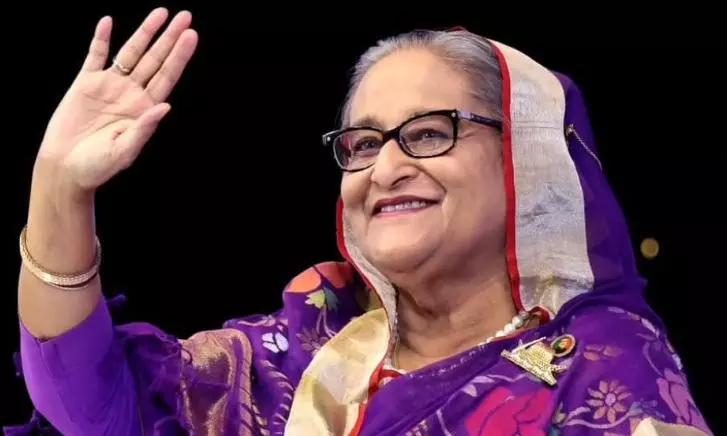
The former Prime Minister voiced concern over deteriorating India–Bangladesh ties, citing anti-India protests and the killing of 27‑year‑old Hindu youth Dipu Chandra Das. Instagram file photo
Violence the norm in Bangladesh: Hasina attacks interim regime
Ex‑PM blames Yunus government for lawlessness, extremist rise, worsening India–Bangladesh relations; Bangladesh faces instability at home and abroad, she warns

Bangladesh’s ousted Prime Minister Sheikh Hasina launched an attack on the Muhammad Yunus government saying that violence has become the norm in Bangladesh, and accused the interim government of failing to maintain law and order and allowing extremist forces to gain ground.
In an email interview with ANI, Hasina said the killing of radical student leader Sharif Osman Hadi and the subsequent unrest revealed what she termed ‘lawlessness’ under the interim government. She argued that conditions had worsened since her ouster and cautioned that the continuing violence was destabilising Bangladesh internally while also straining relations with neighbouring countries, especially India.
'Violence become the norm'
The death of Sharif Osman Hadi, a political activist who played a pivotal role in the July movement that led to Hasina’s ouster, has sparked a fresh wave of violence in Bangladesh. Hadi was shot at close range while travelling in a rickshaw in Dhaka on December 12. He sustained a severe head injury, was airlifted to Singapore for treatment, but succumbed to his wounds on December 18.
In the aftermath of his killing, offices of leading newspapers – The Daily Star and Prothom Alo – along with cultural organisations such as Chhayanaut and Udichi Shilpi Gosthi, were attacked.
Hasina said in the interview that this "tragic killing reflects the lawlessness that uprooted my government and has multiplied under Yunus".
Also read: Bangladesh unrest: Anti-India protests, election uncertainty, Jamaat’s rise test Delhi's options
"Violence has become the norm while the interim government either denies it or is powerless to stop it. Such incidents destabilise Bangladesh internally but also our relationships with neighbours who are watching with justified alarm. India sees the chaos, the persecution of minorities, and the erosion of everything we built together. When you cannot maintain basic order within your borders, your credibility on the international stage collapses. This is the reality of Yunus's Bangladesh," Hasina said.
Rising Islamist influence
In her interview, Hasina also flagged the rising influence of Islamists, alleging the interim government had freed convicted terrorists and empowered extremists.
She accused Yunus of placing radicals in key posts to project moderation abroad while advancing a hardline agenda at home.
"Yunus has placed extremists in cabinet positions, released convicted terrorists from prison, and allowed groups linked to international terrorist organisations to take roles in public life," she claimed, adding that he lacked experience in governing a complex country.
"This should alarm not only India but every nation invested in South Asian stability", Hasina said, asserting that secularism had been one of Bangladesh's core strengths.
India-Bangladesh ties
The former Prime Minister voiced concern over deteriorating India–Bangladesh ties, citing anti-India protests and the killing of 27‑year‑old Hindu youth Dipu Chandra Das. She blamed the interim government for fostering hostility toward New Delhi and failing to safeguard religious minorities.
Also read: Bangladesh unrest affecting Bengal, says Bhagwat; urges Centre to intervene
Das was lynched by a mob over alleged blasphemy on December 18, and his body was later set ablaze. The incident sparked widespread outrage and resulted in the arrest of 10 suspects.
Visa services
Hasina also referred to the suspension of visa services at the Indian Visa Application Centre in Chittagong after a security incident. According to Hasina, India’s concerns were justified. She alleged that extremists empowered by the interim government had targeted minorities, media outlets, and diplomatic missions.
Bangladesh, meanwhile, continues to reel under protests and vandalism, including attacks on media offices, amid a tense political climate ahead of the February elections.