Andhra to Zaragoza — how Indian star gazer spent decades chasing solar eclipses across continents
Earlier this month, a crowd of astronomy enthusiasts gathered in Spain to witness a total solar eclipse. A rare occurrence, India has experienced it too in the past. But superstitions once held back many from enjoying it.

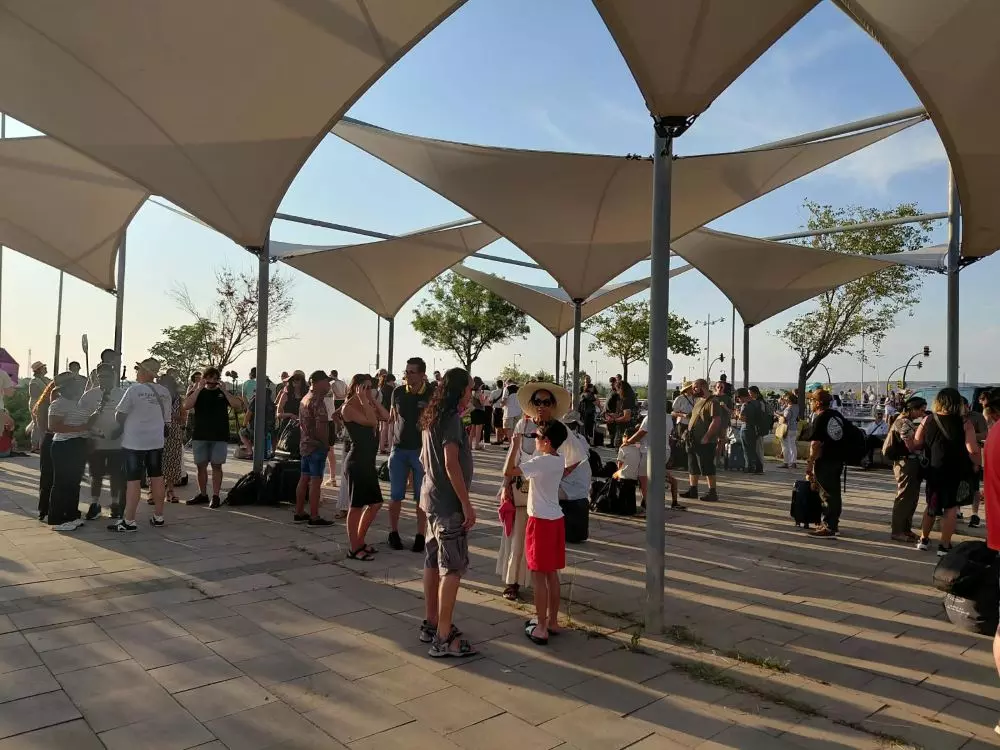
Enthusiasts gathered in Zaragoza, Spain, to witness the total solar eclipse earlier this month. Photo: TR Govindarajan
Earlier this month, I was lucky to witness a total solar eclipse in Spain.
Witnessing a total solar eclipse is a rare phenomenon for any city, state or country. When it does happen, it is a source of immense astronomical activity around that place.
The start (left) and end of the total solar eclipse in Spain. Photo: TR Govindarajan
Going back in history, it was a total eclipse that had helped astrophysicist-mathematician Arthur Eddington to convince the world that Albert Einstein’s theory of general relativity was, after all, correct. Einstein’s theory predicted that light rays from a star bend as they pass close to a massive object like the Sun. This could be measured only during a total solar eclipse and that too in a place where the eclipse is at 100 per cent. Eddington travelled to Africa in 1919 to measure this bending.
In the following Royal Society Meeting, Eddington declared: “Oh leave the Wise our measures to collate/One thing at least is certain, light has weight/One thing is certain and the rest debate/Light rays, when near the Sun, do not go straight.”
When Rahu-Kethu gobble the Sun
In Indian astronomical traditions, Aryabhata, not only fought against the religious belief that an eclipse is caused by the celestial bodies Rahu-Kethu swallowing the Sun, but instead named these entities as the ‘shadow planets’, which help in predicting eclipses. The superstition that eclipses bring bad luck and diseases prevailed for a long time, however. In India, people were told to stay indoors and avoid food during any such occurrence.
The total solar eclipse as witnessed in Spain this month. Photo: TR Govindarajan
In 1980, during a solar eclipse in Andhra, for example, the streets were empty. Even public transport drivers were given leave to stay home.
However, some of us, then students at the Madras University, travelled to Kambam in Andhra, where the total eclipse could be witnessed. To our astonishment, the town was completely empty, despite the people there being lucky enough to be able to witness the great cosmic dance taking place at their doorstep.
Also read: How the Nancy Grace Roman Space Telescope, NASA’s latest eye in space, will help decode the universe
Over the following years, because of the efforts of science groups across the country and the Department of Science and Technology, this belief finally changed. In 1995, when another solar eclipse was visible from Agra, Allahabad and Kolkata, lakhs came out to see it, wearing dark glasses for protection. I was there too, near the Taj Mahal, with my daughter.
Cut to 2009. Patna Maidan was witness to thousands of people (me included) waiting early morning to see an eclipse. Unfortunately, the clouds spoiled the game and the journey proved useless.
The next total eclipse in India is scheduled for 2034 and will be visible from Jammu and Kashmir.
Seeing it in Spain
But I had a chance to see one recently, when I was visiting Spain on August 12.
The path of the eclipse lay across Iceland, Portugal and Spain. Millions in Europe were witness to the rare occurrence, even though it was not a 100 per cent eclipse everywhere. That treat was reserved for a few parts of Spain.
One complication is that the time of the eclipse was close to sunset.
'Bailey Beads', when the Suns rays pass through the outer ring of the Moon, 20 seconds before the eclipse reaches totality, appearing as beads. Photo: TR Govindarajan
Sunset in the northern hemisphere in the month of August is around 9:30 pm (local time). The places from where a total eclipse was to be visible included Burgos, Leon, Mallorca, Gijon and Zaragoza. The last, a place around 250 kilometres from Barcelona, was where I witnessed it.
The eclipse was to start at Zaragoza around 7 pm, reaching totality at 8:29 pm, lasting for one-and-a-half minutes. News of the upcoming total eclipse had ensured that all hotels were booked and prohibitively expensive.
I was going there with my daughter, who had joined me from Canada. We stayed in Barcelona, where the eclipse was at 99 per cent. We took a superfast train and reached Zaragoza in the evening around 6 pm.
Also read: What NASA invitation to India to join work on planned Moon Base could mean for both
The name Zaragoza itself is interesting. It stems from the fact that the city was established by Augustus Caezar (Zar stands for Caezar, meaning emperor and Agosa for Augustus). The town also boasts of old Roman remains which have been very well maintained. It also has links to the old Arab world through a palace named Aljaferia, once a recreational place for the rulers of the Taifa (independent principalities in the Iberian Peninsula, in modern-day Spain and Portugal). It has a defence tower, the courtyard of Santa Isabel and a mosque with a mihrab (niche in the wall of a mosque) which shows the direction of Mecca.
The ‘Solar Corona’, the outermost part of the Sun's atmosphere, can be seen just before and after totality. Photo: TR Govindarajan
Returning to the total solar eclipse, the occurrence holds different interesting features for astronomy enthusiasts. One is ‘Bailey Beads’, when the Sun’s rays pass through the outer ring of the Moon twenty seconds before totality, appearing as beads. Another is called ‘The Diamond ring’, which is formed when, some 30 seconds before totality, a bright shining light appears, looking like a ring. Unfortunately, it only lasts for a couple of seconds. The ‘Solar Corona’, the outermost part of the Sun's atmosphere, can be seen just before and after and is a subject of research even today. Then there are the ‘Shadow Bands’, thin wavy lines visible before and after the eclipse. Also, before the eclipse reaches totality, the sun’s images appear on the ground owing to the pinhole camera effect — when a small hole projects light on a surface, producing an inverted image of whatever is in front of it. Other interesting features include the visibility of planets like Jupiter and Venus during the eclipse, depending on the location and timing. Also, close to totality, there is a sudden drop in temperature.
Near the Zaragoza train station, hundreds of enthusiasts from different places were assembled with their cameras, eagerly waiting to capture the total eclipse. I was concerned that the journey of a few thousand miles should not become a waste, owing to clouds spoiling the vision. But we were lucky.
We were able to see ‘Bailey Beads’ and ‘Diamond Ring’ formations. When the totality occurred, the whole crowd suddenly became silent and then, when the Sun emerged again, a roar went up from the assembled group.