How the saree, the star of Indian weddings and Cannes red carpets, survived the centuries
When Bollywood actors Huma Qureshi and Aditi Rao Hydari recently walked down the Cannes red carpet in sarees — like many other stars from India in the past — they were not just taking pride in their ‘Indianness’, they were also carrying on their shoulders — along with the saree pallu — history.

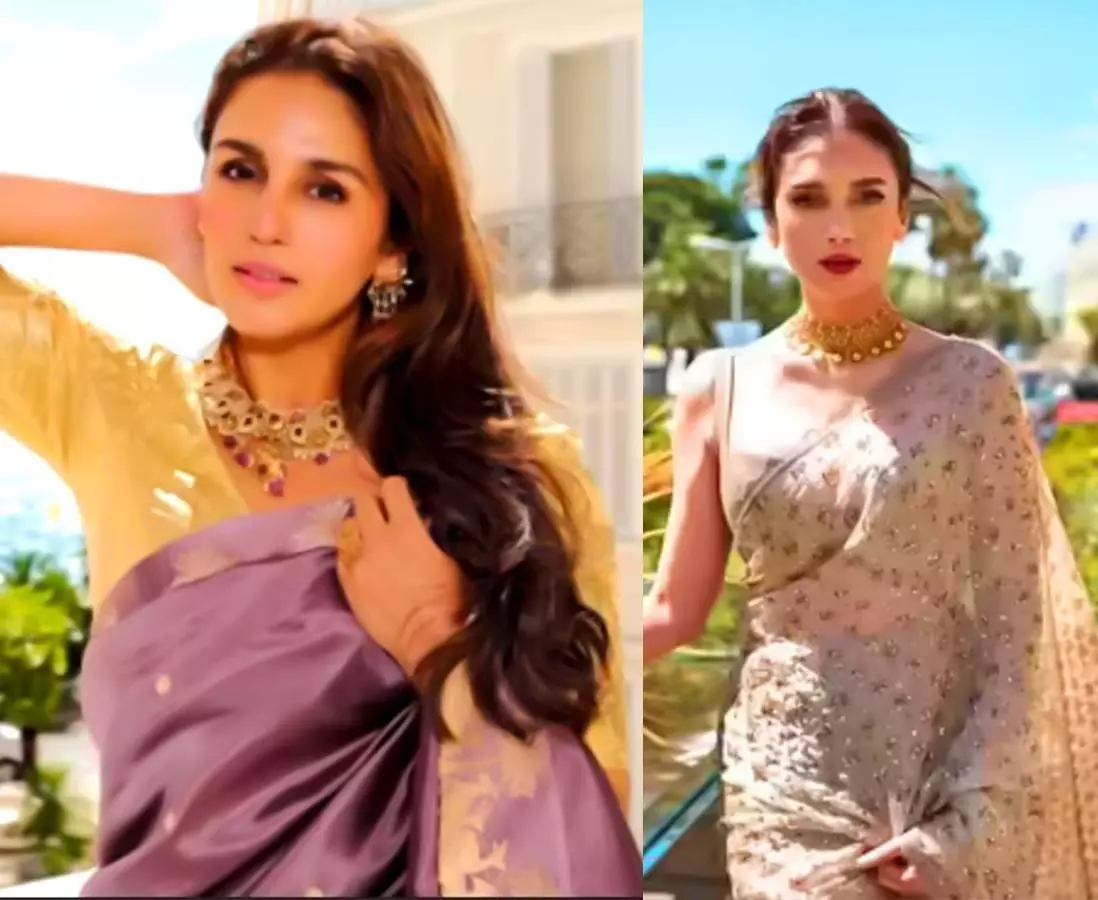
From Huma Qureshi and Aditi Rao Hydari to Shabana Azmi, Nandita Das, Aishwarya Rai, Vidya Balan, Deepika Padukone, Alia Bhatt, Kangana Ranaut and Sara Ali Khan, among others, the Cannes red carpet has seen its fair share of stars in sarees over the years.
Who invented the saree? Documentation is set in stone, sculpted on figures, some surviving on the walls of rock-caves, others unearthed during archaeological excavations.
Believed to be one of the oldest unstitched garments from the Indian sub-continent, with a history spanning over 5,000 years, its existence can be traced as far back as the Indus Valley Civilisation. Early mentions of the saree can also be found in the Rig Veda (3,000 BC). Back then, this garment, which has protected female modesty in its folds for centuries, was most likely worn in cotton.
Believed to have been a two-piece, or even three-piece ensemble once — comprising the antariya (the lower garment), the uttariya (upper cloth) and the stanapatta (which covered the chest) — it later morphed into a single piece, which covered the body fully.
And so, when Bollywood actors Huma Qureshi and Aditi Rao Hydari recently walked down the Cannes red carpet in sarees — or earlier in the month, Ambani daughter Isha Ambani sported it at this year’s Met Gala — they were not just taking pride in their ‘Indianness’, they were also carrying on their shoulders — along with the saree pallu — history.
Of course, Qureshi, Hydari and Ambani were not the first, or only ones, to flaunt the saree on the global stage. From Shabana Azmi and Nandita Das to Aishwarya Rai, Vidya Balan, Deepika Padukone, Alia Bhatt, Kangana Ranaut and Sara Ali Khan (among others), the Cannes red carpet has seen its fair share of stars in sarees over the years.
Alia has sported at the Met Gala, too, two years before Isha, in 2024.
From Indus Valley to red carpets
But to return to its history and origin story, the word saree is derived from the Sanskrit word ‘sattika’, meaning a “strip of cloth”, show old Buddhist and Jain texts.
The history and origin of the saree is shrouded in conjecture, but architectural evidence proves that the saree goes back to early human civilization. This is supported by the primordial Hindu belief that the unstitched garment is pure and auspicious.
The saree is believed to be one of the oldest unstitched garments from the Indian sub-continent, with a history spanning over 5,000 years. Photo: iStock
According to Soha Parekh, author of Saris: Splendour in Threads, a statue recovered from the Indus Valley Civilisation shows a priest wearing a cloth draped like a saree. She also mentions that the dhoti, which is believed to be the oldest Indian unstitched garment, marks the beginning of the saree.
But the story of the saree has not been without its share of lows.
After having been in vogue for centuries, the saree gradually lost its appeal. The 30 regional varieties of sarees, with their historical significance, were on the verge of disappearing, as women across generations started discarding the drape for a more comfortable ensemble — the salwar kameez, practical and easy to wear.
But just when sari and handloom revival experts had all but thrown up their hands in despair, wondering if the saree would become a museum piece, came the grand revival; slow at first, then gathering momentum to create new avatars of the saree, wowing the women into awestruck acceptance.
A couple of enterprising women, anxious to restore the saree to its old glory, devised the movement of “the 100 saree pact” on social media, which, by calling participants to wear sarees for 100 days in a year, revived interest in the drape to a great extent. Women, who hitherto had not taken to sarees, wore them with enthusiasm, as well as delved into the history of the garment.
There are other social media groups too centred around members' shared love for sarees.
Drape as you like
Part of the charm of the saree, and what’s helped it survive, is its versatility and the wide berth of choices it offers. It can be worn on any occasion, dressed up or down, with the blouse adding drama, glamour, mischief or severity to match.
Rta Kapoor Chisti, author of Saris of India: Tradition and Beyond and co-founder of Taanbaan (dedicated to reviving and preserving Indian spinning and weaving methods), says there are more than 100 ways of wearing a saree depending on the texture, the length and width of the saree, and the occasion. Rta has released a series of videos which showcase the non-conventional methods of draping a saree.
Alia’s second appearance at the Met Gala in 2024, for example, saw her draped in Sabyasachi’s interpretation of ‘The Garden of Time’. Anaita Shroff Adajania took credit for the styling. The mint green saree that Alia wore was bedecked with embroidered floral motifs embedded with glass beads and precious stones. What drew gasps was the 23ft long train, with jewellery to match.
And earlier this month, Isha wore a custom Gaurav Gupta drape to the event. While the saree, with Pichwai-inspired motifs, came with a sculpted cape worn with gold threads, her blouse was studded with diamonds.
After having been in vogue for centuries, the saree gradually lost its appeal, with women discarding the drape for a more comfortable salwar kameez. But then came the revival, fuelled in part by social media groups. Photo: iStock
Back home, almost every state has its own draping style.
If Gujaratis wear the saree with the pallu in front, Coorgis wear their sarees with pleats at the back and the pallu drawn across the breasts, over the shoulder and pinned in place with an attractive brooch. The mekhala chador, traditional dress of Assam, has been adopted by women of other states too. A two piece garment, the lower piece is worn like a fitted skirt with pleats, and the other, a dupatta, is draped over the left shoulder and brought forward to make angular pleats.
Kerala’s traditional mundu, generally in white or cream with a gold border, is also a two-piece affair like the Assamese attire, but there are no pleats in the dupatta. It is worn like a half sari, similar to the davani-pavadai traditionally worn by adolescent girls in all southern states, before transitioning to a saree. While the pavadai is a pleated skirt and the davani a shawl or dupatta-like garment, tucked at the waist and thrown over the shoulder like a saree pallu.
Orthodox Brahmin women in states like Tamil Nadu, Andhra and Karnataka still wear the madi saar for traditional functions, a nine yard saree in which the end piece goes between the legs and is tucked into the waist. If you know how to drape it, it is a convenient garment where it offers the convenience and comfort of trousers and yet retains its identity as a saree.
One size fits all
The younger brigade is letting their imagination run wild, wearing sarees over pants, the Pallu flung loosely over the shoulder to reveal the pattern of the blouse, or pairing it with a loose, longish blouse with slits at the side, more like a short kurta or shirt.
One reason for the saree's survival is the versatality it offers, in both draping and stylisation. Photo: iStock
There are pre-stitched sarees now, for those who want to drape them, but are unsure how. And there are experts who charge a lakh or more for a single-time drape!
The saree is a magical ensemble to fit women of all ages and sizes, and its versatility to adapt to the sartorial tastes of women and the trends in fashion makes it the most sought after garment in its different avatars beside making a cultural statement so significant to India.
As Qureshi was quotes as saying in Cannes, “From the ghats of Benares to the French Riviera… it is incredibly special wearing a weave that feels like it has lived through time. At Cannes, surrounded by cinema and storytelling, it feels surreal to wear something that tells its own story.”