



Dedication, discipline, consistency — what it takes to become an 'Ironman'
Twenty-year-old IIT-Madras student Renee Noronha became the champion in her age group (18-24 years) at the Ironman endurance challenge in the Philippines earlier this month. The feat has earned her a place at the 2026 Ironman World Championship in Kona, Hawaii, to be held in October. But race day is the final chapter of a much longer story, which begins in dark hours and cold pools.

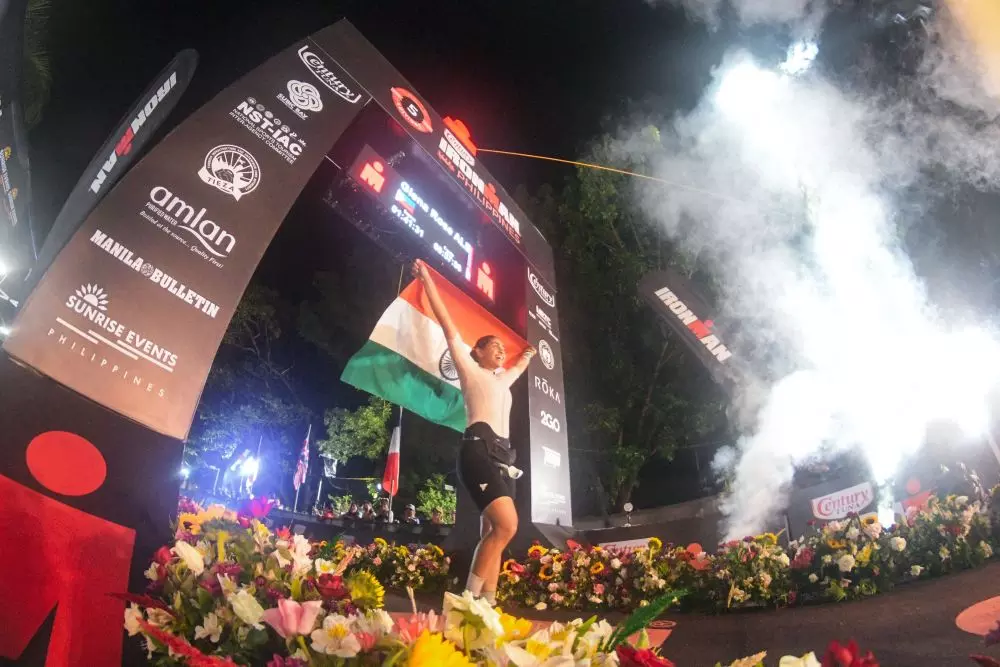
Renee Noronha after her win in Pilippines. Photo: By special arrangement
In the pre-dawn hour, while most of the world is still burrowing under the covers, 20-year-old IIT-Madras student Renee Noronha would be up, not to pore over her undergrad books, but to train for the Ironman triathlon.
Earlier this month, Noronha finished her third Ironman in the Philippines as the champion in her age group (18-24 years), after completing the gruelling endurance challenge in under 14 hours.
The feat not only earned her a place at the 2026 Ironman World Championship in Kona, Hawaii, to be held in October, but also brings her a step closer to her quest of becoming the youngest athlete to complete a full-distance Ironman across six continents — Noronha had earlier completed Iron Hamburg.
Founded in Hawaii in 1978, the Ironman triathlon is often regarded as one of the toughest one-day endurance events in the world. Athletes must swim 3.8 km, cycle 180 km and run a full marathon of 42.2 km, all within a strict time limit. The first Ironman was held in Hawaii in 1978. Today, it is conducted in more than 50 countries across North America, South America, Europe, Africa, Asia and Oceania. India hosts Ironman 70.3 Goa, the half-distance version of the event, comprising a 1.9-km swim, 90-km cycle ride and a 21.1-km run. Athletes compete in qualifying races around the world and earn slots based on their performance within age-group categories. Professional athletes qualify through a separate points and ranking system. According to reports and participants, on race day, competitors can burn anywhere between 8,000 and nearly 12,000 calories as they push their bodies through the challenge.
India has had celebrity participants too — last year, Milind Soman and his wife, Ankita Konwar, completed the Ironman 70.3 in Estonia.
For participants like Noronha, the test begins even before race day, in dark hours and cold pools.
Consistency primary goal
“The first two months [of training] were especially difficult,” recalls ceramic artist Neeti Gokhalay Kheny, who completed a half Ironman in the Netherlands in 2022. Although she cycled regularly and swam occasionally, running did not come naturally. “I'd often come home exhausted and wonder what I had signed up for.”
Early mornings soon became non-negotiable. “The roads are emptier and the weather much cooler. But that also means one has to wake up even earlier to eat something nutritious before the training starts,” explains Kheny, who is in her late thirties.
Over time, however, consistency became her primary goal and setting small goals helped break down an intimidating challenge into a manageable one.
Neeti Gokhalay Kheny cycles as part of the Ironman challenge. Photo: By special arrangement
Staff engineer Kartik Gupta, who has participated in two half Ironmans in Goa, knows the feeling. During peak training blocks, he too wakes up before 4 am so he can finish a swim and either a run or bike ride before his workday begins. “While many admire the race photos and the finish line, they don't see the 4 am alarms, the missed sleep-ins and the rigorous routine that goes on for months,” reveals Gupta, also in his thirties. “Race day is just one day. Most of the work happens long before that,” he adds.
Dr Palak Dengla, chief physiotherapist at Aster RV Hospitals, Bengaluru, who works closely with endurance athletes and has undergone long-distance training herself, agrees. “Maintaining consistency over months while balancing work, family, travel, and recovery does take a toll. Many athletes begin with tremendous enthusiasm but struggle when fatigue accumulates, progress plateaus, or life disrupts training schedules.”
Life beyond the finish line
For most athletes, the biggest challenge isn't race day but fitting training around the realities of everyday life.
Noronha is currently pursuing a Bachelor's degree in Data Science and Applications at IIT Madras. The long-distance study programme allows her to be based in the UK and participate in Ironman challenges around the world while continuing with her studies.
She plans her training around assignments and examinations, often relying on the discipline she has learned through sport to stay on track.
“Endurance sport has taught me discipline, consistency and time management, which helps me balance both academics and Ironman training. Having clear goals in both areas keeps me motivated,” she points out and credits the support of her professors and staff for making that balancing act possible.
For Gupta, working from home has become an unexpected advantage. The hours saved on commuting are redirected into training, recovery, nutrition and sleep.
Family support, the athletes say, is equally important. “Training for an Ironman can easily take up to four, five or sometimes six hours on a weekend day,” says Gupta. “That only works when the people around you understand what you are trying to achieve.”
Dr Flemingson Lazarus at the finishing line. Photo: By special arrangement
Dr Flemingson Lazarus, a 55-year-old dentist who has completed Ironman races across six continents, agrees. During peak preparation, he often trained for more than 20 hours a week while continuing to run his dental practice.
“It was never an option to let go of either training or my profession,” he believes. “During the final weeks of preparation, I reduced my dental appointments and focused only on urgent cases.”
The sacrifices extended beyond work, as he points out. “The support from family is very important. In my case, they just tolerated me!”
Mind over miles
Although the body does the work, the athletes say that it’s the mind that ultimately determines whether they will reach the finish line. Noronha's qualification race in the Philippines tested that principle. Athletes battled heat, humidity, heavy rain and challenging terrain.
“It reminded me that endurance is as much about patience and resilience as it is about fitness,” she says.
Psychiatrist and counsellor Dr Murali Krishna believes that successful endurance athletes possess a rare combination of intrinsic motivation, grit and an ability to delay gratification. “Great Ironmen view obstacles as information rather than failure,” he observes. “They are willing to sacrifice immediate comfort for a goal that may be months or years away.”
When fatigue and self-doubt inevitably arrive, athletes often rely on mental strategies such as breaking the race into smaller segments. “Rather than thinking about the entire distance, they focus on reaching the next buoy, the next aid station or the next landmark,” Krishna explains. Positive self-talk and acceptance of discomfort also play a crucial role.
Renee Noronha is now gearing up for the 2026 Ironman World Championship, to be held in Hawaii in October. Photo: By special arrangement
The approach echoes Noronha's own philosophy. “On race day, something might go wrong and you need to learn how to accept that and adapt, whether it's heat, rain, fatigue, cramps or self-doubt,” she emphasises. “The athletes who succeed are the ones who stay calm and keep moving forward when things get difficult.”
Training smarter
Behind many successful Ironman athletes is a coach helping them navigate the complexities of training, nutrition and recovery.
Noronha has trained under certified Ironman coach Shankar Thapa since she was 15. "He has guided me through every stage of my endurance journey, from learning how to swim to completing multiple full-distance Ironmans and qualifying for Kona," she shares.
Lazarus, meanwhile, worked with South African coach Darren Nash throughout his Ironman journey across six continents and Gupta trains under veteran triathlon coach Sridhar Venkataraman, whom he credits with bringing structure and purpose to his preparation. “Having a coach takes away a lot of the guesswork. Every session has a purpose and there is a structure to the training,” he says.
Rest is training too
For all the focus on punishing workouts, experts insist that improvement happens during recovery. “Every session creates stress on the body, but it's recovery that allows you to absorb that training and come back stronger,” says Noronha.
According to Dengla, many amateur athletes mistakenly believe that more training automatically leads to better results. "One of the biggest lessons in Ironman preparation is learning that more training is not always better," she notes. "There are times when choosing recovery over another hard session feels uncomfortable, yet those decisions often prevent injury and enable long-term progress."
She further points to the importance of strength training, mobility work, neuromuscular conditioning and so-called "brick sessions" that teach the body to transition efficiently from cycling to running. Strong gluteal muscles and a stable core, she adds, are essential for maintaining efficiency across all three disciplines.
Karthik Gupta takes part at a a half Ironman. Photo: By special arrangement
Gupta has learned the same lesson through experience. "You actually get stronger when you rest," he says. "It's okay to miss a session. What really sets you back is taking weeks off."
Lazarus adds that injury prevention depends on mobility work, strength training, adequate sleep and a disciplined recovery routine.
As Noronha prepares for the 2026 Ironman World Championship in Kona, she continues to juggle academics, training and an ambitious goal of becoming the youngest athlete to complete a full-distance Ironman on six continents before turning 21. The challenge ahead is immense.
Yet after months of pre-dawn alarms, long rides, endless laps and quiet sacrifices, Ironman athletes know that race day is merely the final chapter of a much longer story.
