Why literary translators feel their work is finally getting its due in India
In an interaction with The Federal in the backdrop of the announcement of the latest International Booker Prize, which awards fiction works from across the world translated into English, veteran translators Malini Seshadri and Shubhashree Desikan discuss literary translation, cultural nuance, the use of AI in translation, and the growing global recognition.

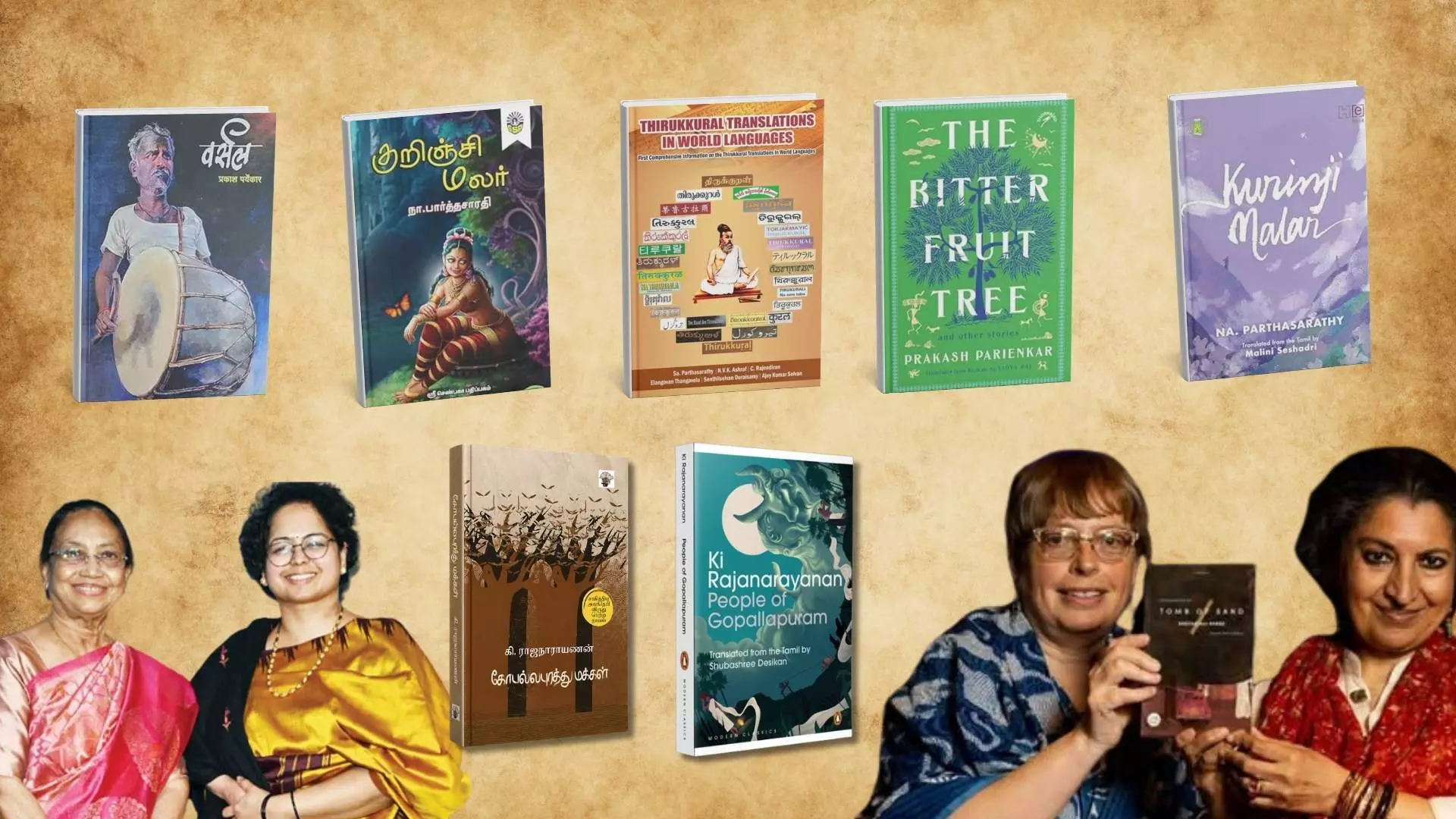
Translating cultures across languages
Translation is no longer viewed as a secondary literary exercise but as a crucial bridge connecting cultures, histories and communities across languages, according to veteran translators Malini Seshadri and Shubashree Desikan. As translated literature gains unprecedented global recognition through prestigious awards and growing readership, translators are increasingly being acknowledged for their role in carrying literary voices beyond linguistic boundaries.
The Federal spoke to Seshadri, who has spent more than two decades translating major Tamil literary works into English, and translator Desikan, known for translating Ki. Rajanarayanan's celebrated novel Gopallapurathu Makkal into English as People of Gopallapuram, to discuss the growing visibility of translators, the challenges of preserving cultural nuances, and the impact of artificial intelligence on the profession.
The conversation came in the backdrop of Taiwan Travelogue becoming the first book translated from Taiwanese Mandarin to win the International Booker Prize last month. The book written by Yáng Shuāng-zǐ was translated into English by Lin King.
Since 2006, the International Booker Prize has annually awarded the best fiction work of the year from around the world, translated into English. Last year, in 2025, the award went to Heart Lamp by Banu Mushtaq, translated from Kannada by Deepa Bhasthi.
Growing recognition
Talking to The Federal, Seshadri said translation has witnessed remarkable growth over the past two decades.
According to her, literary translation was once largely confined to major Indian languages such as Hindi, Marathi and Bengali. Today, however, even less widely spoken languages are finding readers through translation.
"It is definitely picking up everywhere globally and also in India," she said, noting that translation is increasingly being viewed as an important literary craft rather than a mechanical exercise.
She described translation as a bridge that allows readers from different linguistic backgrounds to experience literary worlds that would otherwise remain inaccessible.
Tamil literature, she added, has particularly benefited from institutional support. Since 2017, the Tamil Nadu government has actively promoted translation through initiatives aimed at taking Tamil literature to the world and bringing world literature into Tamil.
According to Seshadri, around 100 titles have already been translated under these efforts, with plans to translate several hundred more works in the coming years.
Also read: Why e-Commerce brand known for Bengali-themed T-shirts chose the cockroach for its new collection
Challenges of dialect
Desikan recalled that translating People of Gopallapuram had been both exciting and daunting.
The project was offered to her by editor Mini Krishnan, and she immediately accepted because of her admiration for Ki. Rajanarayanan's writing. However, once she began working on the manuscript, she realised the complexities involved.
The novel draws heavily on the distinctive dialect and cultural landscape of Tamil Nadu's black-soil region. Preserving those elements in English while ensuring readability posed significant challenges.
"The truth hit me that it's not so easy," she said.
Meeting readers' expectations while remaining faithful to the original text demanded constant negotiation between authenticity and accessibility.
Cultural textures
One of the central themes of the discussion was how translators handle culturally rooted expressions, rituals, idioms and forms of address.
Seshadri explained that translators often make choices depending on publishers' preferences. Some favour footnotes and explanatory notes, while others prefer a seamless reading experience without interruptions.
In many cases, translators retain culturally significant words and forms of address to preserve the flavour of the original language.
She argued that readers should be encouraged to enter the cultural world of a translated text rather than expect every unfamiliar expression to be fully explained.
The translator cited examples where direct translations of Tamil imagery worked beautifully in English. Phrases comparing passing years to a slippery palm fruit sliding down the throat or describing teeth glistening like fish in flooded paddy fields retained their poetic power even after translation.
At the same time, she acknowledged that many idioms resist direct translation and require creative adaptation.
Making books accessible
When asked whether translated works reach wider audiences, Seshadri emphasised that translators can only control the quality of their work.
The responsibility of marketing, distribution and audience outreach rests largely with publishers and institutions.
However, she believes increasing readership and growing demand for translated literature are creating a positive cycle. As more readers discover translated works, publishers become more willing to invest in them.
Desikan noted that publishers vary significantly in how much they promote translated books.
While some receive extensive publicity, others depend primarily on distribution networks. She said she had benefited from strong distribution channels that helped her translated works reach readers across India.
Also read: How the all-women team of Khabar Lahariya journalists survived risks, jibes and misogyny
Titles and adaptation
The conversation also explored how translated books receive English titles.
Seshadri explained that translators often collaborate with editors and publishers when selecting titles that will resonate with new audiences.
In some cases, literal translations may fail to capture the spirit of a work.
She cited her translation Mystery Set to Music, the original Tamil title of which did not adequately convey the novel's central themes of music, mystery and complex characters. The English title, she argued, better reflected the book's essence, while appealing to prospective readers.
The discussion also touched on whether translators can influence the content of a work.
Desikan cited examples where translators had suggested changes that eventually shaped published editions. One example involved a translated novel whose ending was revised following discussions between translator and author.
Both translators agreed that author-translator relationships vary widely. Some writers allow considerable freedom, while others resist even minor alterations.
Understanding cultures
Desikan argued that translated literature plays a vital role in expanding readers' understanding of unfamiliar worlds.
She pointed to People of Gopallapuram as an example of a work that introduces readers to the lives, occupations and social realities of people living in a specific rural region of Tamil Nadu.
Through such works, readers gain insight into cultural practices, historical experiences and everyday realities beyond their own social environment.
She also described her use of footnotes to introduce readers to original Tamil words while maintaining readability in English.
Seshadri echoed this view, observing that generations of readers have learned about other societies through translated literature, often without consciously recognising that they were reading translations.
Classic works from French and Russian literature, she said, have long helped readers understand different historical periods and cultural experiences.
Translating Bama
One of the most moving parts of the discussion focused on translating the works of Tamil writer Bama.
Seshadri described Bama's writing as deceptively simple. Rather than presenting social injustice in dramatic terms, Bama often narrates painful realities in calm, understated language.
Capturing that emotional restraint in translation proved especially challenging.
According to Seshadri, the power of Bama's work lies precisely in its refusal to exaggerate suffering. The quiet, matter-of-fact narration often has a stronger emotional impact than overtly dramatic writing.
Desikan added that certain elements of language, including rhythm, silence and sound, are nearly impossible to reproduce fully in translation. Some emotional and musical qualities inevitably remain tied to the original language.
AI and the future
The discussion concluded with a consideration of artificial intelligence and its growing role in translation.
Both translators acknowledged that AI tools are already being used for technical and short-form translations.
However, they argued that literary translation remains far more difficult for machines, especially when dealing with Indian languages.
Seshadri pointed out that AI systems require extensive linguistic databases containing not only vocabulary but also usage patterns, idioms and cultural references.
While English-language datasets are relatively large, many Indian languages still lack comparable resources.
As a result, literary translation between Indian languages and English is likely to remain a human-driven endeavour for the foreseeable future.
Although AI is advancing rapidly, both translators believe that preserving cultural nuance, emotional depth and literary style will continue to require human judgment and creativity.
The content above has been transcribed from video using a fine-tuned AI model. To ensure accuracy, quality, and editorial integrity, we employ a Human-In-The-Loop (HITL) process. While AI assists in creating the initial draft, our experienced editorial team carefully reviews, edits, and refines the content before publication. At The Federal, we combine the efficiency of AI with the expertise of human editors to deliver reliable and insightful journalism.