How senior advocate and activist Indira Jaising talks of her 'home', the Indian Constitution, in new book
In The Constitution Is My Home: Conversations on a Life in Law, Jaising looks back at years in constitutional litigation, told in conversation, and also makes a sharp diagnosis of the present moment.

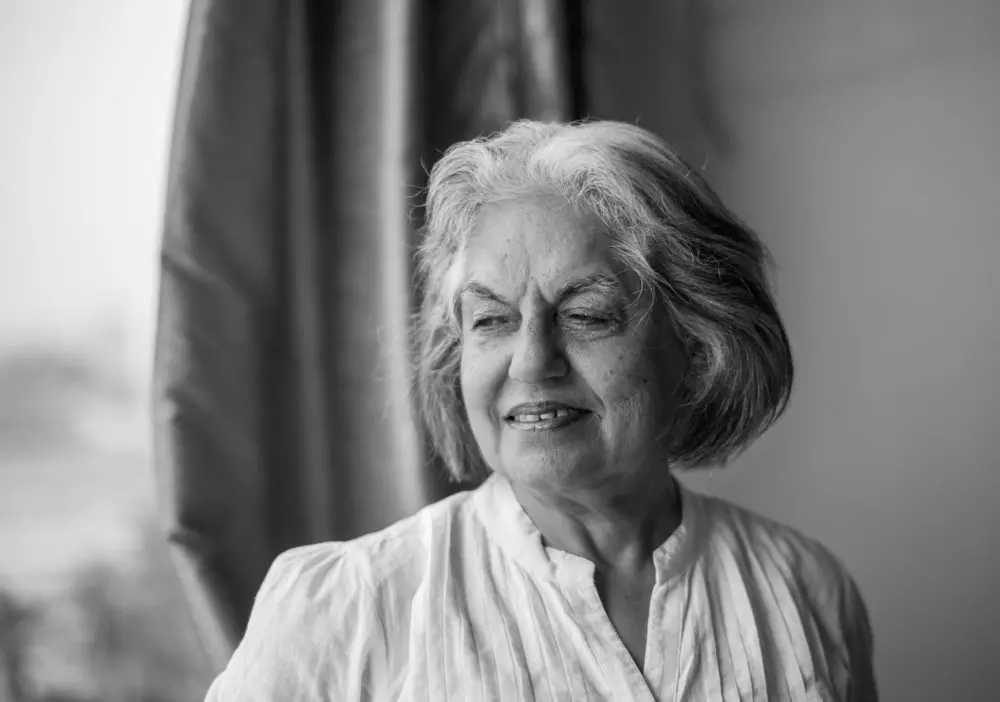
“Where are you from?” is the first question one is asked in India and for most of her life, senior advocate and activist Indira Jaising had no satisfactory answer. There is no Indian state called Sindh; her family came from there as refugees after Partition.
She eventually arrived at an answer of her own. She belongs to the Constitution of India. The title of her book, The Constitution Is My Home: Conversations on a Life in Law, published by Speaking Tiger, is therefore not a metaphor but a citizenship claim. The 220-page conversation with the publisher Ritu Menon that follows is the testament of a woman who has spent fifty years defending the house she chose.
The conversation is organised by theme rather than chronology and reads less like a deposition than like a long, candid evening at the senior advocate’s chambers. As Supreme Court judge Justice BV Nagarathna said at the book’s launch in New Delhi on May 21, court records “tell us judgments, but they don’t tell us the strategy, loneliness, fear or hope of litigants and lawyers within the courtroom.”
This book does. It opens in the chambers of a senior who taught the young Jaising what she calls “stealing truth” — the lawyer’s craft of extracting from a witness what the witness will not give. She does not sanitise the apprenticeship. The Constitution she has spent a lifetime defending is built, the passage reminds the reader, on a craft that is not entirely innocent.
From there, the chapters move through the cases that made her reputation: pavement-dwellers, hawkers, women workers, Bhopal gas tragedy survivors, women denied inheritance, women denied entry into a temple, women harassed at work. The cases are well known. The texture of how they were built is not.
Livelihood to women's issues
Take the Bombay Hawkers' Union v. BMC and Olga Tellis cases; the parallel 1985 judgments through which she helped pull the right to livelihood into the right to life under Article 21. The doctrinal headline of Olga Tellis — that the right to life includes the right to livelihood — has been taught for 40 years. The book's contribution is the strategic detail.
In the hawkers' case, it is the photograph she placed before the Bench of a woman selling bananas whose basket had been crushed under a police officer's boots. KK Venugopal, then appearing for the Corporation, conceded the obvious: "There can be no argument against a photograph". The Court held for the first time in Indian legal history that hawkers had a right to vend and directed the Corporation to demarcate hawking zones.
A week later, in Olga Tellis, the Bench led by Chief Justice YV Chandrachud applied the same constitutional logic to the pavement-dwellers facing eviction. From cases like these, Jaising, who has also served as additional solicitor general of India, derives what she calls democratic lawyering: the use of courts not only to defend rights but to expand them. At the launch, she put it succinctly: In the 1950s and 60s, she said, liberals and the Left fought over land reform and detention but ignored "working people, homelessness, the self-employed". Her generation "decided that the court belongs to us".
The cover of Jaising's book, The Constitution Is My Home: Conversations on a Life in Law. Photo: X
The feminist chapters are the book’s strongest. Jaising moves the reader from formal equality (the McKinnon Mackenzie case, on equal pay for women stenographers under the Equal Remuneration Act, 1976) to the harder terrain where formal equality is not enough. The Domestic Violence Act of 2005, which she helped draft, is the legislative monument. The challenge to triple talaq in the Shayara Bano case of 2017, the 1986 inheritance case argued for Mary Roy, and the 2018 Sabarimala temple-entry for women argument are litigation monuments. In all of these, she refuses the alibi of religious immunity. Her line in the triple talaq case — that “there is nothing truly ‘personal’ about personal laws” — is a one-sentence demolition of the doctrine that has shielded religious personal laws from constitutional challenge since the Bombay High Court’s 1951 ruling in the Narasu Appa Mali bigamy case.
There is a harder chapter, on the 1995 Rupan Deol Bajaj case against former Punjab police chief KPS Gill, in which Jaising, facing Gill’s senior counsel KTS Tulsi, challenged him in open court to demonstrate on her own person the gesture his client was accused of and observe the consequence. Tulsi declined. The eventual conviction under the Indian Penal Code became one of the earliest legal recognitions of workplace sexual harassment in India.
Protecting her 'home'
Jaising’s diagnosis of 2026 is sharper than the cliché of an undeclared Emergency and she rejected the comparison at the launch. During the Emergency (1975-77), the Constitution itself was used to oppress, she said; now, without amending a single word of the text, “every other form of transformation is happening”. She calls it the repudiation, not the suspension, of the Constitution, and its consequence is impunity. The protective mechanisms, in her phrase, are in cold storage.
The supporting evidence the book gathers — the sengol installed in the new Parliament building, extrajudicial speeches by sitting judges on the Hindu civilisational roots of the Constitution, the Bhima Koregaon prosecutions, the Bilkis Bano remission, the long captivity of Umar Khalid — is cumulative rather than systematic.
The last item supplied the book launch its sharpest counter-current. Three days before the book was unveiled, a two-judge Bench led by Justice BV Nagarathna questioned another two-judge Bench for diluting a 2021 three-judge ruling on bail under the anti-terror law — a ruling authored by Justice Surya Kant, now the Chief Justice, who sent a video message to bless the book’s metaphor. Jaising welcomed the corrective as “extraordinary… a matter of celebration.” The book’s ambivalence about the Court is sharper than that phrase admits.
Where the book is less satisfying is on public interest litigation, the jurisdiction Jaising helped build and continues to defend. It honours Justice P.N. Bhagwati and Upendra Baxi, and credits the Bhopal journalist Rajkumar Keswani. It is less candid about what the jurisdiction has become — a vehicle by which courts run cities, ban cattle slaughter, regulate firecrackers and rewrite school curricula. A book that defends the bar’s right to militancy ought to settle accounts with the Bench’s drift into governance. This one largely does not.
Her prescription is unembarrassed. “It is only a strong bar which can keep a judiciary in check,” she told journalist Srinivasan Jain at the book launch. “The tragedy is that we do not have a strong and a militant, vociferous bar in this country, ” she told the audience.
The book’s most exposed passage records a humiliation she suffered for trying. Arguing the hawkers’ case in the Supreme Court, she was snapped at by a judge who reminded her that her clients were “only licencees, not owners, of the premises”. Her reply was that the very building in which the Court sat and the electricity and water it consumed were on licence too. The judge, she records, was stunned, then reprimanded her for daring to question a judge’s knowledge of law.
“The moment passed with me in tears.” Then came the rebuke that she should be “more like Mr Grover, who is calm in court”. Adding insult to injury, she writes, “was casual male chauvinism.” She refused to play victim about it.
The CBI case opened against her in 2019, days after she had publicly criticised the in-house procedure in Justice Ranjan Gogoi’s sexual harassment case, was, as she put it at the launch, “the institution that I had served all my life… the very institution that attacked me”.
A home, the book reminds the reader, is also what one defends when others come to redecorate it. Justice Nagarathna at the launch called the Constitution Jaising’s “permanent residence”. The Chief Justice, in his message, generalised the metaphor into a “shared home” — inherited, inhabited, handed on. Both formulations are softer than Jaising’s own.
She does not say the Constitution belongs to her. She says she belongs to it, as a founding daughter who arrived after the founding mothers had finished their work and inherited the obligation to keep the house in repair. The reader closes the book with a quieter, sharper question. Is the house she returns to still the home she once knew?